Field note 01
Why the interval is shorter on some Mountain House streets
Exposure to the Altamont wind corridor is the single biggest factor in how fast a Mountain House wall gets dirty — more than age, paint or orientation.
Air funnelling down off the pass carries fine mineral dust and, in late spring, a heavy load of grass pollen. Homes on the western edge of the community and along the open frontage near Byron Road catch that stream directly. Their west elevations often look a season older than the same wall on a house two streets inland.
Interior-block homes in Questa and Hansen sit in each other's wind shadow. Those walls collect the same dust more slowly and can comfortably run a two-year cycle without looking neglected.
The practical test is not a calendar at all. Drag a clean white cloth down the wall at shoulder height. If it comes back gray, the wall is carrying film that will start to hold moisture and organic growth, and it is time.
Field note 02
Roofs, gutters and windows run on separate clocks
Each surface on a Mountain House home has its own useful interval, and washing them all on the same annual visit wastes money on some and neglects others.
Concrete tile roofs are the slowest. Streaking becomes visible from the street after roughly two to three years in 95391, faster on north slopes and under the mature landscaping now filling in the older villages. Soft washing before the staining darkens is cheaper because it needs one pass instead of two.
Gutters are the strictest. They need to be clear before the first serious rain, which in Mountain House usually arrives late October or November. A single blocked downspout on a two-story elevation puts water against the stucco all winter.
Windows are the fastest cycle of all, and the reason is the water rather than the air. Mountain House is supplied with treated Delta water carrying enough mineral content that sprinkler overspray leaves visible rings on glass within months. Twice a year keeps that from etching.
Field note 03
What waiting too long actually costs in 95391
Delaying a Mountain House wash past about two years roughly doubles the labor, because film turns into rooted organic growth that needs dwell time and a second pass.
A wall washed on schedule is a single application and a rinse. A wall left four years carries algae with a hold on the stucco texture, and clearing it takes stronger chemistry, longer dwell and often a second treatment on the shaded courses.
There is a second cost that shows up later. Organic growth holds moisture against the finish, and on the stucco used across Mountain House that eventually shows as chalking and uneven paint fade — a repaint problem rather than a cleaning problem.
Roof tile behaves the same way. Light streaking lifts in one soft wash; heavy lichen carries a $0.05 per square foot surcharge because it has to be treated and then given time before rinsing.
Field note 04
A realistic Mountain House schedule
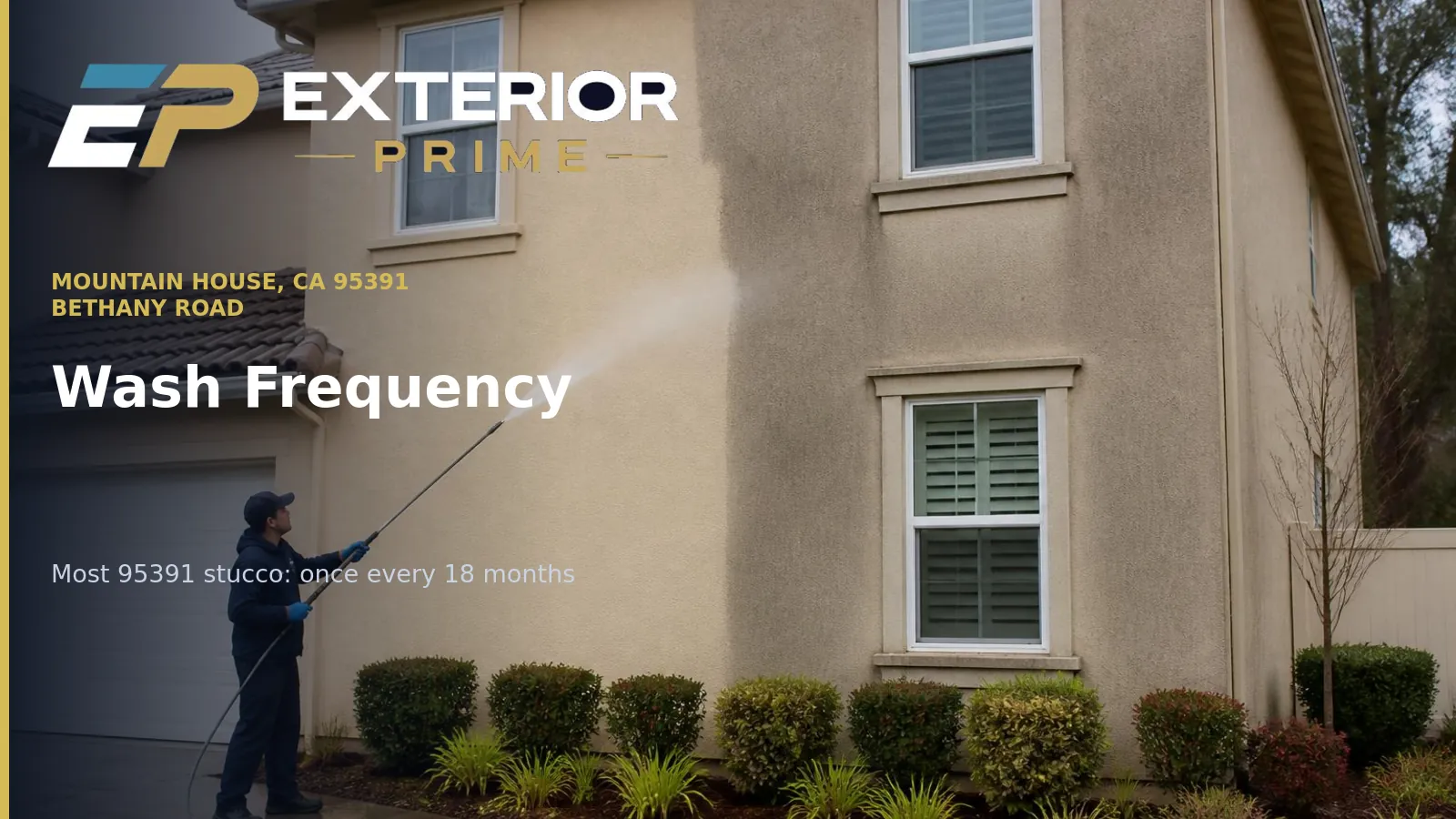
A workable 95391 rotation is a spring wash of walls and flatwork every 18 months, gutters each October, windows twice a year and the roof when streaking shows.
Pairing matters as much as timing. Because a standalone visit starts at $297, most Mountain House households do best putting the wall wash and the driveway on the same trip, then adding windows or solar as ride-along work at the lower add-on rate.
If your lot backs onto open ground west of the community, plan on the 12-month version of that cycle for the exposed elevations only. There is no need to wash all four sides at the same frequency, and Exterior Prime professionals will quote a partial wash.
Households with solar have a third reason to keep the interval tight: the same dust that films the walls settles on panels, and cleaning both on one visit takes the panel rate down to the $10 per panel bundle price.