Field note 01
The dark streaks on a Mountain House tile roof are alive
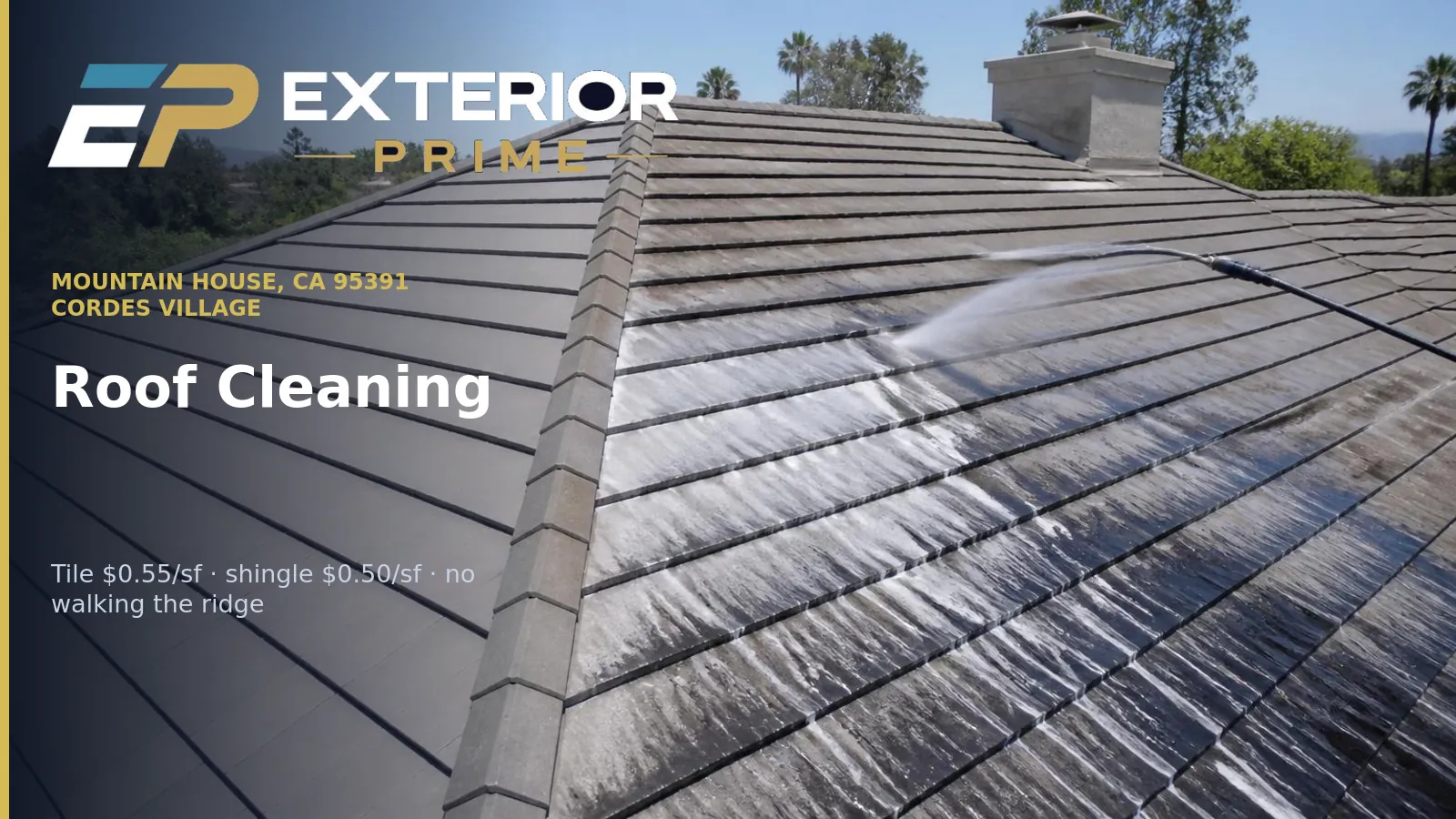
Those black or dark green streaks running down 95391 roof slopes are gloeocapsa magma, a cyanobacteria that feeds on the limestone filler in concrete tile.
That is why it is worse on the north-facing slope, worse under the eave shadow line, and worse on homes that back onto irrigated greenbelt. All three conditions keep the tile damp longer, and damp tile is habitat.
It is also why pressure is the wrong tool. Blasting the streak removes the visible colony and leaves the root structure inside the tile's pores, so it returns in a season — usually darker, because the surface is now rougher. A soft wash kills the organism outright and lets rain carry the dead material off over the following weeks.
Homeowners often ask whether the streaks matter beyond appearance. On concrete tile the honest answer is that they are consuming the tile's surface slowly and holding moisture against it. It is not an emergency, but it is not purely cosmetic either.
Field note 02
Why nobody should be walking your tile field
Concrete flat tile carries weight only on the headlap and along the batten line, so foot traffic in the wrong place cracks tile that then leaks quietly for years.
The cracks are rarely dramatic. A hairline break lets water past the tile onto the underlayment, which is doing its job until it is not, and the first sign inside is a stain on a bedroom ceiling several rainy seasons later.
Soft washing removes the reason to be up there. Solution is applied from the eave and from ladder-set positions with equipment reaching the ridge, and the rinse is a low-pressure flood, so the tile field is never loaded.
It also protects the mortar work. The ridge and hip mortar on Mountain House roofs is the most common failure point, and it is a lot easier to break than it looks. Our professionals inspect it while they are working and report anything cracked or missing rather than stepping on it.
Field note 03
Where the water goes, and the parts of the job people forget
On a soft wash the whole roof volume of rinse water ends up in the gutters and beds, so downspouts, plants and the array above the tile all have to be planned for.
That is the practical argument for pairing roof cleaning with gutter cleaning in Mountain House. Dead algae and rinse residue land in the trough. Cleaning the gutters first and flushing them after the roof means the season starts with a clear system rather than a fresh sediment bed.
Landscaping gets pre-watered and flushed, and on the tight village setbacks that is a real consideration because everything from the roof arrives in a strip a few feet wide against the foundation.
If there is a solar array on the slope, the panels are handled as their own surface — masked or rinsed depending on layout — and the tile underneath is treated from the accessible edges. Arrays also make a good argument for cleaning both at once, since the equipment and access are already staged.
Field note 04
Roof cleaning cost and timing in 95391
Price follows roof area rather than house size, and the best Mountain House window is spring or early fall, before the wet season or right after it.
A single-story village home with roughly 1,400 square feet of tile lands near $770 at $0.55 per square foot. A larger two-story footprint at 2,000 square feet is about $1,100. Steep sections add $0.10 per square foot, and genuine moss or lichen colonies add $0.05.
Frequency in Mountain House is longer than people expect: five to seven years for most homes, sooner on greenbelt-backing lots with dense north-slope shading. This is not an annual service, which is exactly why it should be done properly when it is done.
Beware anyone quoting a roof over the phone by square footage of the house. Roof area on a tile roof is substantially larger than the floor plan because of pitch and overhangs, and a quote that ignores that will change once the truck arrives.