Field note 01
How much output a dusty 95391 array actually loses
Uniform dust on a Mountain House array typically costs a few percent of production, but bird droppings and localized soiling do far more damage because they trigger bypass losses across whole panel strings.
Even soiling is the easy case: it dims every cell a little, and production sags in proportion. What hurts is shading that covers part of a cell. A single opaque dropping can knock a substring out and cost far more than its area suggests.
Mountain House has both problems at once. The wind supplies the uniform dust layer, and the open land at the village edges supplies the pigeons that nest under panels and drop directly onto the array below.
The measurable pattern is a slow slide from May onward that does not recover until the first real rain. Homeowners watching their monitoring app usually notice it in July and assume the panels are degrading, when the panels are simply dirty.
Field note 02
Deionized water, no detergent, and why that matters here
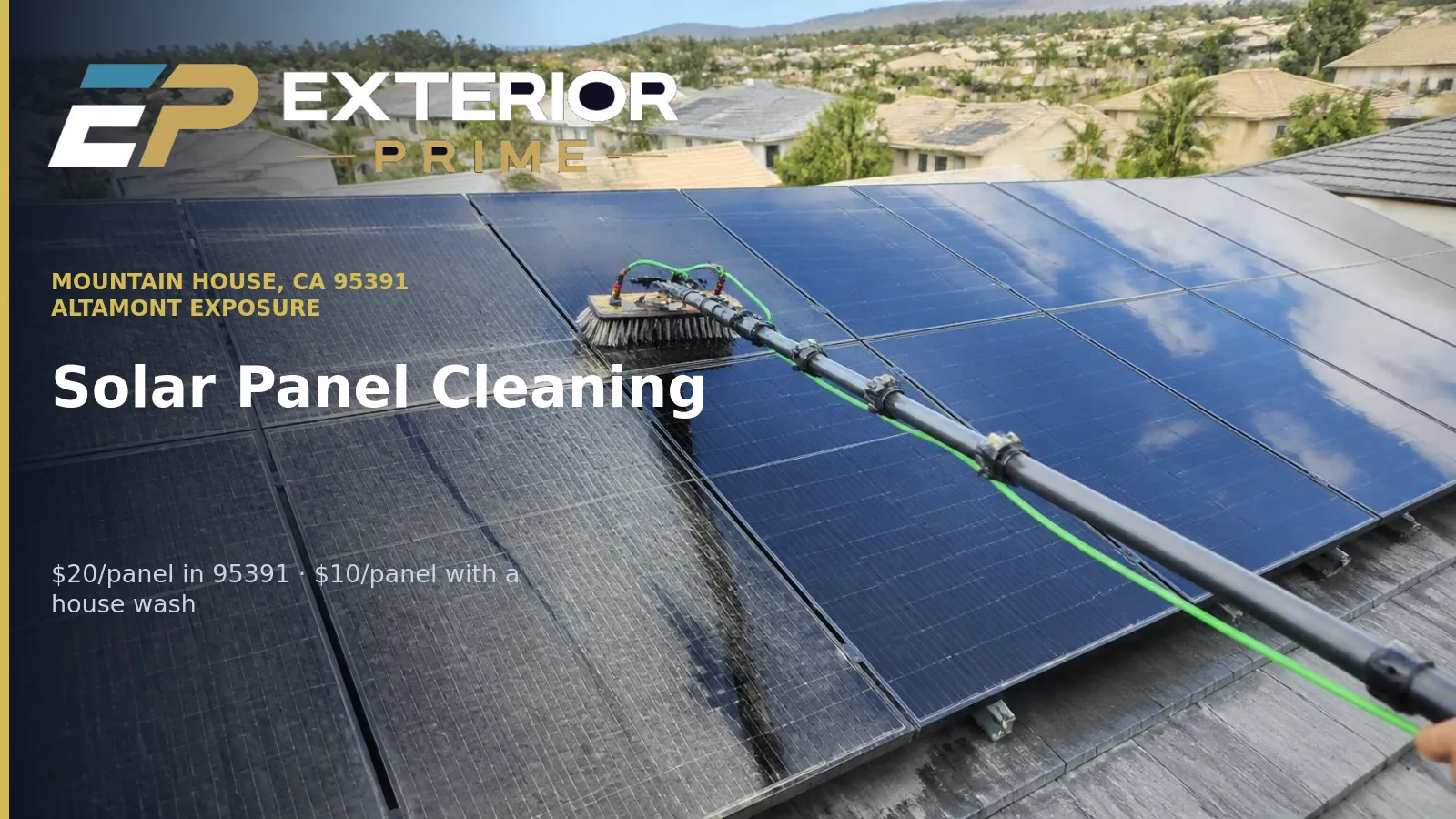
Panels are cleaned with deionized water and a soft brush — no soap, no abrasives, no pressure — because any residue left on the glass becomes a new dust magnet.
Detergent film is the classic mistake. It dries into a sticky layer that holds the next week of Altamont dust more tightly than clean glass would, so the array is dirtier a month later than if nothing had been done.
District tap water is the other one. Hard water dries into the same mineral spotting that plagues Mountain House windows, except here it sits over photovoltaic cells and cannot be squeegeed off easily. Deionized water has the minerals removed, so it dries clear.
Pressure is a third risk. A jet aimed at a panel edge can breach the frame seal or push water into a junction box. Panels take flow, not force — a gentle rinse and a soft brush is the whole method.
Field note 03
Access, roof safety and pigeons under the array
On the concrete tile roofs standard in Mountain House, arrays are cleaned from the roof edge and from reach positions so nobody walks the tile field between panel rows.
The gap between panel rows on a tile roof is exactly where the tile is most vulnerable, and a cracked tile under an array is the worst possible place to have one — repairing it means partial panel removal.
Pigeons are the other Mountain House specific. The cavity under a panel is warm, sheltered and predator-free, and once a pair nests there the droppings accumulate on the tile and on the panels below. Cleaning the glass without addressing the nesting means the same call again next quarter.
Our professionals report what they find under the array with photos: nesting material, droppings, chewed wiring insulation. Whether you then add mesh critter guard is a separate decision, but you should be told rather than left to discover it.
Field note 04
What it costs in Mountain House and when to schedule it
Twice a year suits most 95391 arrays — once after the spring wind season and once in late summer before the highest-value production months end.
At $20 per panel, a 15-panel array is $300, a 22-panel array is $440 and a 32-panel array is $640. Arrays of 33 panels and up drop to $17 per panel. The Mountain House premium of $5 per panel over the base rate reflects the drive and the roof access here.
The cheapest way to buy it is bundled. Panel cleaning is $10 per panel as an add-on to a house wash, which cuts a 22-panel array to $220, and the Solar Saver package covers house, driveway and solar at $647.
The annual plan option is $25 per panel per visit for two scheduled visits a year, which is priced higher per visit because it includes the monitoring check-in and guaranteed scheduling before peak production months rather than whenever there is an opening.