Field note 01
Why flatwork here has to be surface-cleaned, not wanded
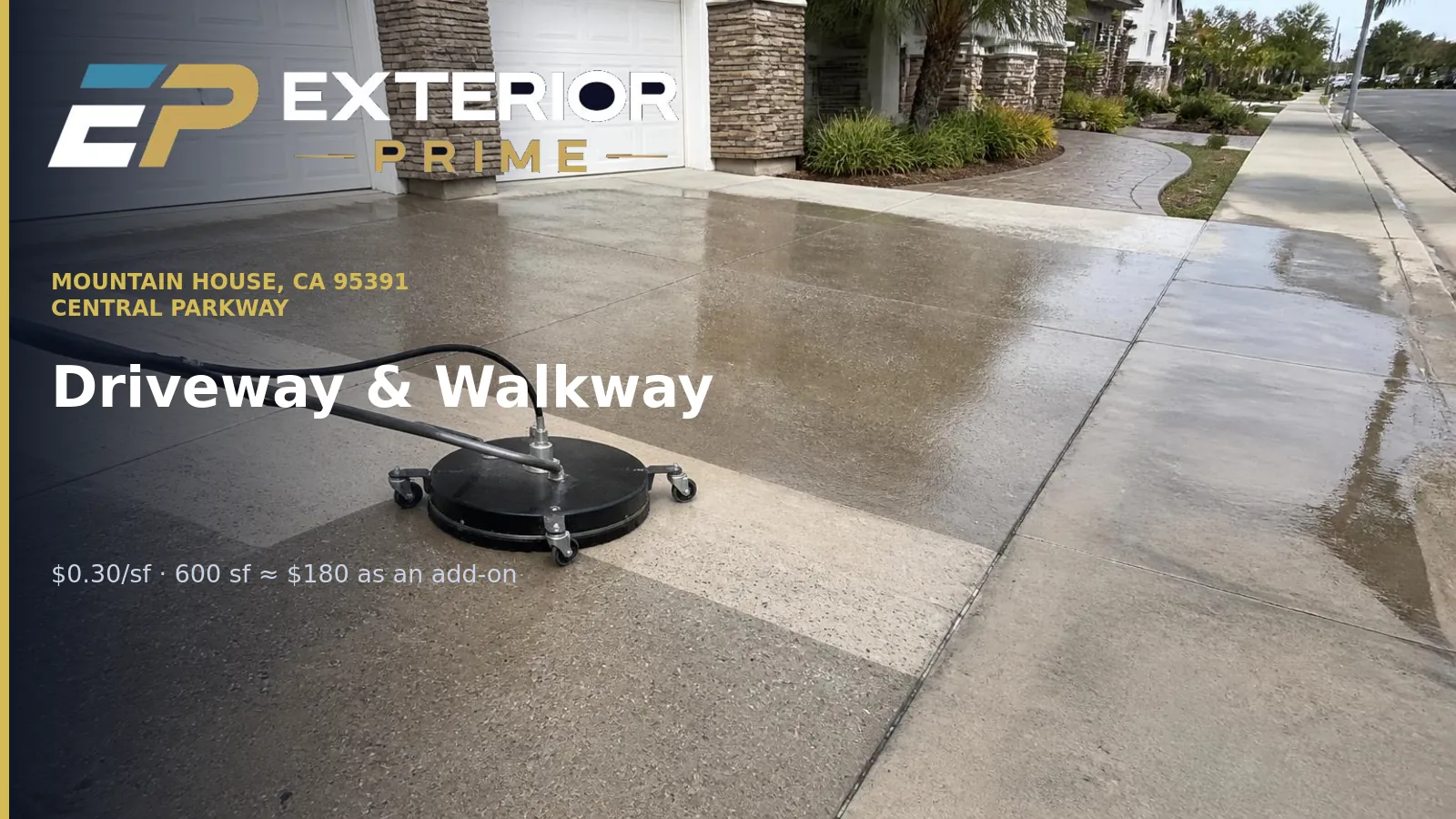
A rotary surface cleaner keeps water at one consistent distance and angle, which is the only way to get an even tone on the light broom-finished concrete used across Mountain House.
A handheld wand cleans in an arc. Every pass is slightly closer at the middle than the edges, and on pale concrete that difference is visible forever as a series of overlapping crescents. Homeowners on Central Parkway describe it as zebra stripes, and once the cement paste has been cut unevenly there is no washing it back out.
The shrouded rotary head solves that geometrically. Two jets spin at a fixed height inside a housing, so the whole width gets identical treatment and the dirty water is pulled out rather than blown across the neighbor's driveway.
Edges and vertical faces are still hand-detailed, because a round head cannot reach into a control joint or up against a garage threshold. That hand work is where a Mountain House drive either looks finished or looks like it stopped an inch short.
Field note 02
The four stains that dominate Mountain House driveways
Tire polymer transfer, sprinkler rust rings, oil drips at the garage apron and irrigation grit are the four things our professionals plan for on nearly every 95391 driveway.
Tire transfer is the one people mistake for a permanent shadow. Hot tires leave a polymer film exactly where the car parks, and it needs a degreaser and dwell rather than more pressure — pressure alone just polishes it.
Rust rings come from the sprinkler heads and from patio furniture feet, and they are a chemical problem, not a mechanical one. An oxalic-based treatment pulls the iron out of the surface; a surface cleaner run over the top of a rust ring accomplishes nothing but a cleaner rust ring.
Oil at the apron gets a pre-treatment before the machine runs, which is a $25 to $75 addition depending on how far it has soaked. Fresh drips on four-year-old concrete usually lift completely. A decade of parking in the same spot does not, and our professionals say so at the estimate rather than after.
Field note 03
Sealing, and when a Mountain House drive is worth it
Sealing after cleaning costs $0.77 per square foot including material and is worth it on decorative or stamped concrete, and rarely necessary on plain broom-finished village driveways.
The stamped border bands and colored release finishes used on many Questa and Hansen walkways are essentially a thin decorative layer. Sealer protects the color and keeps the pattern crisp, and on those surfaces it genuinely extends the interval between cleanings.
On plain gray flatwork the calculation is different. Sealer makes the surface easier to rinse and slightly darker, but the concrete was not going to fail without it. Our professionals will quote it if you want it and will tell you when it is not worth the money.
One local caveat: sealer needs dry concrete and moderate temperature. In Mountain House that means spring or early fall, not a July afternoon on a south-facing drive and not during the winter fog window when the slab never fully dries.
Field note 04
How flatwork is bought in 95391 without paying twice
Because driveway pricing lands under the $297 minimum, Mountain House flatwork is scheduled alongside a house wash, gutters or windows on a single visit.
The arithmetic is simple. A 600-square-foot driveway is $180 of work. Sending equipment out I-205 for $180 does not cover the trip, so it would have to be billed at the minimum, which means you would pay $297 for $180 of cleaning.
Pair it with a stucco wash and both services are billed at their real rates on one mobilization. Curb Appeal formalizes that at $447. Add windows and Refresh Plus covers all three at $597.
The other way Mountain House homeowners solve it is by scope. Driveway plus front walkway plus side-yard path plus pool deck often totals 900 to 1,200 square feet, which stands on its own as a visit and leaves the whole property's flatwork one consistent color.