Field note 01
Why the shaded half of a 95391 patio always goes first
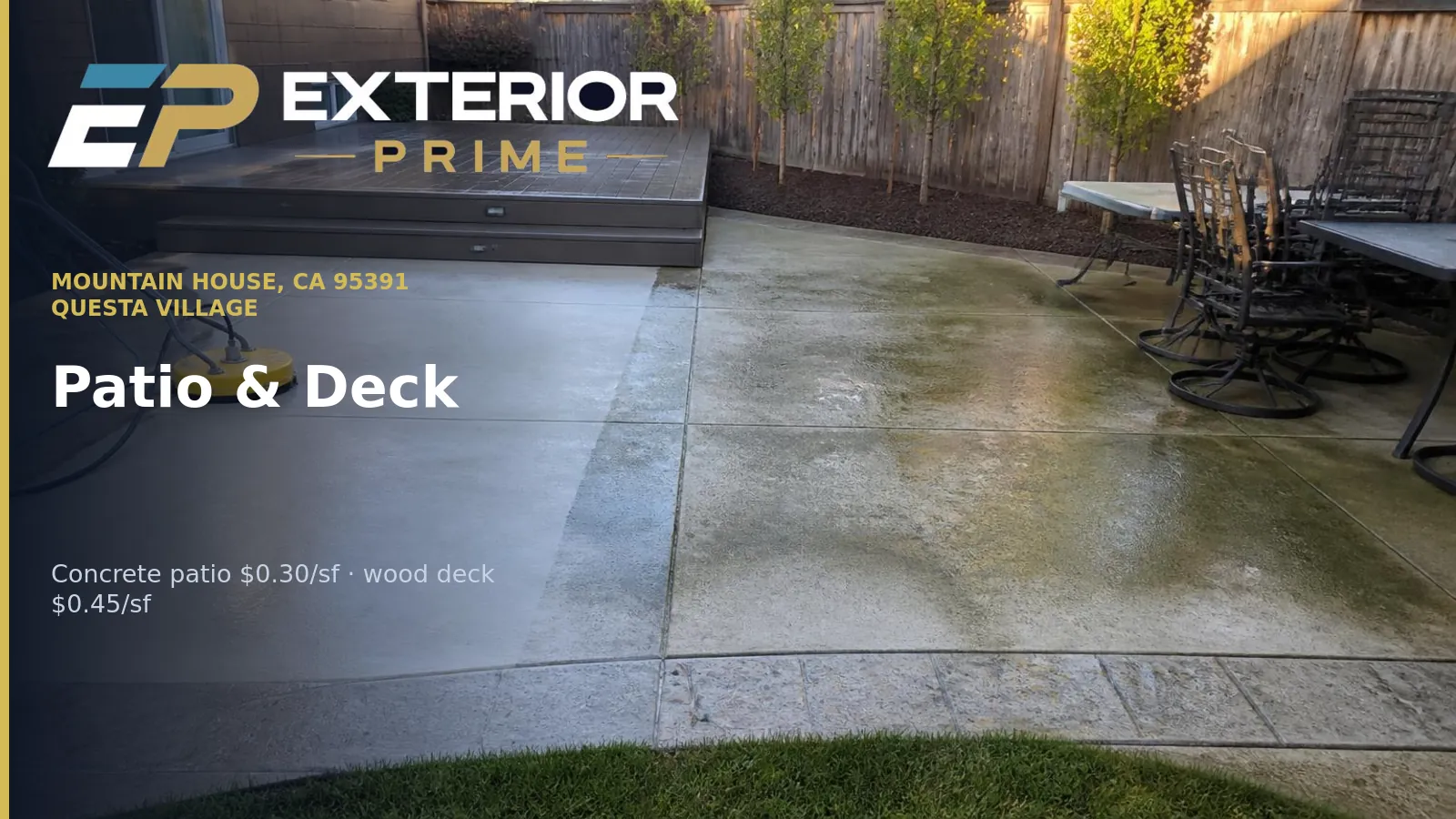
North and east-facing patio sections in Mountain House stay damp hours longer each morning, and that alone is enough to grow the algae film that makes concrete slick.
On a standard village lot, the house casts shade over a meaningful share of the patio for most of the day. Combine that with morning irrigation and a fenced yard that limits airflow and the surface never fully dries in winter.
The result is a biological film rather than dirt. It is why sweeping does nothing, why the green comes back within weeks of a plain water rinse, and why the affected area is measurably more slippery than the sunny concrete two feet away.
Treating it means applying a solution that kills the growth and letting it dwell, then cleaning. Skip the dwell and you get a patio that looks clean for a month and then reappears exactly as it was, which is the most common complaint we hear from Mountain House homeowners who tried a rental machine first.
Field note 02
Concrete, pavers, wood and composite each want different handling
Concrete takes a rotary surface cleaner, pavers take lower pressure plus re-sanding, wood takes a wide fan with the grain, and composite takes chemistry and almost no pressure at all.
Paver patios and the paver bands common on Questa and Hansen lots lose joint sand under high pressure. Cleaning them properly means dialing pressure back, then re-sanding the joints so the field stays locked. Skipping the re-sand is how pavers start to shift.
Wood decking on these homes is usually a redwood or cedar surface on a raised platform. It cleans at $0.45 per square foot with a wide fan moving with the grain — never across it — and it needs to dry several days before any stain or seal goes on. Deck plus stain or seal is $1.85 per square foot including material.
Composite decking, which is what most newer Mountain House builds use, is the surface people damage most often. It looks tough and it is not: pressure lifts the embossed grain and leaves a permanently fuzzy patch. It gets a deck-safe cleaner, a soft brush and a rinse.
Field note 03
Pool decks, furniture rust and the details that get skipped
On a Mountain House pool deck the work that matters is the coping edge, the furniture rust rings and the textured surface that traps sunscreen film.
Textured and knock-down pool deck finishes hold body oils and sunscreen residue in a way smooth concrete does not. It reads as a gray shadow around the seating area and needs a degreaser and dwell before the machine touches it.
Metal furniture feet leave iron rings, particularly on the light concrete used here. Those get the same oxalic-based treatment as sprinkler rust on the driveway — a chemical fix, not a pressure fix.
The coping edge and the first foot of decking around the water are handled by hand, both to control what enters the pool and because the coping joint is usually caulked and does not want a jet in it. Our professionals also cover or move furniture and rinse it rather than working around it.
Field note 04
What backyard cleaning costs in Mountain House and how to schedule it
Backyard work in Mountain House is priced by measured square foot and almost always scheduled alongside the driveway or a house wash, because a single patio rarely reaches the $297 minimum on its own.
A typical village patio is 300 to 500 square feet, which is $90 to $150 of concrete cleaning. A raised deck of 200 to 400 square feet is $90 to $180. Neither justifies a dedicated trip out I-205.
Combined, though, a full flatwork package — driveway, front walkway, side path, back patio and deck — commonly runs 1,000 to 1,400 square feet and stands on its own as a visit, with every hard surface on the property coming out one tone.
Timing matters more here than for front-yard work. Spring is best: the shaded algae has finished its wet-season growth, the surface will actually dry afterward, and if you plan to seal or stain there is a real window before summer heat arrives.