Field note 01
Where pigeons roost on a Mountain House home besides the array
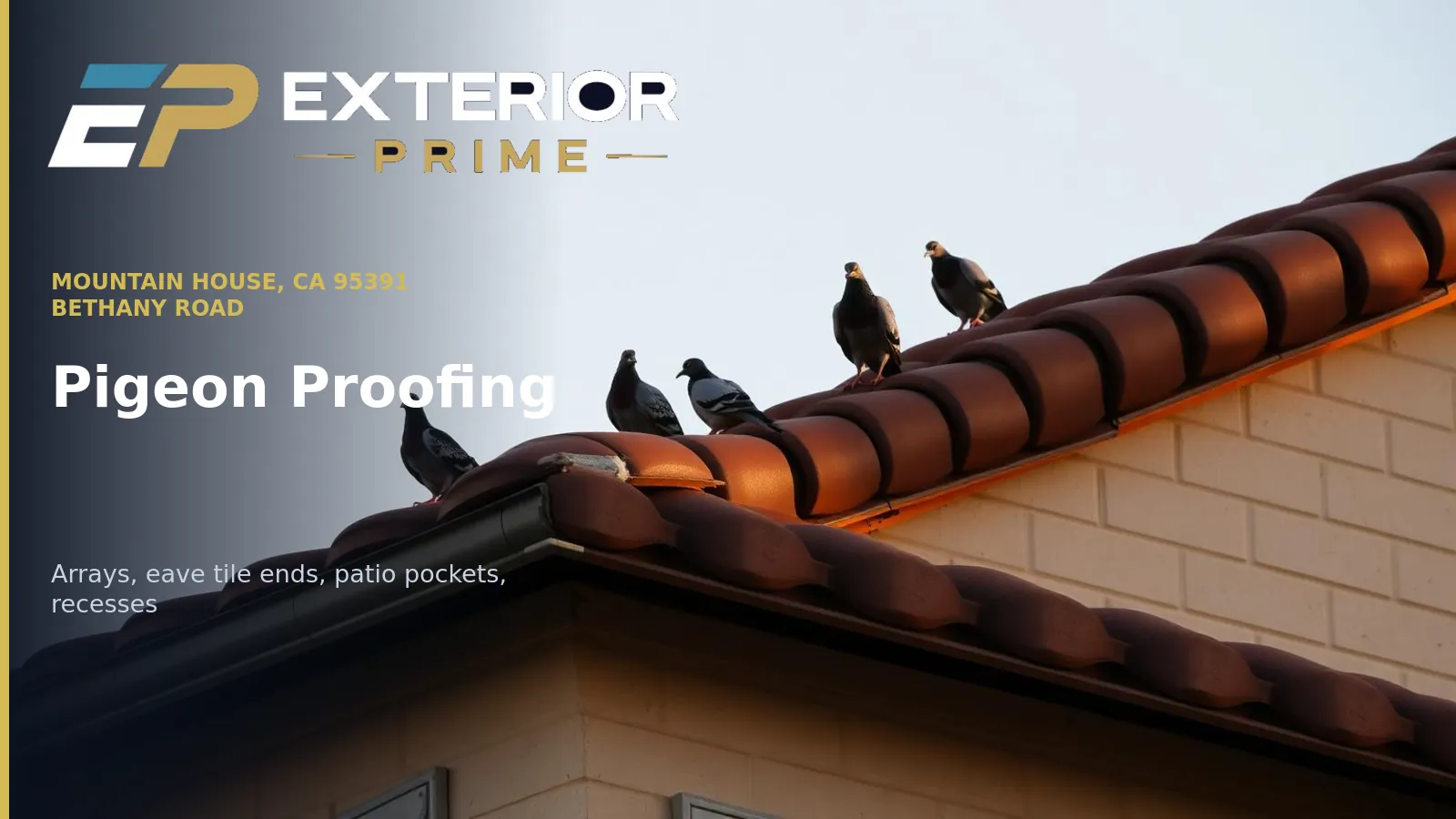
The four common non-array ledges here are open tile ends at the eave, patio cover beam pockets, second-story architectural recesses, and the void behind a gutter that has pulled from the fascia.
Concrete tile roofs leave a cavity at the end of each tile course along the eave. On many 95391 elevations those are open, and they are almost exactly the right size for a nesting pigeon.
Patio covers are the second favorite, especially the beam-to-ledger pocket on the rear elevation. It is shaded all afternoon, sheltered from the wind, and directly over the furniture you were hoping to sit on.
Then there are the recesses — the little roofed nooks over entryways and above second-story windows that these floorplans use for street presence. Every one of them is a ledge, and the birds find the deepest one first.
Field note 02
Why deterrents fail here and exclusion does not
Spikes, gel, tape and sonic devices ask the bird to stay away voluntarily, and Mountain House pigeons have too much competition for good ledges to take that seriously for long.
With open ground and feed within a mile of every village, the local flock density is high and the sheltered ledge count is limited. When the alternative is roosting in the open Altamont wind, a pigeon will happily nest between spikes.
Exclusion is dimensional. A closed tile end is not a partly-uncomfortable tile end; it is not a ledge at all. That is why we quote closures and mesh rather than a maintenance program of reapplied product.
It is also the cheaper answer over any real time horizon. Deterrent products are recurring cost with recurring inspection; a properly fabricated closure is done.
Field note 03
How the whole-home walk is priced
Arrays are per module at $58; eave tile ends, patio pockets and recesses are quoted by run after a walk, because the count varies wildly between village floorplans.
A single-story Wicklund home might have a dozen open tile ends and no other ledge. A two-story Bethany Road elevation with a deep entry recess and a full-width patio cover is a different scope entirely.
That is why proofing that is not array-only gets a site walk before a number. It is not evasive — it is that a linear-foot figure invented over the phone is either too high for you or too low for us.
Cleanup is its own line as always, from $200. Roost sites accumulate less material than nest sites, but the staining on stucco below a heavily used ledge is often the bigger job.
Field note 04
Proofing and cleaning are the same trip in 95391
The wash that removes the dropping streaks and the exclusion that stops them recurring should happen on one visit, because both need the same ladder positions.
Dropping streaks on stucco come off with a low-pressure soft wash at $0.36 per square foot on stucco elevations. Doing that before the ledges are closed just means doing it again next year.
Gutters usually need attention too, because a heavily used eave ledge feeds material straight into the trough. Combining gutter cleaning with proofing keeps the wet season from starting with a blocked downspout.
One trip out I-205 also means one mobilization, which is the practical reason bundling saves real money in Mountain House rather than a token discount.