Field note 01
Why 95391 arrays attract pigeons faster than older neighborhoods
Mountain House rooftops combine three things pigeons want: an elevated flat-tile plane, a 3-to-6-inch shaded gap under the modules, and open grassland feed within a mile of every village.
The homes here are new enough that nearly every array is rail-mounted on concrete flat tile rather than sat flush. That mounting height is what creates the cavity, and the cavity holds heat overnight — a genuine advantage for a bird in a windy corridor like this one.
Feed and water are the other half. West of Grant Line Road and out toward Byron the land is still agricultural, so a flock can feed in stubble in the morning and loaf under your modules through the afternoon wind.
Once a pair nests successfully, their squabs return to the same array to breed. That is why bird problems in Mountain House rarely fade on their own — each season the population under the panels is larger than the last.
Field note 02
What exclusion actually means, and what it does not
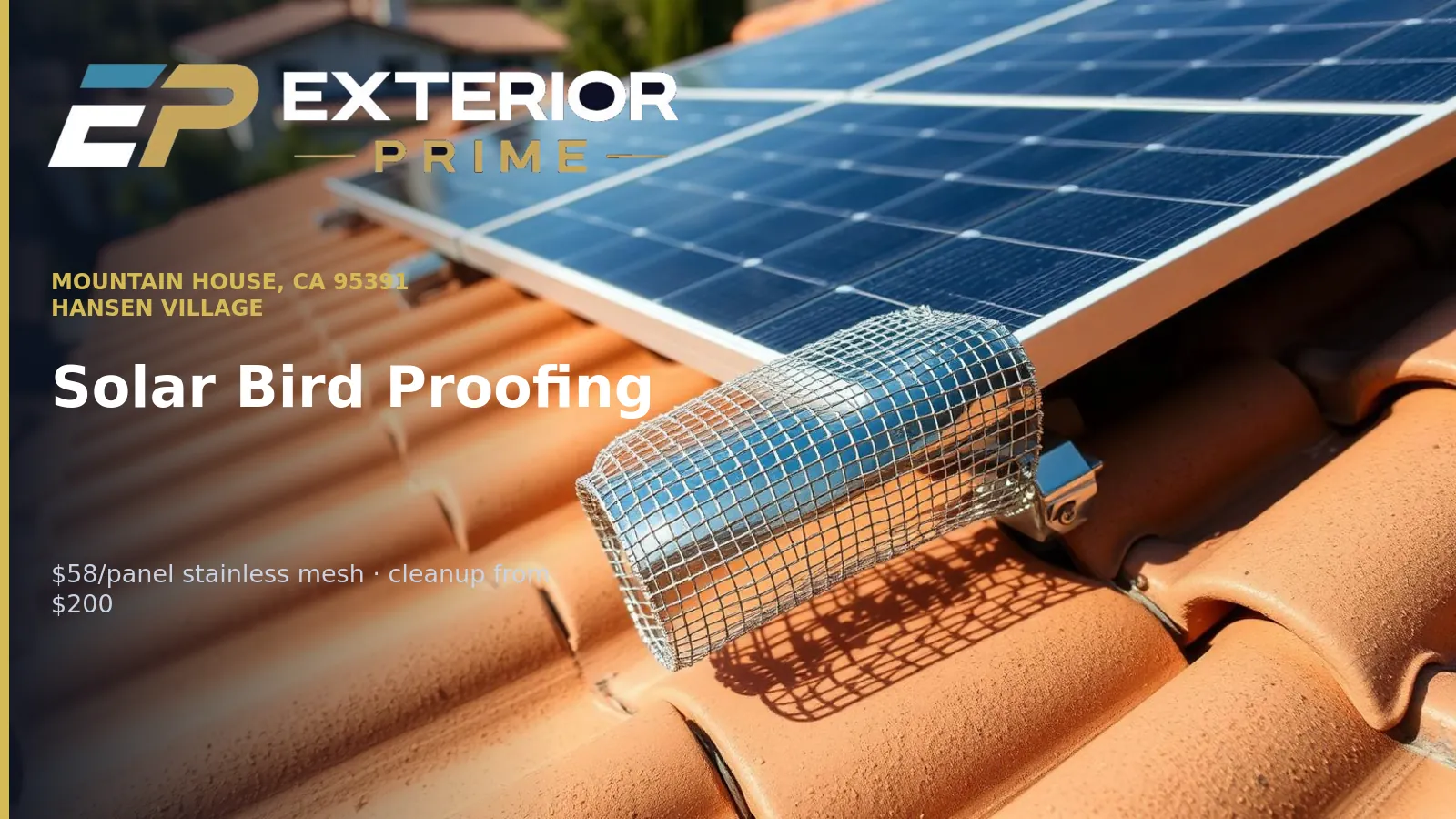
Exclusion means physically sealing the perimeter gap between module and tile with clipped stainless mesh, so there is no deterrent to habituate to and nothing to reapply.
Spikes, gels, reflective tape and sonic units all rely on discomfort. Pigeons are relentlessly adaptable and they habituate, which is why homeowners who tried the hardware-store route usually call after one nesting season with the same birds and a new expense.
Mesh does not ask the bird to change its mind. The cavity simply becomes inaccessible, so the flock relocates to the next unprotected roof. That is also why timing matters: proofing works best right after cleanup, before the next brood is laid.
The critical detail is fastening. Our professionals use panel-frame clips rated for the module edge — no screws through frames, which can void a panel warranty, and no fasteners into tile, which is how leaks start.
Field note 03
The damage that is already happening under the modules
Nesting material under an array traps heat against the module backsheet, blocks the drainage path across the tile, and puts acidic droppings on wiring and flashing.
Panels shed heat off their back face. Pack that space with twigs and feather down and the modules run hotter, which quietly costs production on exactly the hot Mountain House afternoons your system was sized for.
Nesting debris also dams water. During a wet-season storm the sheet of water that should run down the tile field is diverted sideways under the array, and on concrete flat tile the drainage path is the whole waterproofing strategy.
Then there is the wiring. Droppings are acidic and they land on module junction boxes, MC4 connectors and the conduit run. It is not a fast failure, but it is a real one, and it is the kind of thing a solar installer will point at when a warranty claim comes in.
Field note 04
What a Mountain House bird proofing visit includes
One visit covers array inspection, nest and debris removal, sanitizing, a panel rinse and the full mesh perimeter, and it is scheduled outside active nesting where possible.
Cleanup comes first because meshing over an occupied cavity is both inhumane and pointless. Nests, eggshells, feather mats and compacted droppings are removed, bagged and hauled off — nothing is swept onto the tile or into the gutters.
The tile under the array is then rinsed and treated, and the panels themselves are washed while access is already staged. Bundling the array cleaning with proofing is why most Mountain House homeowners do both in one trip.
The mesh perimeter is cut and clipped module by module, following the array outline including the awkward inside corners around jumper wires and skirt gaps. Cheap installs skip corners; a pigeon finds the skipped corner within days.