Field note 01
Reading the signs before you go up a ladder
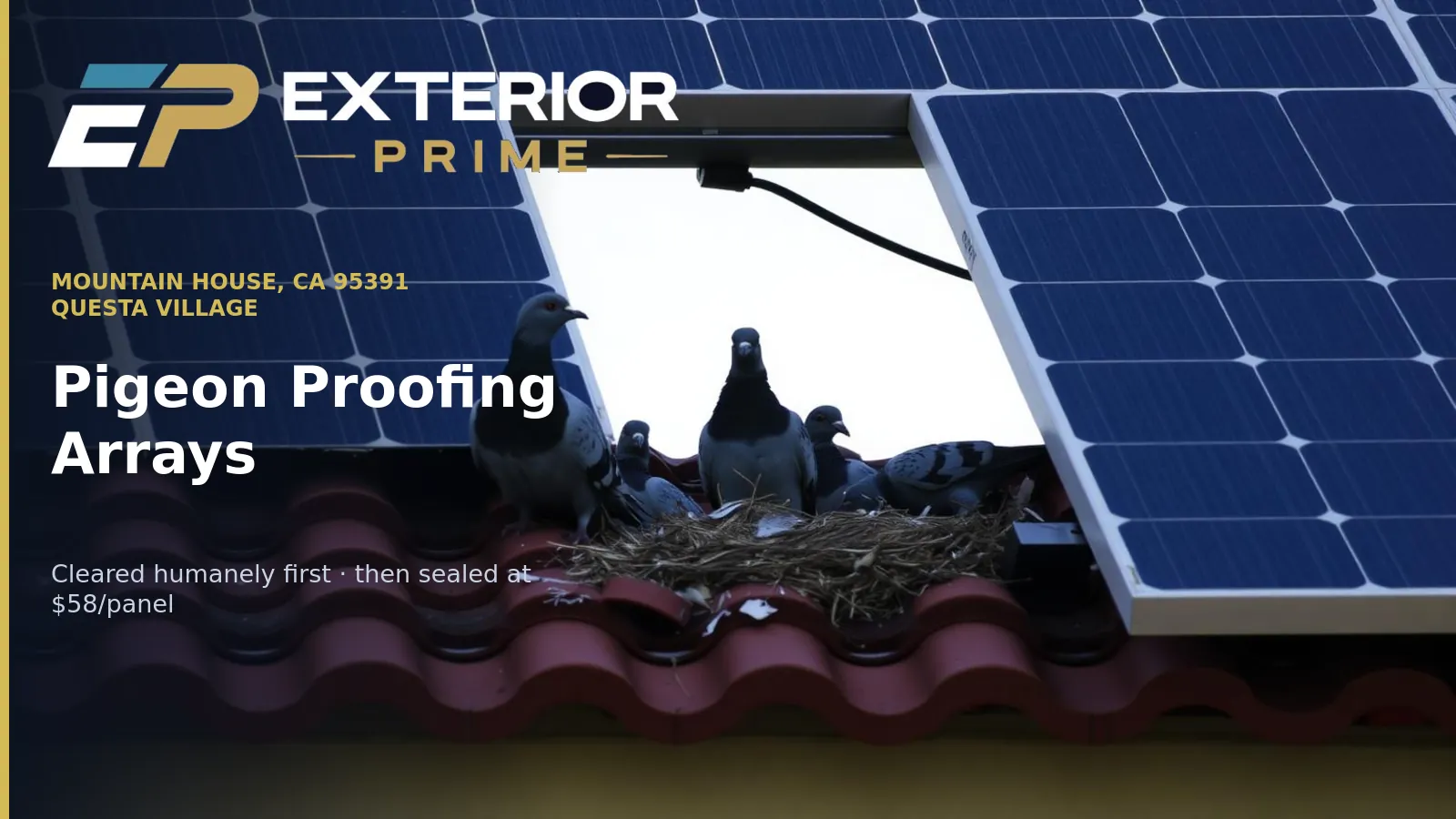
You can usually confirm a pigeon colony under a Mountain House array from the ground: white streaking down the fascia, cooing at dawn, feathers in the side-yard, and grit on the walkway below the array line.
The streaking is the clearest tell. Droppings accumulate at the array's lower edge, overflow the tile course and run down the fascia in vertical white lines that follow the module rows above.
Sound is the second. A pair defending a nest coos persistently in the early morning, and on the tight village lots here that carries straight into an upstairs bedroom window.
Then there is the debris on the ground — down feathers caught in shrubs, and a fine grit of broken nesting material on the walkway. On a narrow Mountain House setback, all of that lands in the three feet of concrete you walk every day.
Field note 02
Health and cleanup, handled properly
Dried pigeon droppings are the actual hazard, so the cleanup is done wet, bagged and hauled — never dry-swept or blown off the roof.
Dry droppings aerosolize when disturbed, which is the whole reason dry sweeping an array cavity is the wrong method. Material is wetted and sanitized before it is handled, then sealed in bags on the roof.
Nothing goes into the gutters. Flushing colony material into the trough moves the problem to your downspouts and, on a Mountain House lot, deposits it in the strip of bed against the foundation.
The tile underneath gets sanitized and treated after the bulk material is gone, because droppings sit in the porous concrete surface and will keep staining and smelling if only the loose layer is removed.
Field note 03
Humane sequencing, and why it also produces a better result
The cavity is cleared and confirmed empty before mesh goes on, and if there are unfledged squabs the mesh install is scheduled after they leave.
Sealing a live nest under an array is inhumane, and it also guarantees a callback — decomposition under modules produces odor, flies and a mess that has to be reopened to fix.
Waiting on a brood is usually a matter of a couple of weeks. We do the cleanup and tile work that can be done, then return to close the perimeter, which is why some Mountain House jobs are quoted as two visits.
The birds themselves relocate once the ledge is gone. There is no need for anything lethal, which is a question homeowners ask often and are usually relieved to have answered.
Field note 04
Cost of a Mountain House pigeon proofing job
Mesh is $58 per module and cleanup starts at $200, so most 95391 arrays land between roughly $900 and $1,400 all in.
Worked through: a 14-module array is $812 of mesh. Add a $200 cleanup on a first-season nest and the visit is about $1,012. A long-established colony pushes the cleanup line up, which is why it is quoted from the photographs rather than guessed.
Adding a module wash at $10 per panel is common on these jobs, because the glass has been under a colony and the access is already staged.
Standalone visits start at $297. Small carport or shed arrays sit at that minimum rather than at a bare per-panel figure.