Field note 01
Why 95391 arrays get colonized so quickly
A rooftop array creates a dry, shaded, predator-free ledge a few inches above warm tile, and in a new-build community like Mountain House it is often the best roosting site for a mile.
Older towns give pigeons bridges, barns, warehouse eaves and mature structures. Mountain House gives them tile roofs and solar arrays, which is why the pressure here concentrates on residential rooftops rather than commercial ledges.
Colonies also move by observation. Once one array on a street holds a successful nest, neighbours report the same problem within a season, which is why proofing tends to happen in clusters on the same block.
The cost of ignoring it is not just noise. Droppings acidify tile and array hardware, nesting material blocks airflow under modules and holds moisture against the roof, and the debris field eventually reaches the gutters.
Field note 02
Clear first, seal second — never the other way round
Nothing gets meshed until the cavity under the array has been cleared, sanitized and confirmed empty, because sealing a live nest in is both inhumane and a worse problem than the birds.
Cleanup starts at $200 and covers removal of nesting material and droppings plus sanitizing of the cavity. On arrays that have been occupied for a couple of seasons this is genuinely substantial work — the material compacts.
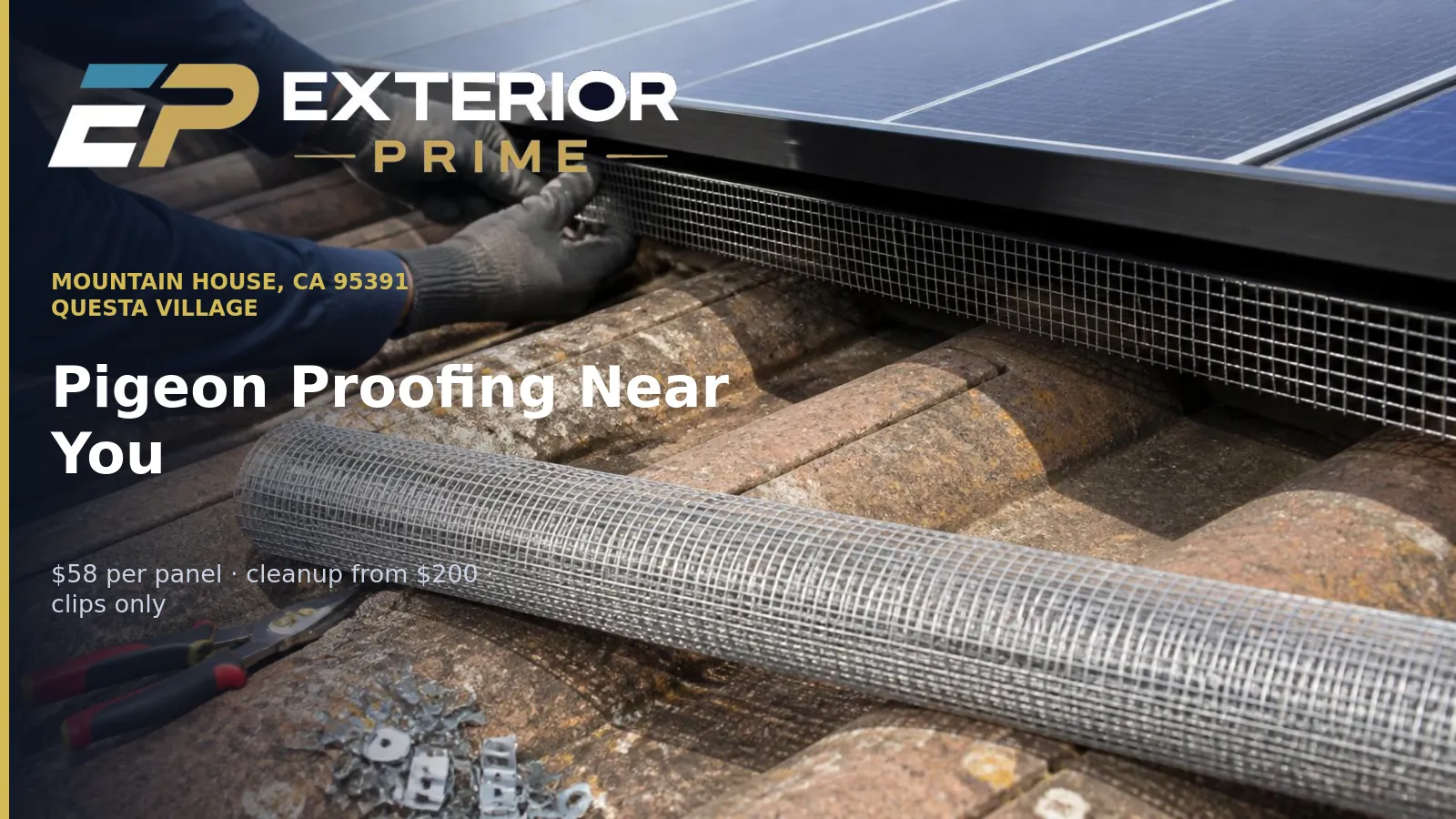
Then the mesh goes on. Stainless exclusion mesh at $58 per panel, cut to each run on the roof and fixed with clips to the module frame. No screws into panels, no penetrations into tile, and nothing that could affect a panel warranty.
The details decide whether it holds: inside corners, jumper notches, and the ends of each row are where a proofing job either lasts for years or fails within a week. Those are worked by hand rather than run straight through.
Field note 03
Local coverage, roof safety and what nobody should be doing
We cover all of Mountain House 95391 and work from ladder-set positions, because the concrete tile field here cracks under foot traffic and a cracked tile leaks quietly for years.
This is exclusion work, not pest control. No poisons, no trapping, no recurring contracts — the gap is closed, the birds relocate, and the job is finished.
Any company proposing to screw mesh into your tile or through a module frame is creating two future problems: a roof penetration and a warranty argument. Clip-mounted mesh achieves the same seal without either.
Coverage runs across every village — Questa, Wicklund, Bethany, Cordes, Altamont and Hansen — plus the eave tile ends and patio pockets that are the second most common roost once the array is closed.
Field note 04
What proofing costs near you, counted honestly
The mesh line is simply your module count multiplied by $58, which is why any Mountain House quote can be checked from your own driveway.
Count the modules on the roof. Twelve panels is $696 in mesh, eighteen is $1,044, twenty-four is $1,392. Add cleanup from $200 where a nest is present, and that is the whole number.
Typical residential jobs here land between $650 and $1,200, and the $297 standalone minimum applies to very small arrays or cleanup-only visits. Combining proofing with a panel clean on the same trip is the efficient way to buy it, since access is already staged.
Booking is open around the clock and quotes start by counting modules, not by inspecting your wallet. If someone quotes a flat four-figure package without knowing your panel count, they are pricing a story rather than a job.