Field note 01
Why stucco is soft washed and never pressure washed
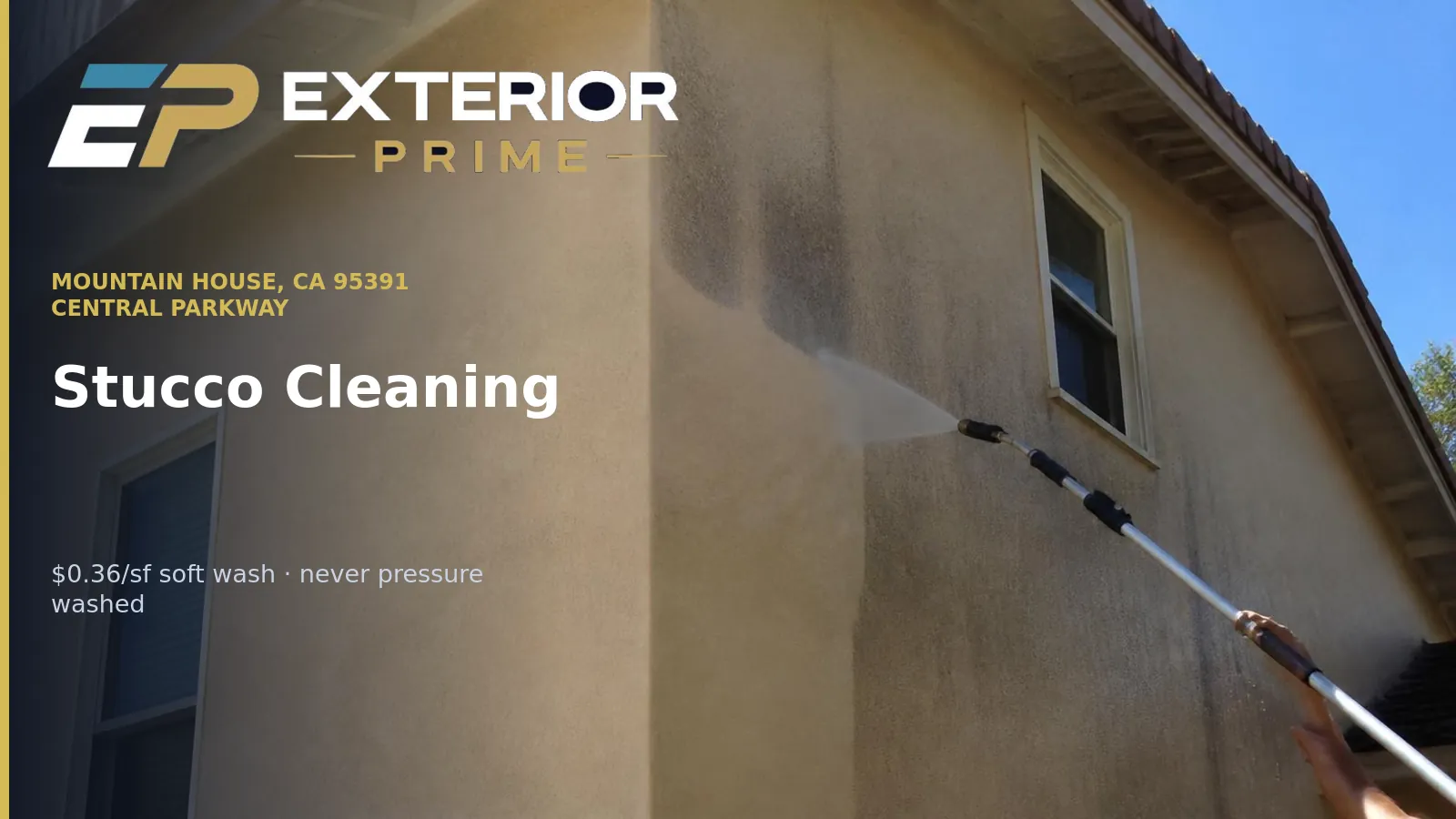
Forcing water into a stucco wall at pressure pushes it past the paint film and into the assembly, where it delaminates coating, spreads hairline cracks and can wet the sheathing behind the lath.
Stucco is a cementitious skin over lath and building paper. It is designed to shed water running down it, not to take water driven at it sideways with several hundred PSI behind it. A pressure wash finds every hairline crack and pushes moisture through.
The visible failures show up later: paint blistering in patches, a chalky band where the coating was thinned, dark streaks that were not there before because water carried dirt into the texture instead of off it.
A soft wash inverts the approach. A cleaning solution does the work at low pressure, dwells long enough to kill the biological growth, and is rinsed with a wide fan. The wall gets cleaner than pressure would make it, with nothing driven into it.
Field note 02
What is actually on a Mountain House stucco wall
Three distinct layers accumulate on 95391 stucco: fine wind-driven dust across the whole elevation, algae on the shaded and irrigated sides, and a hard-water mineral band on the bottom two feet.
The dust is the reason a whole house looks flat and tired rather than dirty in spots. It settles into the texture's shadow side, so the wall reads darker and the color looks faded even though the paint underneath is fine.
Algae concentrates on north-facing elevations and anywhere landscaping keeps the wall damp. On the tight village setbacks that is usually the side yard, where a fence, a neighbouring wall and a sprinkler line combine to keep a strip permanently shaded and wet.
The mineral band is the one people misdiagnose most. A pale chalky line along the bottom eighteen to twenty-four inches is calcium from district water hitting the wall, not mold. It needs a separate acid-side treatment, and it will return unless the irrigation head is turned.
Field note 03
Painted, integral-color and older stucco finishes
Painted stucco tolerates a standard soft-wash mix; integral-color and lime-finish stucco need a gentler solution and a test patch, because their color is in the material rather than on it.
On painted walls the film protects the substrate, so the practical concern is not damaging the paint — no aggressive scrubbing, no strong solution left to dry in the sun, and rinsing before it does.
Integral-color stucco has pigment through the coat. There is no film to protect it, and a strong mix can lighten it unevenly. Our professionals test an inconspicuous area on those elevations before committing to the front of the house.
Chalking is the honest limitation on sun-exposed Mountain House walls. Where the paint has oxidized to a powder, cleaning will remove dirt and some of the chalk and reveal that the finish itself is spent. That is a repaint conversation, and it is better to have it before the wash than after.
Field note 04
Wall square footage, pricing and bundling in 95391
Stucco is priced on wall area rather than floor area, at $0.36 per square foot, which is why a two-story Mountain House home costs more than its footprint suggests.
Wall area is perimeter multiplied by height, less major openings. A single-story village home commonly lands between $297 and $900, and a two-story between $340 and $1,035, with the extra reflecting reach equipment and safety setup rather than a different method.
The Curb Appeal bundle at $447 pairs a house wash with driveway and walkway flatwork, which is how most 95391 households buy it — the wall runoff lands on the concrete anyway, so cleaning the concrete afterwards is the natural sequence.
Interval here is about 18 months, and the best timing is late spring after the February-to-May wind season has finished delivering its dust. Washing in March means washing again in June.