Field note 01
Where 95391 rust actually comes from
Almost all Mountain House rust traces back to four sources: iron in the irrigation water, fertilizer with an iron component, metal furniture or planters left on concrete, and rebar or a tie sitting too close to the surface.
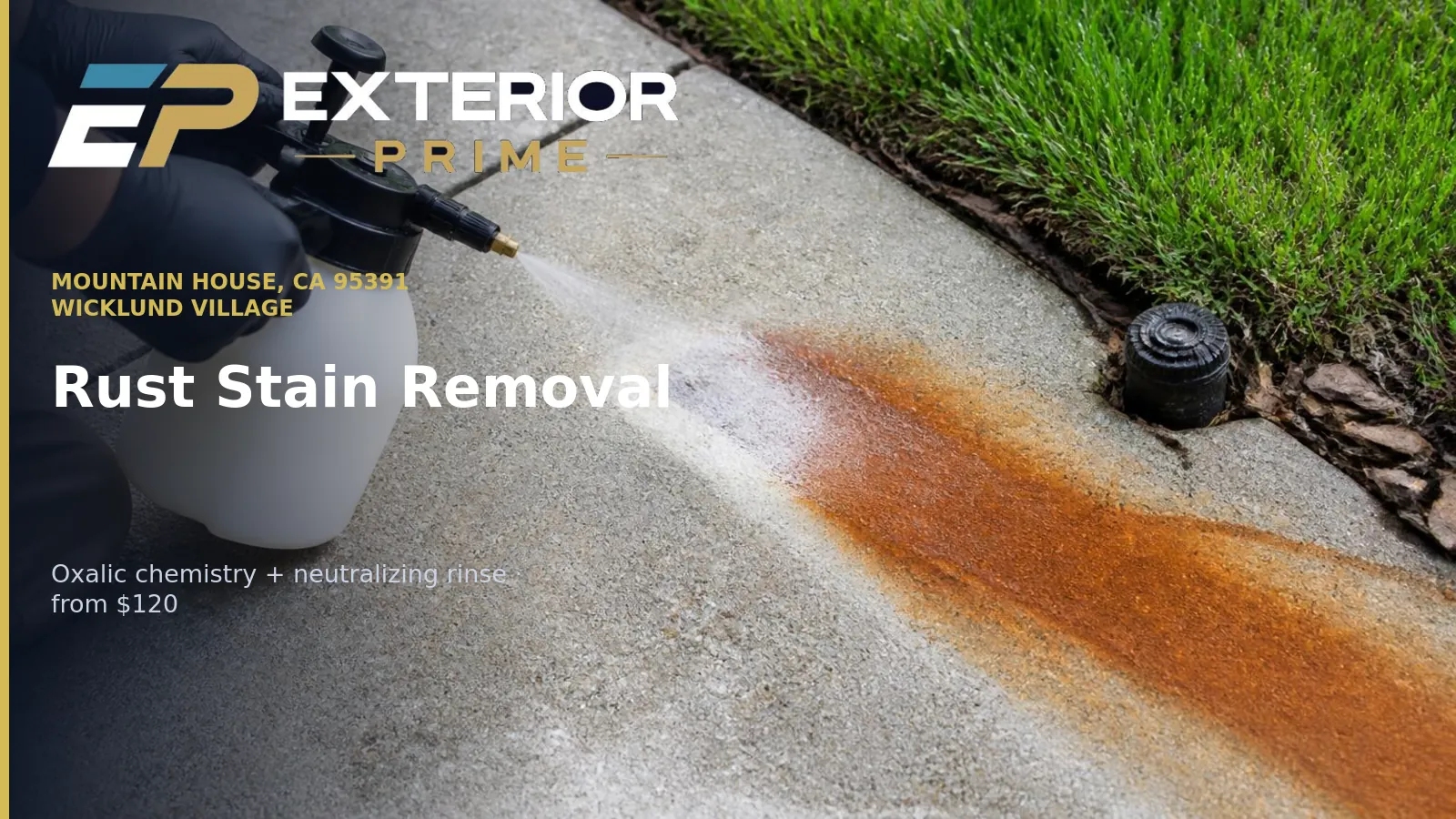
Irrigation rust shows as a fan or streak radiating out from a head, always in the same direction, always strongest nearest the source. It builds slowly and homeowners often think it is soil staining until they notice the pattern matches the spray arc.
Fertilizer rust is different and worse. Granules that land on wet concrete dissolve and drive iron straight down into the pores, leaving intense spots that can be deeper than any surface treatment reaches. Those get an honest expectation set at the estimate.
Furniture and planter rust is the most cooperative kind — usually a ring or a set of small circles, usually shallow, and usually clears completely if the metal has not sat there through several wet seasons.
Rebar bleed is a repair issue, not a cleaning one. If iron inside the pour is corroding, the stain returns because the source is internal. We will say so rather than sell a treatment that lasts one season.
Field note 02
Why the chemistry has to match the surface
Concrete tolerates a stronger acid-side dwell; painted stucco, coated pool decks and colored pavers do not, so treatments on those get a shorter dwell, buffering and more careful neutralizing.
On broom-finish concrete an oxalic or reducing-agent product with a real dwell will convert and lift the iron with no visible change to the surface texture, provided it is rinsed and neutralized properly.
On painted stucco the paint film is the constraint. Too strong or too long and you dull the sheen or pull color, which trades a rust stain for a patch. Mountain House elevations are almost all painted stucco, which is why rust bleed on walls is quoted after testing rather than off a photo.
Colored and stamped concrete adds a third problem: the color hardener and sealer both react. Treatment on those is tested in an inconspicuous spot first, and sometimes the right recommendation is partial improvement plus a reseal rather than chasing a full lift.
Every treatment ends with a neutralizing rinse. Residual acid left on concrete keeps working, and what looks clean on the day can come back in a week as a pale halo if that step is skipped.
Field note 03
Stopping the source, not just the stain
A rust stain in Mountain House that is removed without fixing the sprinkler head, the planter foot or the fertilizer routine will be back within one irrigation season.
Our professionals note which heads are throwing onto flatwork and stucco and in what arc, because a quarter-turn adjustment is a permanent fix that costs nothing. On tight village lots this is the single most common recurring cause.
Furniture and planters get feet, pads or a relocation recommendation. Iron patio sets on a Mountain House patio will keep marking the slab as long as bare metal contacts damp concrete.
For iron-containing fertilizer, the fix is application discipline — keep granules off the flatwork and sweep before watering. That advice has saved more 95391 driveways than any product we carry.
Field note 04
What a rust job costs and how it is bought
Standalone rust work is $297 in Mountain House, which is why most homeowners add it to a driveway or house wash at $120, with wall bleed as a $45 zone.
Rust removal is chemistry, dwell and rinsing rather than square footage, so it is priced by zone and severity rather than per foot. A driveway with two sprinkler fans is one thing; a whole irrigated frontage with six is another.
It is also the treatment that most benefits from being done during a general wash. The surrounding concrete is already brightened, so the stain zone can be judged against a clean baseline instead of against dirt.
Expectations get set in writing. Sprinkler and furniture rust in 95391 usually clears fully; fertilizer burns and rebar bleed are quoted as improvement, with a percentage estimate rather than a promise.