Field note 01
Why oil comes back after it looks gone
Pressure alone cleans the top surface, so oil that has wicked several millimetres into a 95391 slab migrates back up with moisture and reappears as a shadow within weeks.
This is the single most common complaint we hear about previous cleanings. The driveway looked perfect on the day and then a gray ghost of the old stain returned. Nothing failed in the rinse — the oil below the surface was never lifted out.
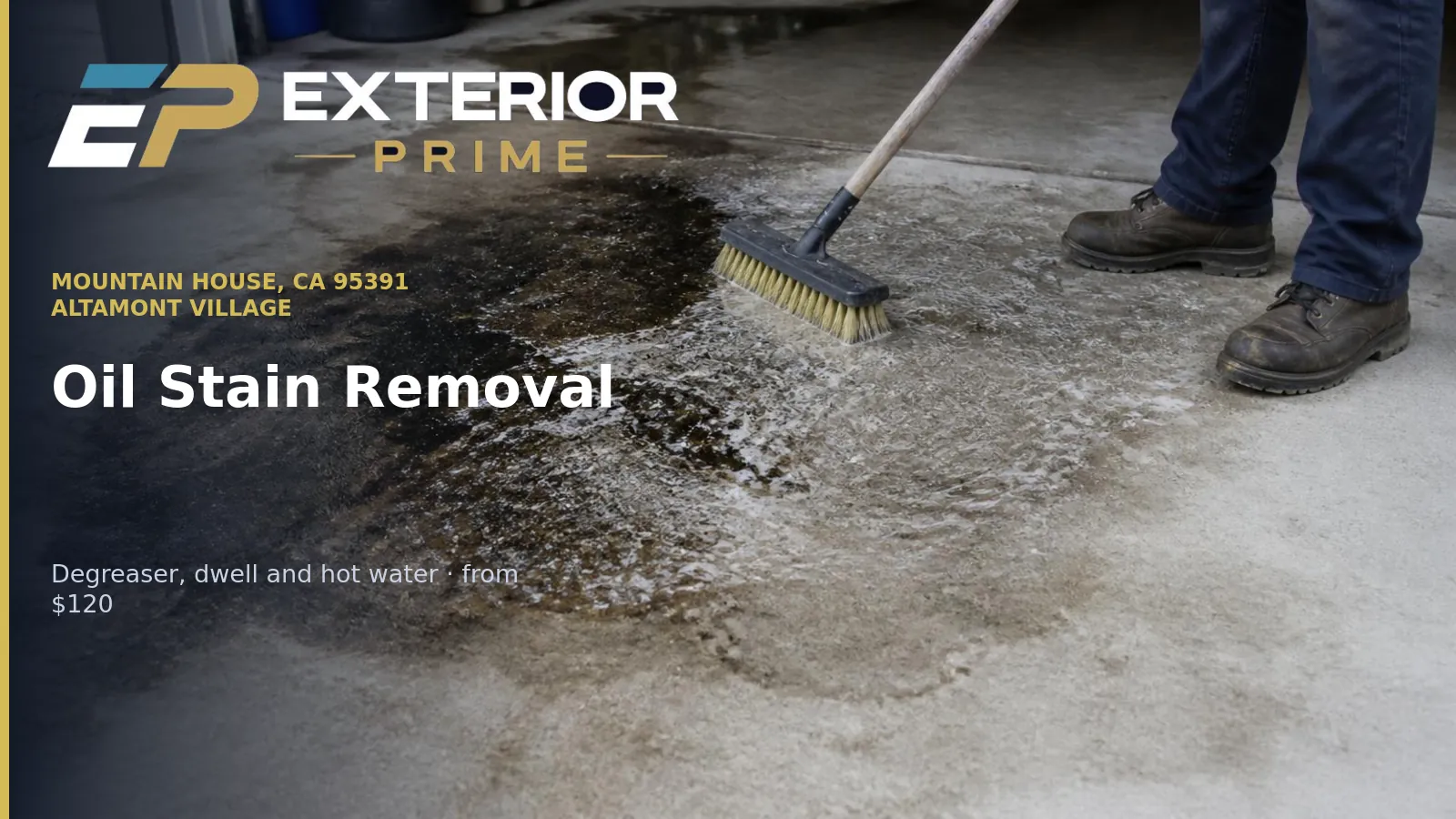
Pulling it out takes a surfactant that can emulsify hydrocarbon plus enough dwell for that surfactant to travel into the pores. Heat accelerates it. Skipping the dwell is what turns an oil treatment into a cosmetic pass.
It also usually takes more than one cycle. Our professionals plan for a second application on aged Mountain House stains rather than treating once and hoping, because the second pass is where the deep material actually comes out.
Field note 02
Fresh drips, aged leaks and the difference in outcome
A drip caught within days generally clears completely; a leak that sat under a parked car for two summers clears substantially but leaves a faint tone difference.
Age matters far more than size. A large fresh spill is easier than a small old one, because the depth of penetration — not the surface area — decides how much material has to be drawn back out.
Heat cycling in Mountain House works against you. Summer surface temperatures on an unshaded driveway drive oil deeper, so the same stain that would have cleared in March is more stubborn by September.
Where a full lift is not realistic, the options are honest ones: accept an improved but visible mark, or clean and then seal so the whole slab reads uniform. We will lay both out with the price rather than promising a disappearance.
Field note 03
Garage slabs, hot tire pickup and the parking track
Inside a Mountain House garage the stain is usually a combination of oil, brake dust and hot tire polymer transfer, and each of the three responds to a different part of the process.
Hot tire pickup leaves dark scuffed bands where a warm tire lifted residue or coating. That is not really oil, and treating it as oil will not touch it. It needs mechanical agitation with the right pad and a citrus-based solvent.
Brake dust is metallic and fine, and it grays the whole parking track rather than making discrete spots. It comes out with the general flatwork pass once the hydrocarbon has been dealt with first.
Garage slabs also have nowhere for water to go. Our professionals plan the recovery — squeegee routes, wet vacuum, or working in sections to the apron — because a garage is the one place a big rinse volume creates a problem instead of solving one.
Field note 04
Cost, bundling and prevention on a Mountain House driveway
Oil work is a $120 add-on to any Mountain House flatwork visit, $297 standalone, and the most cost-effective time to do it is during a scheduled driveway cleaning.
The reason is straightforward: the degreaser needs the surrounding slab cleaned anyway to judge the result, and the equipment, hot water and trip out I-205 are already paid for. Standalone oil visits make sense mainly for a fresh spill you want handled immediately.
Severity adds $25 to $75. That covers the extra product, a second application and the additional dwell an aged stain needs, and it is quoted at the walk-through rather than discovered afterwards.
Prevention beats treatment. A drip tray under a known leak, prompt cat litter on a fresh spill, and sealing the slab after cleaning all reduce how far the next one penetrates. Sealed concrete does not stop oil, but it buys you days instead of hours.