Field note 01
Why a surface cleaner and not a wand
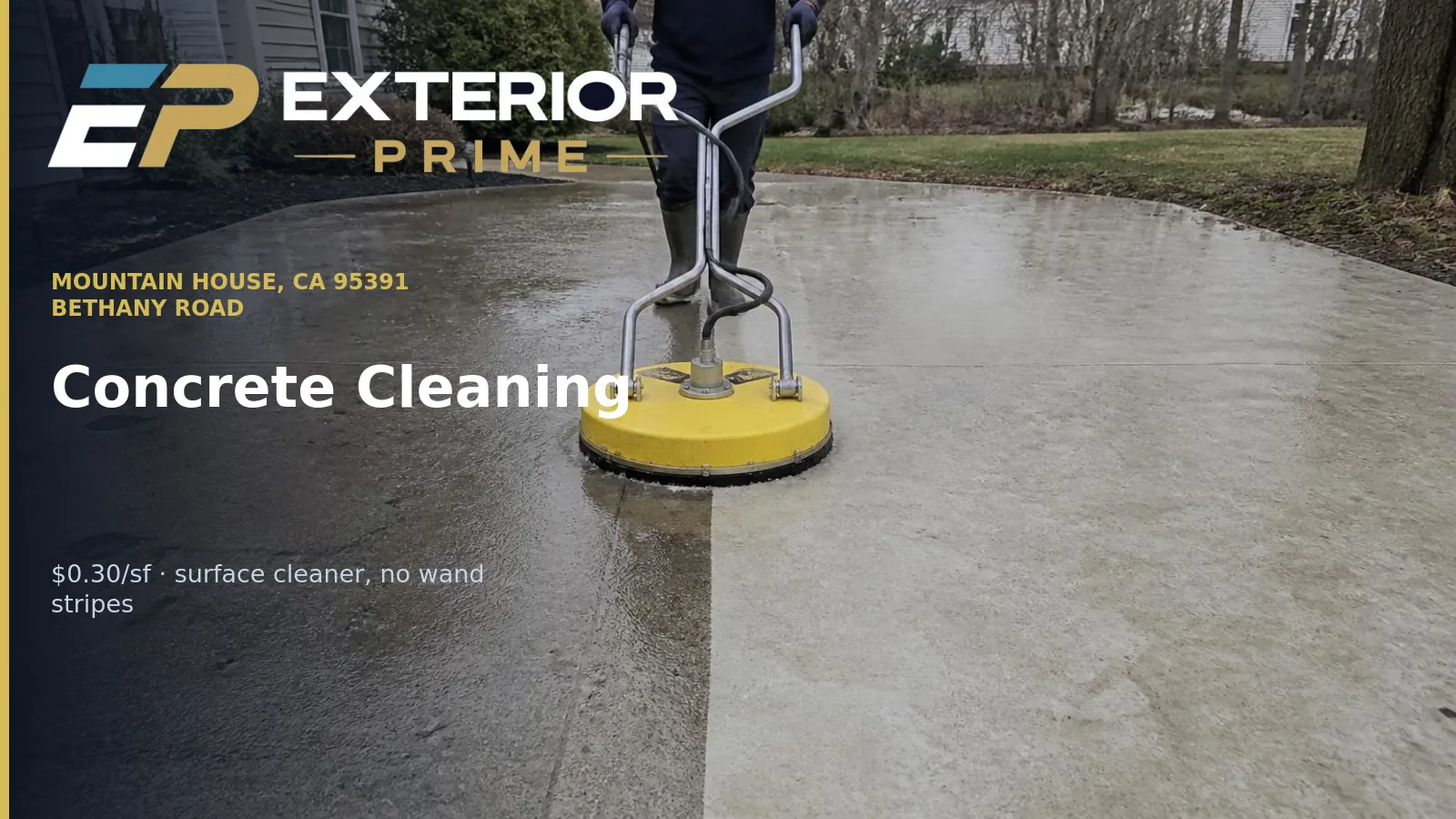
A rotary surface cleaner holds two jets at a fixed height and speed, so every square inch of a Mountain House slab receives the same energy — which is precisely what a hand-swung wand cannot do.
Wand cleaning leaves a signature: overlapping crescent marks, darker where the arc slowed at the end of each sweep. On a broom-finish slab in flat 95391 daylight those marks are visible from the sidewalk for years, because they are etched, not dirty.
The enclosed skirt on a surface cleaner also controls the water. Instead of firing slurry across the garage door and up the stucco, it captures it and pushes it out one side, which means less rework and no dirty rinse line up the wall.
Edges are the one place a wand belongs. Perimeters, control joints and the strip against the garage threshold are detailed by hand after the field pass, at the same distance and pressure so the finish matches rather than announcing itself.
Field note 02
The three stains on almost every 95391 slab
Mountain House concrete accumulates a gray wind-dust film across the field, a sprinkler mineral band along irrigated edges, and dark tire or oil marks in the parking track.
The film is what makes a slab look uniformly dull rather than dirty, and it is the part that responds instantly to a surface cleaner. Homeowners are often surprised how much of the color they had written off as aging concrete was just this layer.
The mineral band runs wherever a head throws district water onto flatwork. It is white to buff, it sits at a consistent height or distance, and it needs an acid-side treatment rather than more pressure. The lasting fix is adjusting the head.
Tire marks and oil are hydrocarbon, so they get a degreaser and dwell before the field pass, not after. Cleaning around them first and then attacking them leaves a halo where the surrounding slab is already bright.
Field note 03
Where concrete cleaning stops and repair begins
Cleaning restores color and removes contaminants, but it cannot fill spalling, hide a prior acid burn, or lift a stain that has migrated deep into the pour.
Spalling — the flaking of the top few millimetres — is common where de-icing salt never happens but sprinkler cycling and summer heat do. Cleaning a spalled area makes it more visible, not less, because the fresh break faces are lighter than the surrounding surface. Our professionals point those out before starting.
Old acid etching from a previous contractor cannot be washed out. It has changed the surface texture, so it will always take light differently. Sealing helps even the appearance; cleaning alone will not.
Deeply set stains — a transmission leak that sat for two summers, a planter that rusted through — sometimes clear to eighty or ninety percent and stop there. We would rather say that at the estimate than promise a full lift and hand you a partial result.
Field note 04
Square footage, minimums and how to buy it here
At $0.30 per square foot a slab has to reach roughly 990 square feet to clear the $297 standalone minimum, so most Mountain House concrete is cleaned as part of a combined visit.
A two-car driveway plus front walk in a village lot is often 700 to 900 square feet — real money at per-foot rates, still under the minimum on its own. Add the back patio, the side yard run and the pool deck and the same trip covers everything at the per-foot rate.
That is the whole logic of the minimum. The $297 covers the drive out I-205 to 95391, the commercial equipment on the trailer, insurance and photo documentation. Once the truck is on your street, additional square footage is cheap.
Frequency for Mountain House flatwork is about every 18 months, sooner on north-facing walks that stay damp and on slabs under an irrigated tree line. Sealing after cleaning extends that, and it is quoted separately because it needs its own dry day.