Field note 01
What gets dirty first on a Mountain House multi-unit building
Breezeway ceilings, stairwell stringers, carport posts and the stucco band within four feet of grade take the abuse — not the upper elevations everyone photographs.
The band near grade collects irrigation overspray, landscape mud and the fine Altamont wind grit that never stops moving through this town. It is the part residents and prospective tenants actually stand next to.
Breezeways are worse because they never get rain-rinsed. Spider casings, dust film and handprint traffic build on the ceiling and the wall return, and the concrete underfoot picks up the dark polish of foot traffic.
Stairwells and carports are the third zone. Stair nosings hold black traffic film, and carport posts collect vehicle grime plus whatever drips from a stored trailer or bike rack.
Field note 02
Cleaning around residents rather than through them
Multi-unit scopes here are phased by building and stack, with notice posted in advance, so no resident is boxed in or cut off from their door for a whole day.
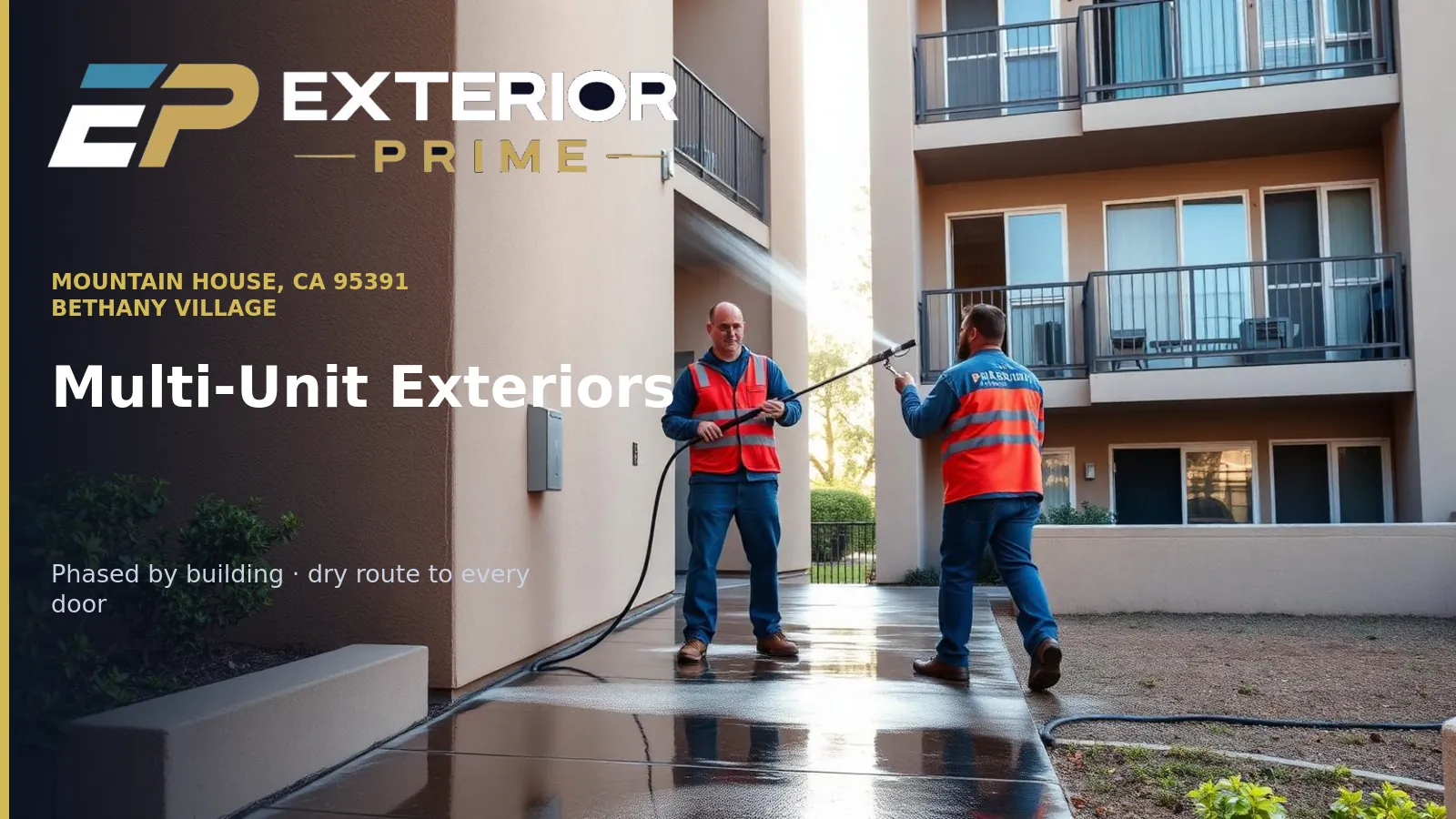
We work a building or a stack at a time and re-open access as we go. Practically that means breezeway floors are done in halves and a dry route to every door stays open.
Notice matters as much as the sequence. Managers get a phased schedule they can post 48 hours ahead, naming buildings and dates, so the office is not fielding calls all week.
Parking is planned with the manager. On Mountain House sites where carports are tight, the carport bays get a posted date and residents move once rather than being asked to shuffle repeatedly.
Field note 03
Surface-matched methods on an occupied property
Stucco and siding are soft washed at low pressure, concrete flatwork gets a rotary surface cleaner, and painted metal railings are hand-detailed rather than blasted.
Soft washing is not just about damage. On an occupied building it is also about water volume and where it goes, because high pressure throws water into weep screeds, window frames and sliders that residents left open.
Flatwork gets the surface cleaner because breezeway and walkway concrete shows wand stripes worse than a driveway does — the lighting under a breezeway is raking, so every stripe reads.
Railings, mailbox banks and light fixtures are hand-detailed. It is slower and it is the difference between a building that looks cleaned and one that looks maintained.
Field note 04
How the bid is built for a 95391 property
The walk counts buildings, stories, breezeway runs, stair flights, carport bays and flatwork area, and the bid is priced from those quantities with a written scope per building.
There is no published per-square-foot commercial number, and we would rather say that than pretend an averaged rate fits a 24-unit townhome block and a three-story stack equally.
What is published is the minimum — $297 for a standalone visit — and the structure of the bid, which lists quantities so a board or a manager can compare it against another proposal line by line.
Recurring scopes are quoted at the same time as one-off scopes, because most Mountain House HOA and rental properties end up on an annual or semi-annual cycle once they see what one wash does to the curb appeal.