Field note 01
Irrigation overspray is the real problem on 95391 commercial glass
Nightly sprinkler overspray puts hard water on the bottom third of commercial glass, and once it bakes on in Mountain House sun it is mineral deposition, not dirt.
You can identify it from the pattern: a spotted band across the lower panes, heaviest on the elevation nearest the planter, fading upward. Wash it normally and it looks cleaner for a day and then reads spotted again in raking light.
Removing it takes a mineral restoration step with the right acid dilution and dwell, worked and rinsed pane by pane. It is slower than cleaning and it is a one-time correction rather than a recurring line.
The other half of the fix is not ours: adjusting or shielding the heads that are hitting the glass. We flag them on the walk, because otherwise the restoration is on a clock.
Field note 02
Water-fed poles up high, hands at eye level
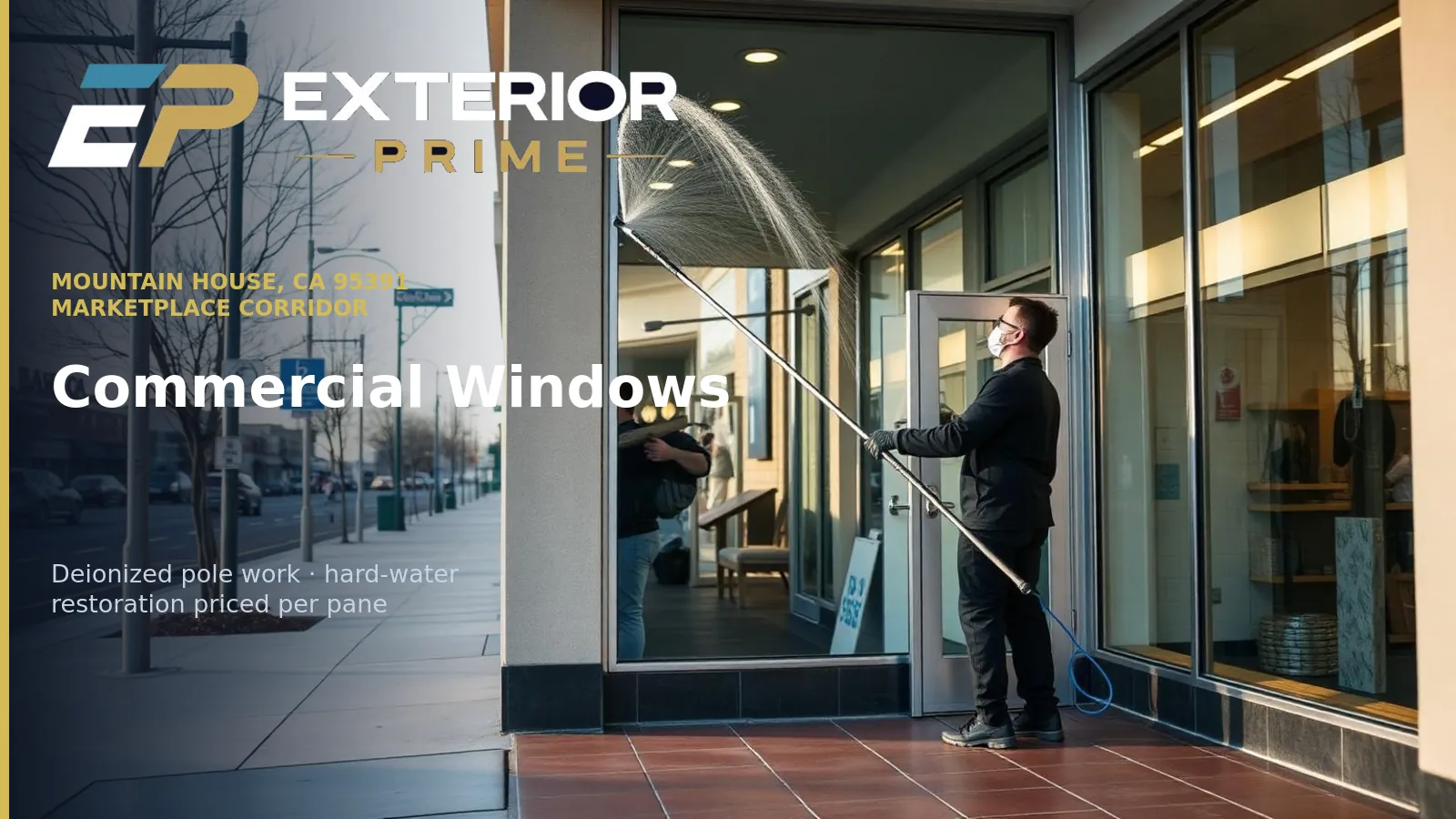
Upper elevations are cleaned with deionized water-fed poles from the ground, and everything at customer eye level is hand-detailed with a squeegee and a dry edge.
Pure water dries without spotting, which is what makes pole work viable on second and third floors without lifts or ladders on a live commercial site. Fewer ladders on a sidewalk also means fewer liability conversations.
Eye-level glass gets hands. Entry doors, storefront panes and clubhouse sliders are what people stand a foot away from, and a hand-detailed edge is visibly different from a pole finish there.
Frames, sills and door tracks are wiped as part of the job. Left dirty they bleed back onto the glass with the next irrigation cycle or the next wind day.
Field note 03
Working around business hours and tenants
Storefront and office glass is scheduled before opening or after closing, and multi-tenant buildings are sequenced so no single tenant's entry is blocked during trading hours.
Early morning is the usual window in Mountain House. It is cool, the glass is not baking, and the work is finished before customer traffic arrives.
In multi-tenant buildings we run one elevation at a time with signage at the working entry, so a tenant never loses their door with no notice.
Interior glass, where it is in scope, gets scheduled separately with the tenant rather than assumed — the most common source of friction on commercial glass jobs is an inside/outside assumption nobody wrote down.
Field note 04
How commercial glass is bid in Mountain House
Bids are built on pane count by elevation and height band, plus frequency — monthly, quarterly or one-off — with restoration priced separately from cleaning.
Pane counting is the honest unit for glass. It survives comparison between proposals in a way that a lump sum does not, and it lets you drop or add an elevation without renegotiating.
Frequency changes the per-visit number, because a quarterly building carries more film than a monthly one. Both get quoted in the same proposal so you can see the trade.
Hard-water restoration is a separate one-time line. Rolling it into a recurring rate would either overcharge you forever or leave the spotting untouched, and neither is acceptable.