Field note 01
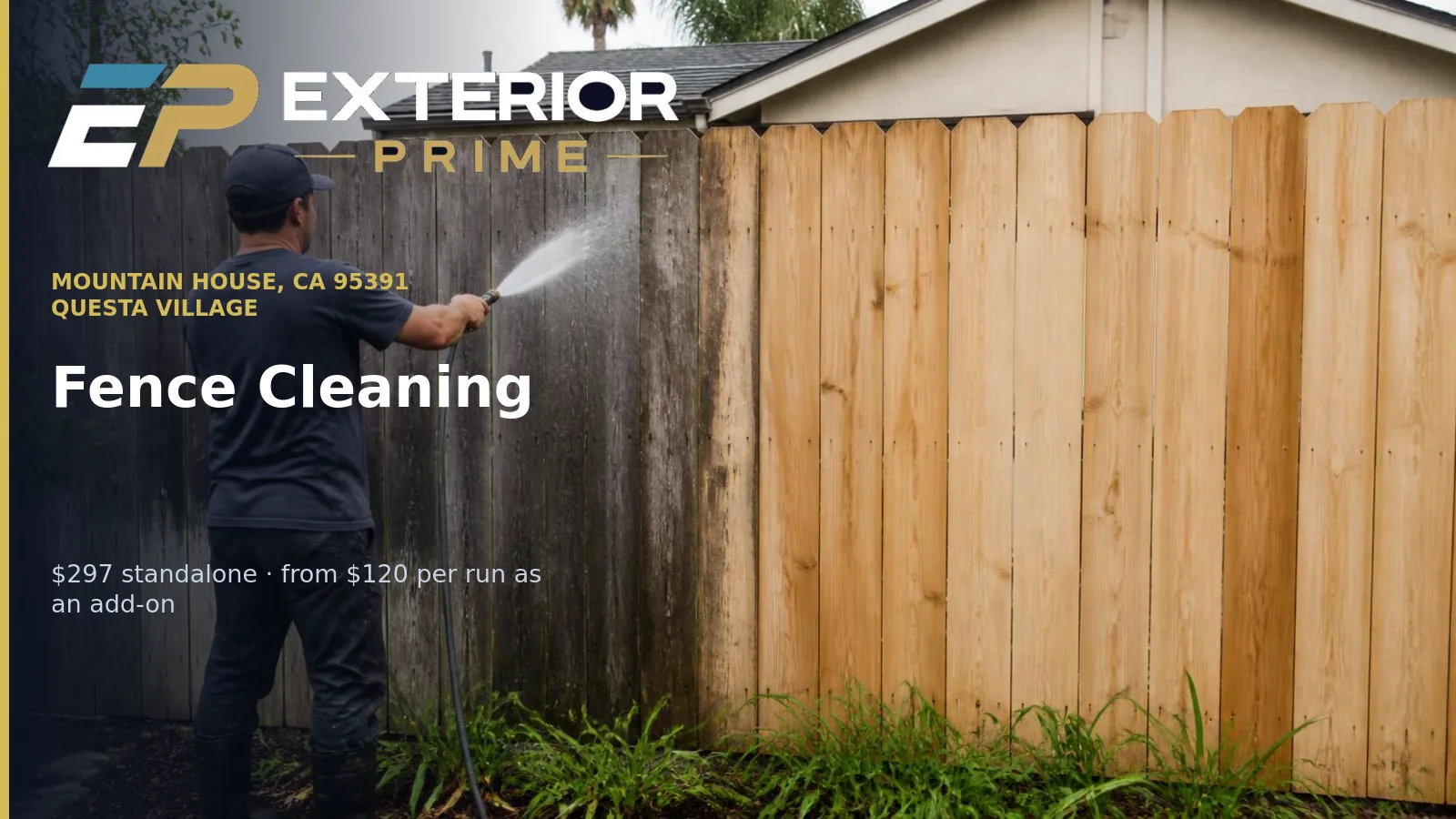
Gray wood is not worn out wood
The silver-gray layer on a Mountain House fence is oxidized surface fiber plus embedded dust, usually under a millimeter thick, and it lifts off with chemistry rather than force.
Homeowners here often price out replacement before they price out cleaning, because the fence looks finished. Pull a board off and look at the back face: on most 95391 fences the sheltered side is still the honey color the wood started as. That is the tell that the fence is dirty and oxidized, not rotten.
Percarbonate solution and dwell time do the work. It lifts oxidation and kills the algae without stripping lignin out of the grain the way a chlorine mix on a wand does. The rinse is a wide fan at low pressure, held far enough back that the fiber lies down instead of standing up.
The one honest limit: cleaning cannot fix a fence that has already lost material. Where a post has gone punky at grade or a board has split through, our professionals will tell you that on the walk-through rather than washing it and letting you discover it later.
Field note 02
The sprinkler line is what actually ruins the bottom rail
Nearly every Mountain House fence has a lawn head throwing district water onto the bottom two boards, which leaves an algae band plus a chalky mineral line right where the wood stays wet.
On the compact village lots the fence sits close enough to the turf that rotor spray reaches it every cycle. Constant wetting with hard water gives you three problems stacked in one strip: living algae, calcium deposit, and wood that never fully dries out between cycles.
Cleaning that band takes a second pass with a different chemistry — the algae comes off with the percarbonate, the mineral needs an acid-side treatment. Doing only the first leaves a visible pale line that homeowners reasonably assume was missed.
The permanent fix is not a cleaning product, it is a quarter turn on the head. Our professionals note which heads are hitting the fence and where, so you can adjust arc before the band comes back next summer.
Field note 03
Vinyl, composite and the shared-fence question
Vinyl and composite fencing in 95391 is washed with a degreaser rather than a wood solution, and shared fence lines are cleaned to the property line unless your neighbour opts in.
Vinyl holds a greasy film of road and wind dust that plain water skates over. A surfactant wash and a soft brush on the rails clears it, and the panels come back to actual white rather than the cream they had drifted to.
Composite boards get the same low-pressure treatment as wood but without any oxidation step — the cap layer is already sealed, so the job is lifting algae and grit out of the embossed grain lines where they sit.
For shared fences, our professionals clean your side and the caps. Plenty of Mountain House neighbours split a both-sides clean once they see one side done, and doing both at once is materially cheaper than two separate visits, since the setup and travel only happen once.
Field note 04
How fence cleaning gets priced and bundled here
Because most Mountain House fence runs land under the $297 standalone minimum on their own, fence cleaning is usually added to a house wash or driveway visit at $120 per run.
A typical village backyard has two side runs and one rear run. Cleaned on its own that is a $297 visit; cleaned the same day as a house wash it is a fraction of that, because you are not paying twice for the run out I-205 and the equipment setup.
Sequence matters. Fences are cleaned after the house walls and before the flatwork, so wall runoff does not land on freshly cleaned boards and the final concrete rinse carries away whatever fell.
If you plan to seal or stain, cleaning is not optional — it is step one, and the wood needs 48 to 72 genuinely dry hours after the rinse before any coating goes on. In Mountain House that means spring or early autumn scheduling, not the week after a storm.