A
What A Nest Cavity Actually Contains
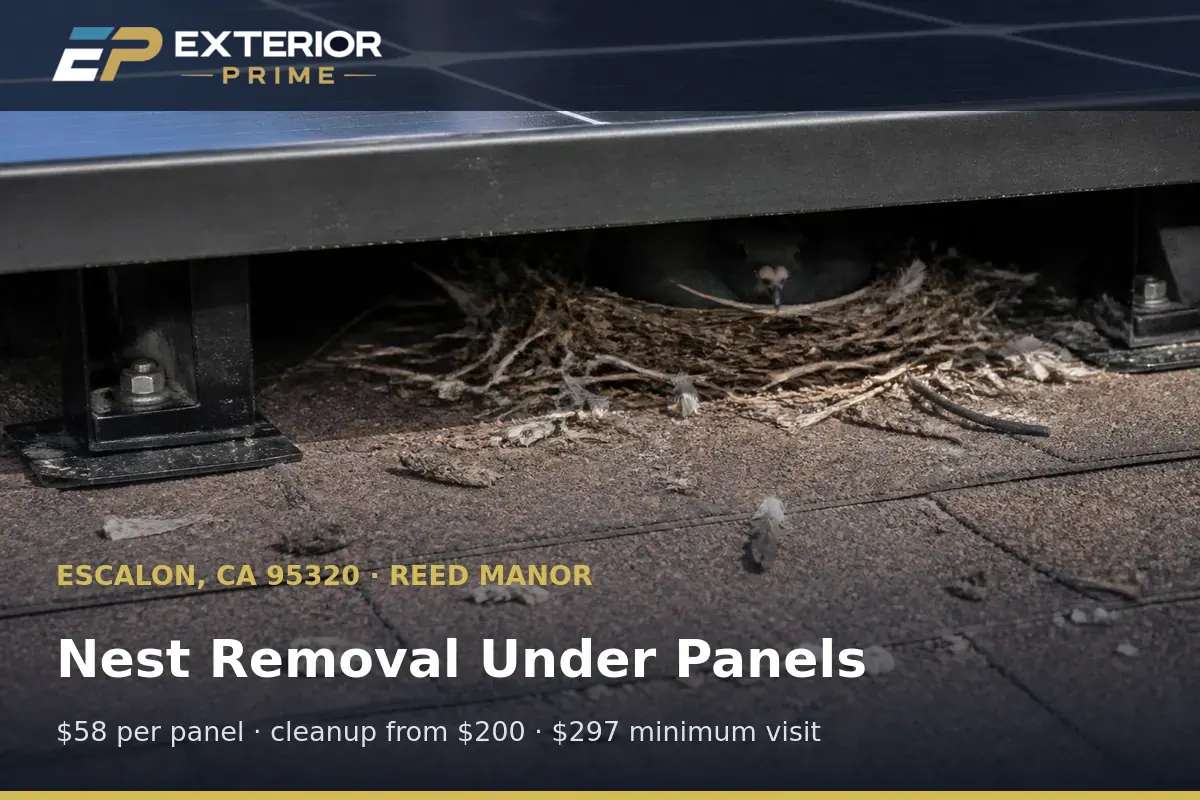
Beyond twigs and straw, an established roosting site typically holds droppings, feather debris and sometimes ectoparasites built up over 1 or more breeding cycles.
A single breeding season under a panel can leave more than nesting material behind. Guano builds up in layers, feather debris packs into the gaps between racking rails, and the whole pocket often carries a population of mites or other ectoparasites that feed on the birds themselves.
On older Rocha Estates homes where arrays sit a bit higher off the roof deck, we've found cavities that had clearly hosted multiple broods across a few years, judging by the layered droppings and the range of nesting material from dry grass to shredded insulation scraps.
That density matters for pricing and for health. Dried droppings are acidic enough to work on roofing granules over time, and disturbing a packed nest without proper handling can send mite populations briefly into the surrounding attic space or eaves.
B
Why Does DIY Removal Often Backfire In Escalon?
Disturbing a nest without sealing the cavity afterward almost guarantees the same spot gets reoccupied within 2 to 4 weeks.
Homeowners sometimes clear visible nesting material themselves, then find droppings and straw back under the array within 4 to 6 weeks. The reason is simple: removing the nest doesn't remove the appeal of the spot. A dry, warm cavity near almond and walnut orchards outside Escalon 95320 stays attractive to the next passing pair unless it's physically closed off, and hot, dry summers only sharpen the appeal of that shaded pocket.
There's also a safety angle. Lifting panel edges or reaching under racking without training risks damaging module clips or microinverter wiring, and a cracked seal on even 1 panel can turn a bird problem into a warranty claim on the solar system itself.
Exterior Prime professionals handle removal and the follow-up exclusion mesh as one coordinated job, which is why the cavity stays sealed after the visit instead of reopening once fledglings from a second brood arrive.
C
The Sanitizing And Cleanup Process
Reachable material is bagged and hauled off, the deck is rinsed, and the array glass is soft washed in 1 pass before mesh closes the gap.
Cleanup starts with bagging every piece of reachable nesting material and droppings directly on the roof, so nothing gets pushed into gutters along the eave or dropped onto a walkway below. Bags are carried down and removed from the property the same visit.
The roof deck beneath the array gets rinsed to lift acidic residue before it can etch into shingles or flashing metal, a step that matters more on older Main Street-area homes with worn granule coverage. The panel glass itself is soft washed afterward, which on more than one San Joaquin County job has visibly restored output that the homeowner had written off as normal panel aging.
Sanitizing addresses what rinsing alone can't: mite and ectoparasite presence left behind once the birds are gone. Only after the cavity checks clean does the mesh installation begin, so nothing gets sealed inside the array.
D
Preventing A Repeat Nest After Removal
Galvanized mesh clamped to the module frame closes the cavity permanently within about 1 visit once cleanup is finished.
Removal without exclusion is a temporary fix. Once the cavity is clean, closing it with mesh is what actually stops the cycle, because the underlying appeal of a shaded, dry pocket near Escalon Community Park, Silverwood, or any orchard-adjacent lot doesn't go away on its own, especially once tule fog settles in for winter mornings.
Mesh is clamped to the aluminum module frame with stainless spring clips, never drilled or glued, so the manufacturer solar warranty stays intact through the process. That barrier typically runs $58 per panel and completes the same visit as the cleanup on most single-plane roofs.
The finished exclusion area carries a five-year workmanship warranty, so if a seam ever opens or a clip lifts, a return visit corrects it rather than the homeowner discovering a fresh nest a year later.