A
What separates real exclusion mesh from hardware-store netting?
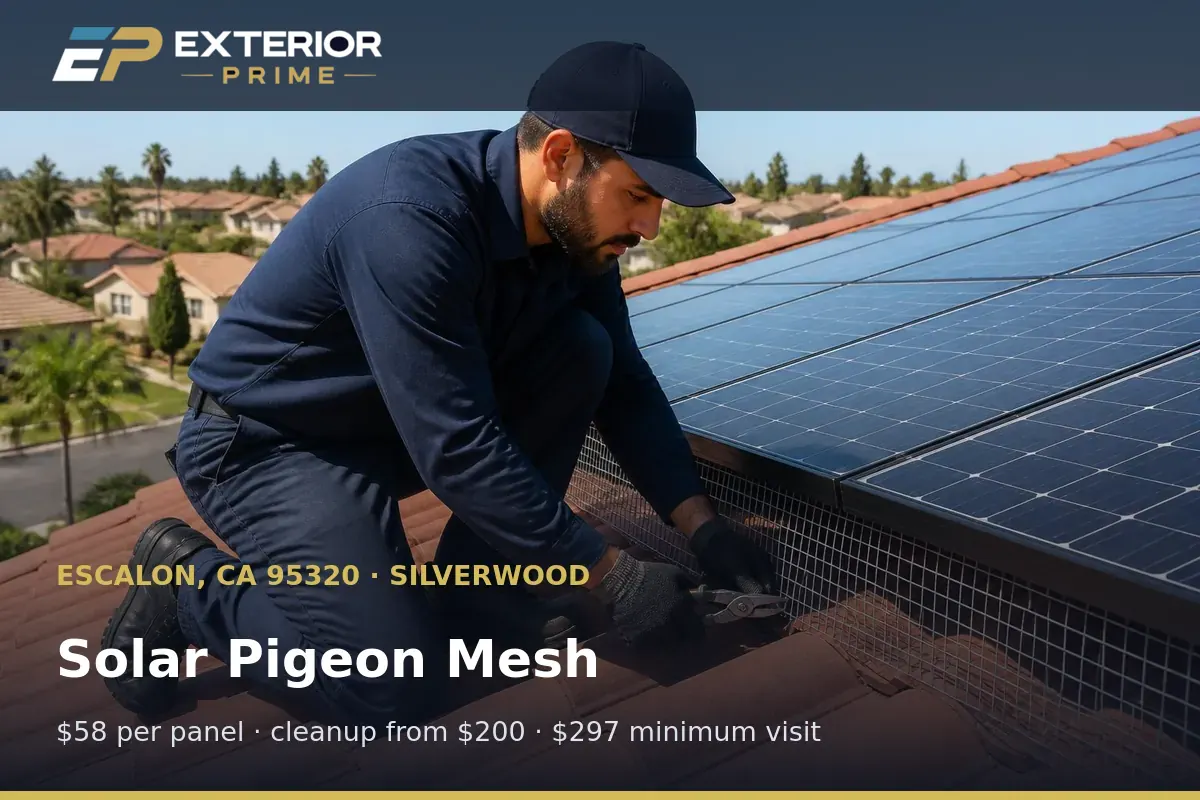
Galvanized steel mesh clamped to the frame outperforms lightweight plastic or nylon netting on nearly every measure that matters in Escalon's climate.
Hardware-store bird netting is usually a thin nylon or plastic weave designed for temporary garden use, and it stretches, sags and tears within about 1 season of exposure to Central Valley sun and wind. Galvanized steel mesh, by comparison, holds its shape and tension through 5 or more years of repeated thermal cycling without the sagging that creates new gaps.
Fastening method matters as much as the mesh material itself. Adhesive-mounted netting relies on glue that softens in summer heat, and panel surface temperatures in Escalon regularly climb well past 100 degrees on July and August afternoons, which is more than enough to loosen most consumer-grade adhesives within a single season.
Stainless clips clamped to the aluminum module frame avoid that failure mode entirely, since the clamp mechanism does not rely on temperature-sensitive adhesive to hold its grip. This is also why Exterior Prime backs a clamped install with a 5-year workmanship warranty, while adhesive netting products typically carry none.
The weave size matters too: mesh cut too wide lets pigeons squeeze through at the corners, while mesh sized correctly for pigeon exclusion blocks entry without restricting the airflow modules need for cooling. Exterior Prime professionals check weave size on every Escalon 95320 array before cutting the first section.
B
How mesh is measured and cut for a specific array
Every Escalon mesh install is custom-measured to the array's actual outline rather than cut from a generic pre-sized roll.
Technicians measure each panel row individually, noting where the racking rail meets the roof deck at every corner return, since that junction is the most common point a pigeon exploits if it is left uncovered. A generic pre-cut mesh sheet rarely matches this junction precisely, and Exterior Prime has measured arrays from Jones Road to McHenry Avenue where an off-the-shelf sheet missed the gap by 2 or 3 inches.
Conduit runs, microinverter housings and roof penetrations under the array each require a custom cutout in the mesh so the finished barrier sits flush rather than tenting up around an obstruction. On a home near Silverwood or Vintage Estates with a retrofit inverter added after the original install, this step often takes longer than the straight-run sections.
Cutting mesh to exact size rather than stretching a single roll across the array also keeps tension even, which matters on older stucco-tract roofs near Escalon-Bellota Road where the roofline is not perfectly straight. Uneven tension is one of the more common reasons a lower-quality install sags and opens a gap within 1 year.
Once cut, each section is dry-fitted before final clamping to confirm coverage of every edge, valley and corner before the mesh is permanently secured to the module frames.
C
Clip spacing and how the mesh holds through Escalon's seasons
Clips are spaced closely enough along the perimeter that no section of mesh is left unsupported through wind, heat or winter damp.
A typical 18-panel Escalon array uses roughly 75 to 85 stainless clips spaced evenly along the mesh perimeter, which keeps any single section from bowing or pulling loose under wind load. Wider clip spacing is one of the shortcuts that lower-cost installs sometimes take, and it is one of the more common causes of premature mesh failure.
Winter Tule fog and cooler temperatures across the Escalon flats cause metal components to contract slightly, while summer heat near almond orchards causes the same components to expand, and this cycle repeats every year. Stainless clips are chosen specifically because they resist the fatigue that cheaper fasteners develop under this repeated cycling.
Hard well water common in parts of Escalon and the surrounding county can accelerate corrosion on lower-grade metals, which is part of why galvanized mesh and stainless clips are used rather than standard steel components that would rust faster in that environment.
The completed installation is designed to be maintenance-free for years at a time, though the 5-year workmanship warranty means any clip that does work loose or any seam that opens within that period is corrected on a return visit at no charge for any Escalon 95320 homeowner.
D
Inspecting mesh on an older, previously installed system
Escalon homes with mesh installed by a previous provider sometimes need a full inspection before any additional work, since fastening quality varies widely between installers.
Technicians occasionally find older mesh systems on Escalon homes that were installed with zip ties, adhesive, or fasteners driven directly through the roof rather than clamped to the module frame, any of which can create the leak risk or warranty issue a proper install is meant to avoid. Exterior Prime has found this on roughly 1 in 5 inspected arrays.
When this is found, the existing mesh is evaluated for whether it can be re-secured with proper clamps or needs to be fully replaced, and either option is explained to the homeowner with pricing before any work proceeds. This inspection is included as part of the standard survey rather than billed as a separate charge.
Corroded or sagging older mesh is also a sign that pests may already be finding gaps in a system that looks intact from the ground. A close inspection from the roof frequently reveals small openings at corners or along seams that were never fully closed in the original install.
Replacing a failed system with properly clamped galvanized mesh restores both the physical barrier and the warranty coverage that an inadequate prior install never provided in the first place, usually within 1 to 2 hours on a standard 18-panel Escalon roof.