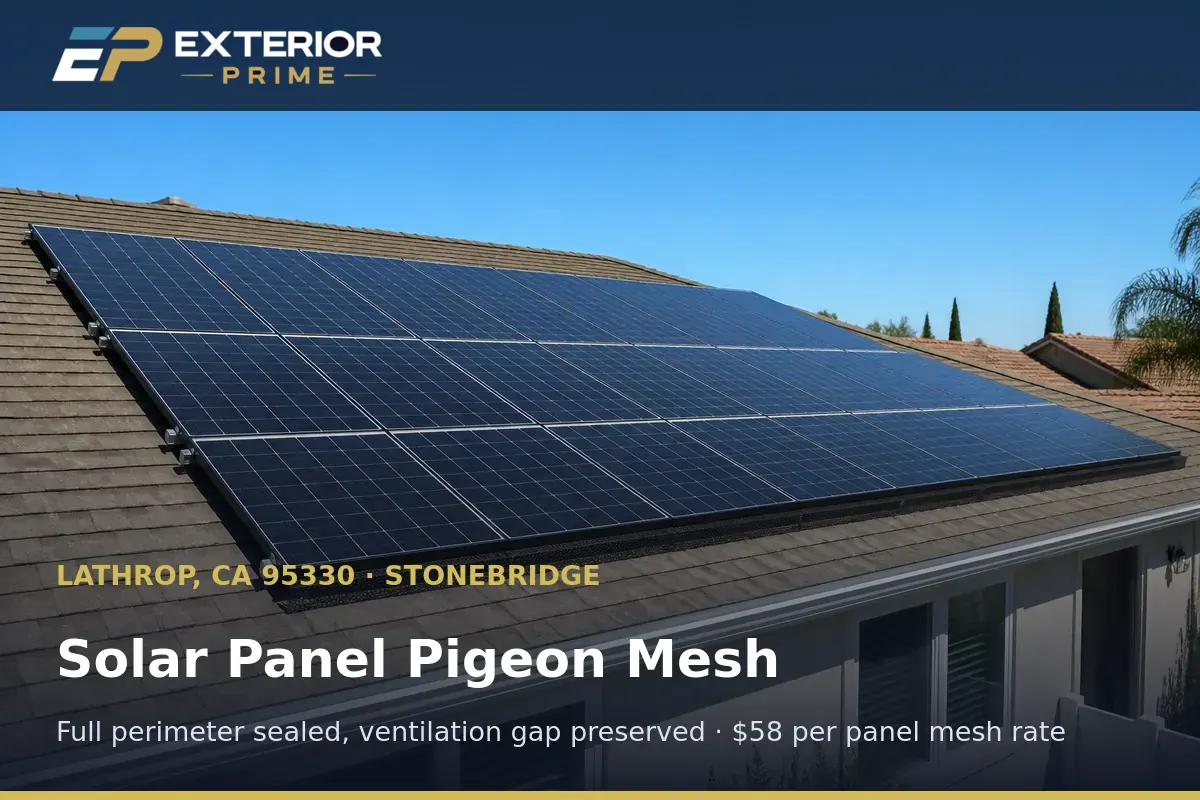
Why does Lathrop have such a persistent pigeon problem?
The San Joaquin River, the Mossdale crossing, and nearby delta levees give Lathrop a large resident pigeon population, often 15 to 20 birds per roosting site, that regularly moves onto rooftops.
Pigeons roost along river structures and levee edges within a mile or two of Dos Reis Road, then range out into residential neighborhoods looking for sheltered nesting spots. A solar array is close to ideal for them — raised off the roof deck, shaded underneath, and largely undisturbed unless someone climbs up to look.
This is different from a lot of Central Valley cities without major river access nearby. Lathrop's pigeon pressure tends to be steadier across all 12 months rather than seasonal, because the river population never fully disperses even in winter fog.
We've meshed 30-plus arrays in River Islands where the homeowner never saw a pigeon land on the roof itself, yet found an active nest under the panels within the first year of ownership. The birds don't need to be visibly perching on your house to find the gap under an array.
Because of this steady pressure, we generally recommend Lathrop homeowners within about 2 miles of the river corridor or in Mossdale Landing install mesh proactively rather than waiting for the first nest to show up.
How is pigeon mesh different from bird mesh for smaller species?
Pigeon mesh uses the same 0.5-inch aperture as general bird mesh, but clip spacing and tension are set tighter since pigeons are heavier and push harder against loose sections.
A sparrow weighs about an ounce; a pigeon can weigh a pound or more. That difference matters for how tight the mesh needs to sit against the panel frame, because a pigeon will lean its body weight into a loose corner repeatedly until it works a gap open.
We tension pigeon mesh installs slightly more than a general songbird job, and we check corners twice during installation rather than once, since corners are where a determined pigeon eventually gets through if the clip spacing is too wide.
For a 20-panel Woodfield array, this typically means an extra 8 to 10 clips compared to a job aimed only at smaller birds, which adds modestly to labor time but not to the base $58-per-panel rate.
We've re-meshed at least 6 Lathrop roofs originally done by other companies using standard clip spacing meant for smaller birds, only to have pigeons force their way back in within 2 to 3 months. Getting the tension right the first time avoids that repeat visit.
Can pigeons already living under my panels be removed safely?
Yes — Exterior Prime removes nests and droppings using physical exclusion only, with no poison, gels, or trapping involved at any point.
Once pigeons establish a nest under an array, droppings and nest material build up quickly, sometimes covering conduit runs and creating a genuine mess for a technician to deal with later. Cleanup is quoted from $200 after we survey the roof and assess how much material has accumulated.
We wear protective gear during cleanup because pigeon droppings and nest debris can carry mites and other ectoparasites, and dried guano dust isn't something anyone should breathe without protection. This is standard practice on every job, not an upcharge.
After cleanup, we sanitize the affected area before mesh goes in, which matters both for hygiene and because leftover nest material can attract a new nesting pair even after the original birds are gone.
The whole process, from cleanup through mesh installation, usually finishes within a single day for a typical Lathrop home, though heavily fouled arrays with years of buildup can occasionally need a follow-up visit.
What is Exterior Prime's warranty on pigeon mesh?
Exterior Prime backs every pigeon mesh installation with a five-year workmanship warranty covering the treated exclusion zone around your array.
That five-year warranty covers the mesh and clips specifically — if a section comes loose or a clip fails due to installation quality rather than storm damage or vandalism, we return and fix it at no charge within the five-year window.
This matters more in Lathrop than some other Central Valley cities specifically because of the sustained pigeon pressure from the river corridor. A weak install that might hold up fine in a lower-pressure city can fail within 1 year here simply because more birds are testing it.
We document every install with photos at completion, which makes any future warranty claim straightforward across the full 5-year term, whether the original professionals or a different Exterior Prime technician handles the follow-up visit.
Roof and panel manufacturer warranties remain separate and untouched, since our clip-on method never penetrates the roof deck or the module frame itself.