Why do squirrels and roof rats target solar arrays in Lathrop?
Homes near almond orchards, ag fields, and mature landscaping give squirrels and roof rats easy roof access, and the shaded space under panels makes an ideal nesting spot.
Lathrop's edges, particularly properties near surrounding row crops and almond orchards, see more rodent and squirrel pressure than denser urban tracts. Tree branches overhanging a roofline give squirrels a direct path onto the array without ever touching the ground near the house.
Roof rats, common where hardpan soil pushes rodents toward roof shelter, are a slightly different problem — they're excellent climbers and can access a roof via utility lines, fences, or even stucco texture on an exterior wall. Once on the roof, the space under a solar panel offers the same shelter and warmth a pigeon nest would, just with a different tenant.
We've serviced River Islands homes where a homeowner assumed the scratching sounds under their array were birds, only to find gnawed wiring insulation and rat droppings once we got a camera under the panels. That kind of damage can affect microinverter wiring, which becomes a real cost beyond just the nuisance.
Because Lathrop sits close to open agricultural land on several sides, critter guard here often does double duty compared to a denser city block, protecting against both airborne and climbing pests with the same install.
Does the same mesh really stop squirrels as well as birds?
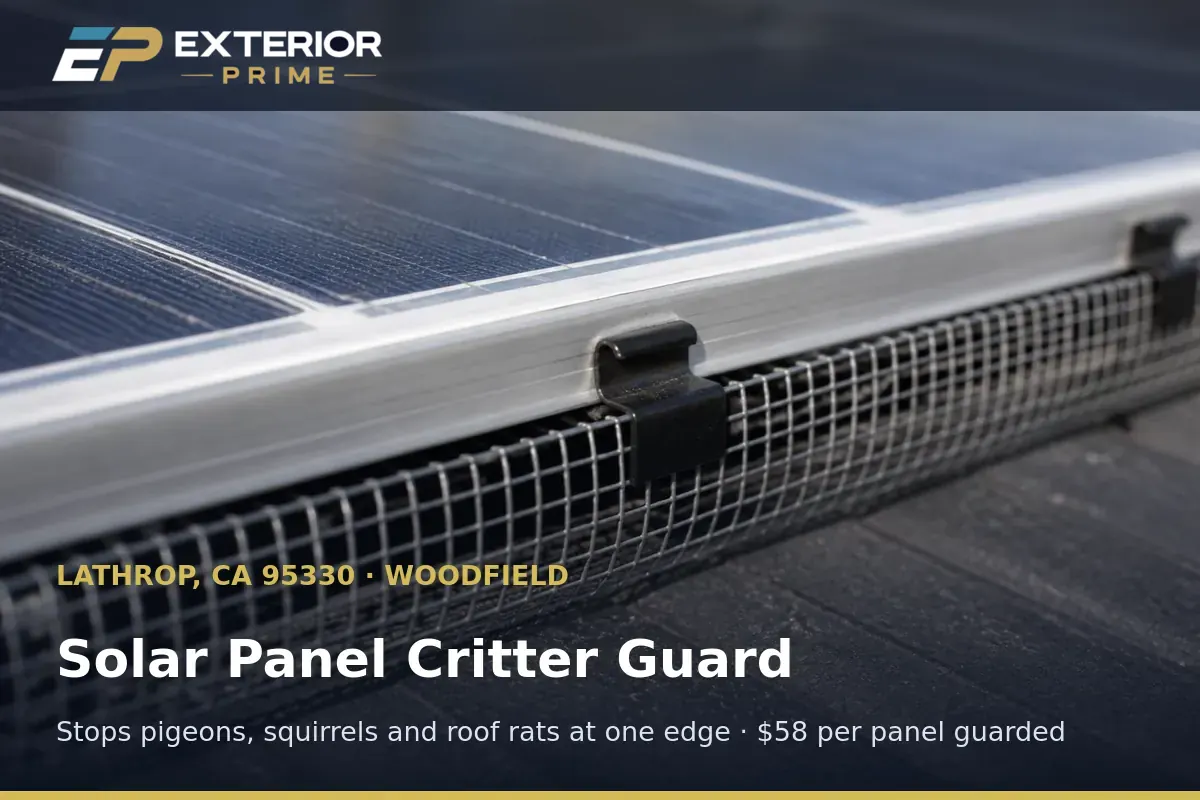
Yes — the half-inch galvanized mesh Exterior Prime uses is sized to block sparrows while also being too small and too tough for a squirrel to gnaw through easily.
Squirrels can chew through some lighter mesh materials over time, but galvanized wire mesh at the gauge we install resists that kind of persistent gnawing far better than plastic netting or thin aviary wire. We've seen plastic bird netting shredded by squirrels within a single season on Lathrop roofs where a previous company used the wrong material.
Roof rats, being smaller and more flexible than squirrels, are actually the pest most similar in size to the birds the mesh was originally designed to stop, so the half-inch aperture handles them without any modification.
For properties with heavier squirrel pressure, such as homes with mature oak or almond trees close to the roofline, we sometimes recommend slightly denser clip spacing purely for extra rigidity against repeated gnawing attempts, at no change to the base $58-per-panel price.
The stainless clips also matter here specifically — a squirrel that finds a loose or corroded clip will work at that weak point relentlessly, so using stainless rather than a cheaper plated steel avoids giving them anything to exploit over the five-year warranty period.
How do I know if it's birds, squirrels, or rats under my panels?
Scratching and rustling sounds usually mean squirrels or rats, while cooing and soft fluttering point to birds, and Exterior Prime confirms with a camera before quoting cleanup.
Squirrels tend to be active during daylight hours, so scratching sounds that happen mid-morning or afternoon are more likely squirrel activity. Roof rats, being nocturnal, usually show up as noise after dark, often described by Lathrop homeowners as scurrying right after sunset.
Droppings differ too — rodent droppings are small, dark, and pellet-shaped, while bird droppings are typically whitish and more liquid. We don't guess based on description alone; our professionals use a small inspection camera to look under the array before recommending a cleanup plan.
Sometimes it's more than one pest at once. We've found a pigeon nest and a separate rat nesting area under the same 24-panel array on a Stonebridge property, which required a slightly longer cleanup than a single-species job.
Once we know exactly what's under there, the cleanup approach is tailored accordingly, though the mesh installed afterward is the same critter guard system regardless of which pest it's excluding.
What does critter guard cost compared to bird-only mesh?
Critter guard costs the same $58 per panel as standard bird mesh in Lathrop, since it's the identical galvanized material doing double duty.
There's no separate 'critter' product line and no upcharge for the added protection against squirrels and roof rats — the half-inch galvanized mesh and stainless clips we already use for pigeons handle all three pests without modification in most cases.
The only added cost tends to come from cleanup, which can run slightly higher than a bird-only job if a rodent nest has caused more extensive debris or chewed insulation that needs addressing before mesh goes in. That's still quoted from $200 and confirmed after inspection.
For a typical 20-panel Lathrop array with no existing pest activity, expect the same $1,150 ballpark as any other mesh job, landing within the usual $750 to $1,400 range depending on roof layout.
Because it's one universal system, homeowners who mesh proactively before any pest problem shows up get full protection against birds, squirrels, and rats from day one, rather than needing to add coverage later if a different pest shows up.