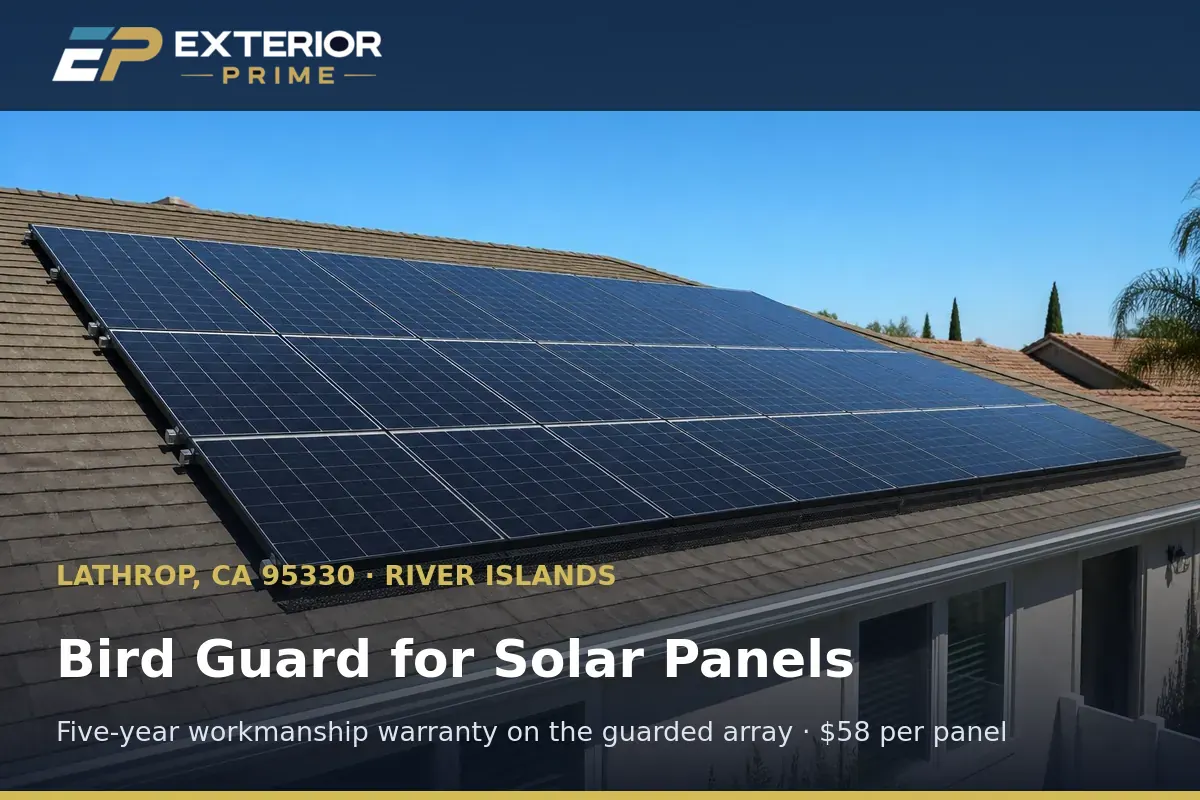
Why does Lathrop need bird guards more than other Central Valley cities?
River Islands and the Mossdale crossing sit right along the San Joaquin River, and delta-adjacent pigeon and starling populations are unusually dense here.
Lathrop's geography is the difference. The city sits where the San Joaquin River bends past Dos Reis Road, and that river corridor is a highway for pigeons moving between roosting cliffs, levee brush, and residential rooftops. A home in River Islands with a west-facing array can see a pigeon pair inspect the panel edge within days of installation, long before a nest ever appears.
Add to that the newer construction pace. River Islands and Mossdale Landing have added thousands of rooftop-solar homes in the last decade, and a fresh, untouched racking system with no guard is the easiest nesting cavity around, easier than an older Historic Lathrop composition-shingle roof where birds already have established colonies elsewhere.
Tule fog settles into the Central Valley most winter mornings and keeps the underside of a panel array damp and shaded for hours, which pigeons actually prefer over an exposed, sun-baked eave. That microclimate under a 24-panel Woodfield roof stays 10-15 degrees cooler than open shingle in July, another reason birds pick the gap under solar over anywhere else on the property.
What does a bird guard actually stop?
A properly clipped guard blocks entry into the four-inch gap entirely, preventing nest debris, droppings, mites, and chewed wiring before any of it starts.
Without a guard, that narrow gap under the panels becomes a self-contained ecosystem. A single breeding season can leave behind 15-25 pounds of sticks, guano, and feather debris packed against the racking rails, and that load doesn't just smell bad, it holds moisture against galvanized rail connections and accelerates corrosion.
Once droppings accumulate, ectoparasites follow. Bird mites and other ectoparasites breed in the nest material and, when the birds fledge or move on, migrate looking for a new host, sometimes finding their way into attic insulation on an older Lathrop Road home. Pest-control callouts for mite complaints near active roof nests aren't rare in San Joaquin County.
Pigeons and their nestlings also chew and rub against anything in reach, including microinverter leads and conduit runs zip-tied along the rail. Exterior Prime has replaced chewed conduit jacketing on more than one Golden Valley Parkway home where a guard was never installed after the original solar hookup.
A guard installed before any of this starts costs a fraction of the cleanup. Exterior Prime's mesh is 100% physical exclusion, galvanized wire clipped with stainless clips, no bait, no poison, no gels, no trapping, so it stops the whole chain at the entry point.
How is the bird guard installed on my Lathrop roof?
Exterior Prime measures the array perimeter, custom-cuts galvanized mesh, and clips it to the module frame with stainless clips, adding zero roof penetrations.
The process starts with a roof survey, usually 20-30 minutes for a typical 20-panel Lathrop array. Our professionals check pitch, existing gap height (commonly 3-5 inches on tilt-up racking common in River Islands), and note any active nesting already in progress.
Mesh is then cut to match each edge run and clipped directly to the aluminum module frame using stainless steel clips rated for outdoor exposure. Nothing is screwed, glued, or drilled into the roof deck or the panel itself, which keeps both your roofing warranty and your solar manufacturer's warranty fully intact.
On homes with multiple roof planes, common in Stonebridge where garage wings sit at a different pitch than the main roof, we run separate mesh sections and seam them at the corners so there's no gap a determined pigeon can squeeze through.
Every install finishes with photo documentation and our five-year workmanship warranty on the treated zone, so if a seam ever loosens from summer heat cycling above 95 degrees, Exterior Prime returns and resets it at no charge.
What does it cost to guard a Lathrop solar array?
Installed mesh runs $58 per panel, so a typical 20-panel Lathrop home lands between $700 and $1,400 once perimeter length and pitch are factored in.
Pricing scales with linear feet of perimeter, not just panel count, so a long, narrow 18-panel array on a Historic Lathrop ranch home can cost more than a compact 24-panel array in Mossdale Landing with a tighter footprint.
If pigeons have already nested, cleanup is quoted separately starting from $200 after the roof survey, since debris volume varies enormously between a single-season nest and a multi-year colony.
Every job, guard-only or guard-plus-cleanup, is subject to Exterior Prime's $297 standalone minimum visit, which covers mobilization, insurance, and commercial equipment, though that minimum is absorbed into larger array quotes rather than charged on top.