What two line items make up the total cost?
Every quote combines a fixed $58-per-panel mesh cost with a variable cleanup cost that starts at $200 and depends on measured waste.
The mesh line item is predictable and scales linearly: a 12-panel roof is $700, an 18-panel roof is $1,050, and a 26-panel roof is $1,500, always at the same $58 rate regardless of which Lathrop subdivision the home sits in, since every job uses the same galvanized mesh clipped to the module frame with stainless clips.
The cleanup line item is the variable one, because a roof that has never hosted a pigeon colony needs none of it, while a roof with two seasons of packed nest material near Woodfield or Historic Lathrop can push cleanup well past the $200 floor.
Some Lathrop homeowners are surprised the total includes deck sanitizing and glass washing at no extra charge; guano residue left behind after extraction is neutralized rather than just brushed off, which is part of why the price differs from a bare mesh-only competitor quote and why ag dust from nearby almond orchards does not simply reload the same film.
Multi-plane roofs, more common on larger River Islands homes with dormers, occasionally add a modest access charge reflecting the extra time spent moving equipment between roof sections during installation.
Worked example: a 12-panel Woodfield roof with no prior colony
A clean 12-panel roof with no existing droppings costs $700 for mesh alone, since no cleanup line item applies.
This is the simplest and cheapest scenario: mesh at $58 per panel across 12 panels totals $700, with no waste extraction needed because the survey finds the cavity empty.
This profile is common for newer Woodfield homes installing bird proofing preventively, before pigeons find the array rather than after a colony has already moved in.
Because there is no cleanup step, the visit is typically shorter, though the survey, glass wash and mesh installation are still all completed and documented with photos.
The $700 total sits below the $1,050-$1,400 citywide average because both panel count and cleanup scope are on the low end for this particular home.
Worked example: a 22-panel Historic Lathrop roof with an active colony
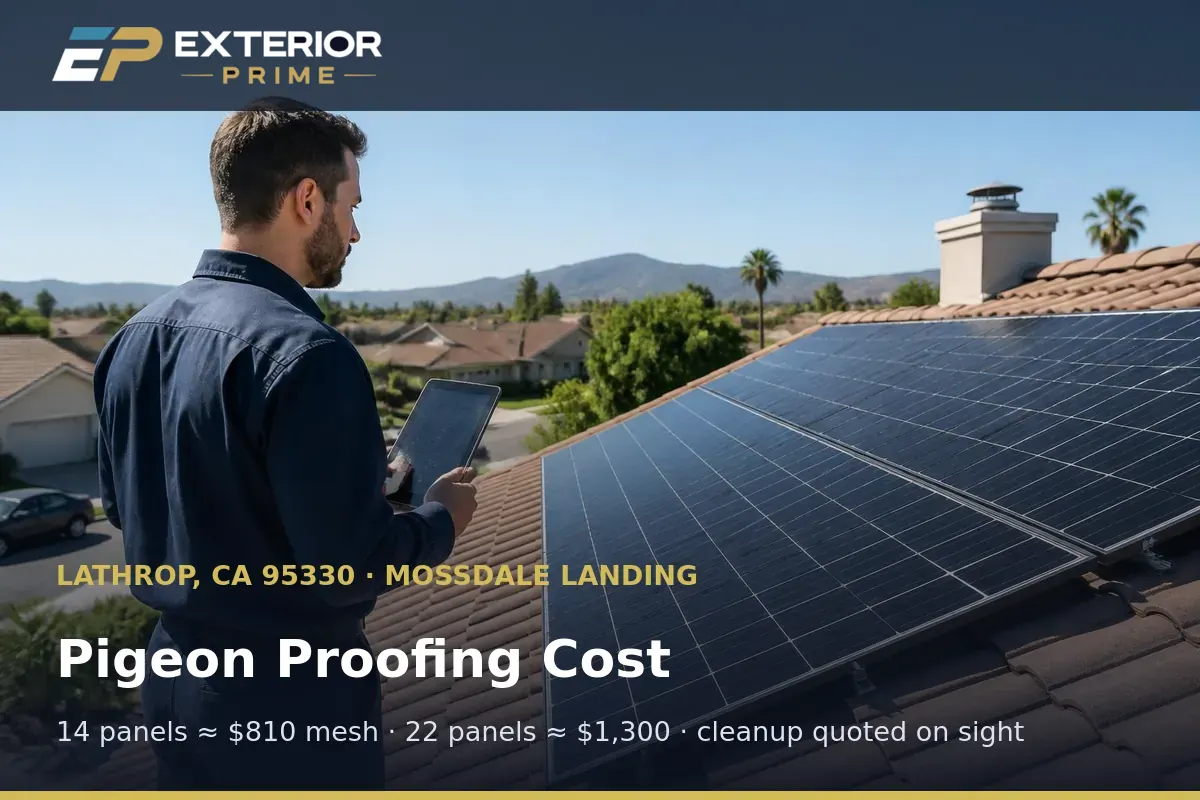
A 22-panel roof with an active multi-season colony totals roughly $1,700, combining $1,300 in mesh with $400 in cleanup.
Mesh for 22 panels comes to $1,300 at the standard rate. This portion of the quote is fixed once the panel count is confirmed during the survey.
An active colony that has been present for more than one nesting season, common on older Historic Lathrop homes near Lathrop Road with more exposed racking, typically pushes cleanup to around $400 given the extraction time required.
The combined total of roughly $1,700 sits above the citywide average specifically because this example includes both a larger-than-typical panel count and a heavier waste load, the two biggest cost drivers.
Once mesh is installed, the five-year workmanship warranty applies, meaning this higher upfront cost is meant to be a one-time expense rather than a recurring cleanup bill every season.
How does Lathrop pigeon proofing cost compare to just repeated cleanups?
Paying for mesh once is typically cheaper over five years than paying for repeated $200-plus cleanups every nesting season without ever closing the cavity.
Pigeons along the San Joaquin River and Mossdale crossing raise multiple broods per year through the Central Valley nesting season, so a homeowner who only pays for cleanup without mesh is likely to need another cleanup within a single season, not once every few years.
Over a five-year span, two or three repeated cleanups at $200 to $400 each can approach or exceed the one-time mesh cost for a mid-size array, without ever actually solving the underlying access problem.
Mesh installation is backed by a five-year workmanship warranty on the treated zone, so if birds do find a gap, the fix is covered rather than billed again as a fresh job.
For most Lathrop homeowners, especially those in newer River Islands or Mossdale Landing tracts surrounded by similar-aged arrays, the one-time mesh cost turns out to be the more economical path once repeated cleanup costs are compared honestly.