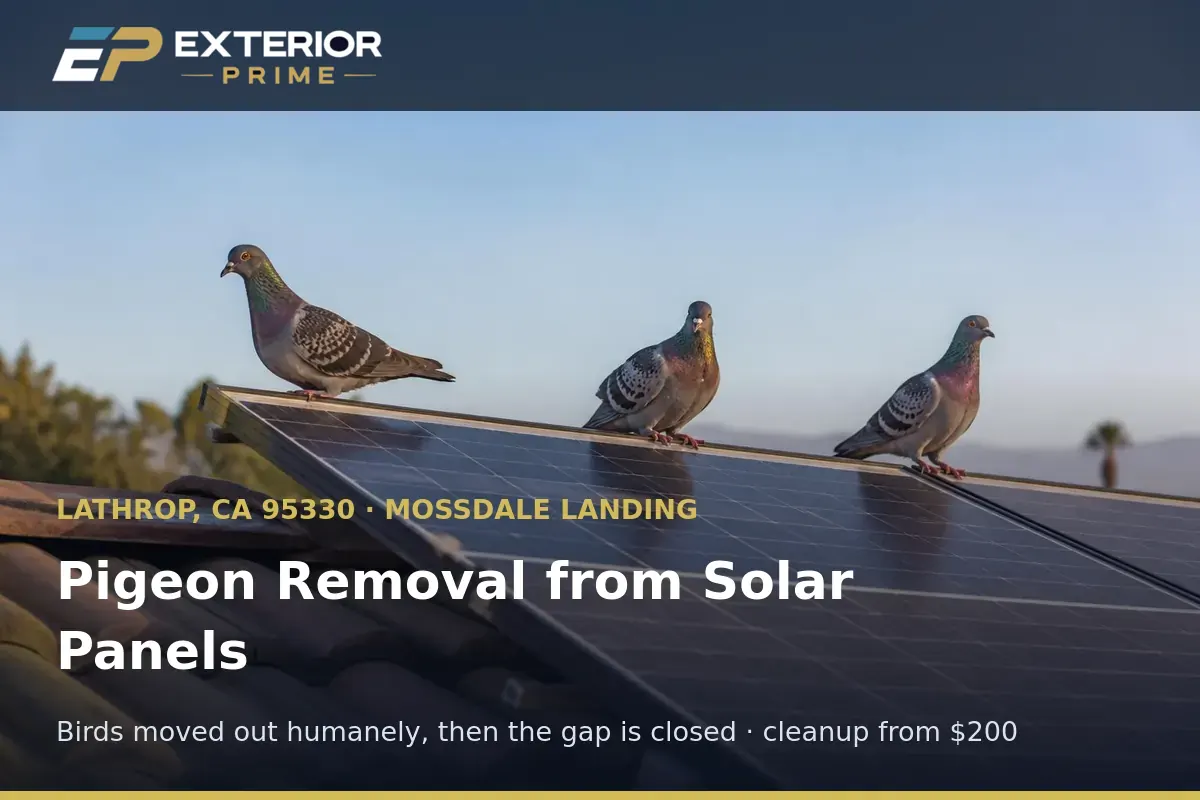
Is it legal to remove a pigeon nest from solar panels in Lathrop?
Feral pigeons aren't a protected species in California, but responsible removal still means confirming no eggs or flightless chicks are present before disturbing the nest.
Domestic and feral pigeons (Columba livia) don't carry the same federal Migratory Bird Treaty Act protections as native songbirds, which is a common point of confusion for Lathrop homeowners. That said, Exterior Prime still treats every job the same way across all 95330 service calls: check the nest first, confirm what's in it, and plan the work around that.
Breeding season in the Central Valley runs roughly February through October, with peak activity in spring and again in early fall after the worst summer heat. A River Islands homeowner who calls in June is more likely to have active chicks under the array than one who calls in December, and that changes our timeline, sometimes by just a few days, sometimes by two to three weeks until chicks fledge. Summer ag dust drifting off surrounding row crops also settles into the same gap, adding a second reason to inspect all 8-10 linear feet of a typical Lathrop array perimeter, not just the noisy section.
Our professionals document nest contents with photos before touching anything, both to plan the safest removal and to give you a clear record of what was actually under your panels, since 20-year-old shingles near Lathrop Road sometimes hide surprising volumes of debris.
How does Exterior Prime sequence a pigeon removal job?
We inspect first, wait out active broods when legally and practically necessary, extract debris by hand, sanitize the cavity, then install exclusion mesh in the same visit.
Step one is always inspection. Our professionals get eyes on the nest with a mirror pole or by carefully lifting a panel edge, checking for eggs, down-covered chicks, or fully feathered fledglings almost ready to leave on their own, which usually happens within a week or two once feathering is complete.
If chicks are close to fledging, we schedule the extraction visit just after they leave rather than displacing them early, since orphaned chicks under an array create a worse mess and a longer problem. If the nest is old debris with no live birds, cleanup happens immediately.
Extraction itself is done by hand with gloves and a respirator, since dried guano and nest material can carry histoplasmosis spores. Everything gets bagged and removed from the property, not just pushed to the roof edge, and a typical bag load runs 2-3 full contractor bags on a first-season nest.
The final step, sanitizing, matters more than most homeowners expect. We treat the cavity and racking rails for residual mites and ectoparasites before mesh goes on, because sealing live mites inside a freshly meshed gap just relocates the problem into your attic insulation instead of solving it.
What happens if I skip professional removal and just scare the pigeons off?
Scaring pigeons without removing the nest or sealing the gap usually just relocates the problem to a neighboring roof plane for a few weeks before they return.
Pigeons are strongly nest-site loyal. A pair that's raised two broods under your Woodfield array over the summer will keep returning to that exact gap even after a scare tactic, spinner, or reflective tape works for a week or two, because the nest structure itself is still there as an invitation, and 9 times out of 10 the birds are back within 30 days.
Leaving old nest material in place also keeps attracting new pairs even if the original birds move on permanently, since the smell and the physical nest cup signal 'proven safe site' to any pigeon scouting the neighborhood, from Dos Reis Road river access up through Golden Valley Parkway.
That's why Exterior Prime always pairs removal with exclusion. Scaring tactics without mesh solve the problem for a matter of weeks; mesh with stainless clips and a five-year warranty solves it for years.
What does pigeon removal cost in Lathrop?
Cleanup starts from $200 depending on debris volume, and exclusion mesh is $58 per panel, with most full-service jobs landing between $700 and $1,400 total.
A single-season nest on a Stonebridge home is usually a quick, lower-cost cleanup, while a multi-year colony on an older Historic Lathrop roof with several active gaps can take our professionals considerably longer and cost more on the cleanup line specifically.
The $297 standalone minimum applies if removal is the only service requested, but most homeowners bundle removal, sanitizing, and mesh installation into one visit, which is more cost-effective than three separate trips.