Why physical exclusion beats poison or trapping
Physical exclusion permanently blocks access to a roosting site, while poison and trapping only remove the birds present today, leaving the space open for new arrivals.
Poison and gel repellents create ongoing liability and rarely solve a Lathrop pigeon problem long term — birds killed or repelled from one spot are quickly replaced by others from the same delta-fed population near the San Joaquin River. Trapping has a similar issue: it removes today's birds but does nothing to stop tomorrow's from finding the same open gap.
Physical exclusion works differently. Once galvanized mesh, netting, or a vent guard closes off a roosting site, it stays closed regardless of how many new pigeons move through the neighborhood. That's a meaningful difference in an area like Lathrop, where regional population pressure from the river and surrounding agricultural land stays elevated year-round.
Exterior Prime doesn't use poison, bait, gels, or trapping on any Lathrop job — not on solar arrays, not on eaves, not on patio covers or attic vents. Every method our professionals use is physical: mesh, netting, clips, or fitted guards that block access without harming the birds or creating a hazard for pets and children using the yard.
This also matters for homes near Crossroads and Golden Valley Parkway with young families or dogs — a mesh barrier carries zero risk of accidental poisoning, unlike bait stations that sometimes get placed in accessible spots.
What does pigeon control actually involve at each site?
Solar arrays get galvanized mesh clipped to the module frame, patio covers get netting across beam gaps, tile roofs get bird stops, and attic vents get fitted wire guards.
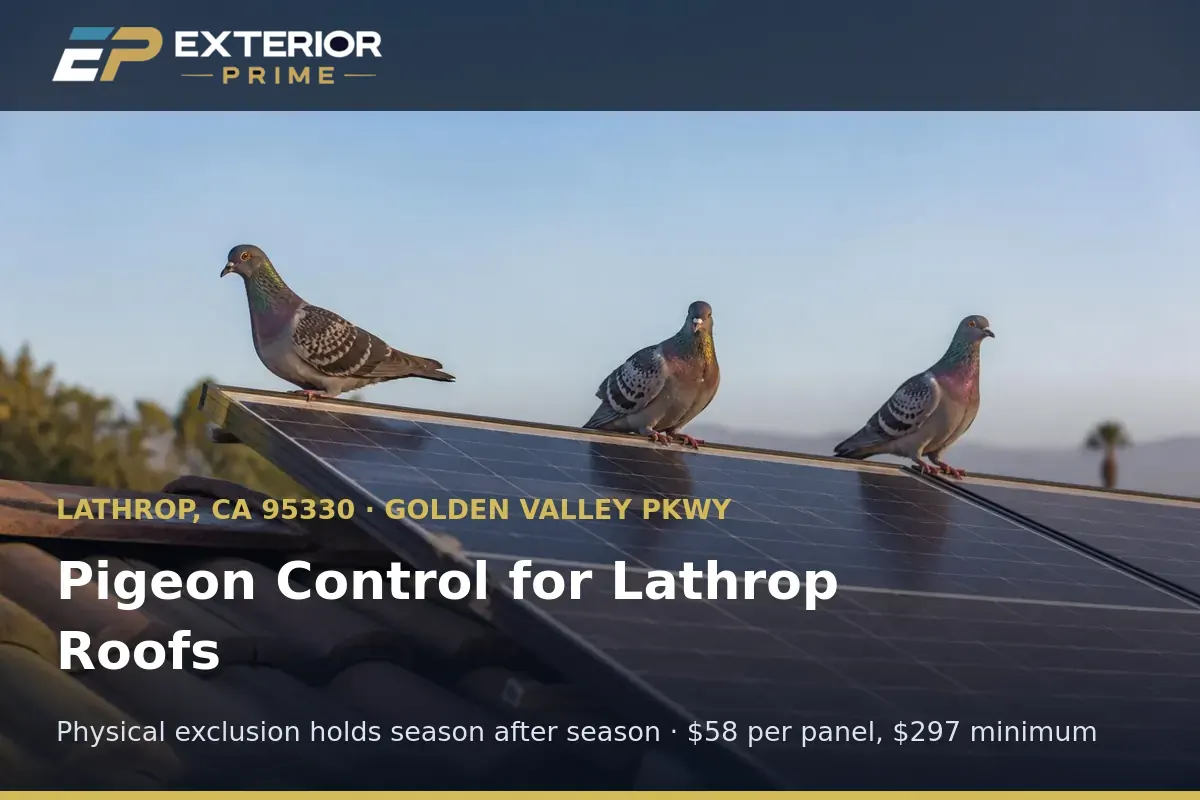
For solar arrays, our professionals clip galvanized mesh to the module frame around the full perimeter, with zero roof or racking penetrations to protect existing warranties. This is the most common request across River Islands and Stonebridge, where rooftop solar adoption is highest.
Patio covers, especially the beam-and-lattice style found in many older Lathrop backyards, get netting stretched across the structure to eliminate roosting ledges while keeping the space usable underneath. We size the netting to the specific beam spacing rather than using a generic panel.
Tile roofs need bird stops fitted under the curved tile profile — a detail that requires matching the specific tile style used across different Woodfield and Stonebridge subdivisions, since an incorrect fit can trap water instead of just blocking birds.
Attic vents get galvanized wire guards custom-fitted to gable, ridge, or soffit vent styles, closing off what's often the highest-risk entry point on the property since it connects directly to interior attic space.
Is pigeon control a one-time fix or ongoing service?
A properly installed exclusion job is a one-time fix backed by a five-year workmanship warranty, though homes near heavy pigeon pressure sometimes benefit from an annual check.
Once mesh, netting, or a vent guard is installed correctly, it typically doesn't need to be reinstalled — the five-year workmanship warranty Exterior Prime provides reflects how durable the galvanized and stainless materials are through Lathrop's fog, heat, and ag dust conditions.
That said, homes closest to Dos Reis Road and the river crossing near Mossdale sometimes see higher pigeon pressure simply due to proximity, and an annual check-up can catch a clip that's loosened or a small gap that opened up from settling before it becomes a full nesting problem again.
Most Lathrop homeowners never need a return visit beyond that occasional check, since the exclusion method doesn't degrade the way poison or repellent gels do over just a few months of exposure to sun and rain.
Pricing for pigeon control across a Lathrop property
Solar array control is priced at $58 per panel, while eaves, patio covers, tile roofs, and attic vents are quoted individually after an on-site inspection.
Solar array pricing stays consistent at $58 per panel, with typical Lathrop arrays totaling $750 to $1,400 depending on panel count and roof complexity. Other structures vary too much in size and configuration to quote without seeing them, so our professionals measure on-site before providing a final number.
Bundling multiple areas — say, a solar array plus attic vents — into a single visit is common and usually more cost-effective than scheduling separate appointments, since travel and setup time is shared across the whole job.
Existing nest or droppings cleanup starts from $200 anywhere on the property, and a $297 minimum applies for any standalone single-service visit that doesn't include a bundled area.