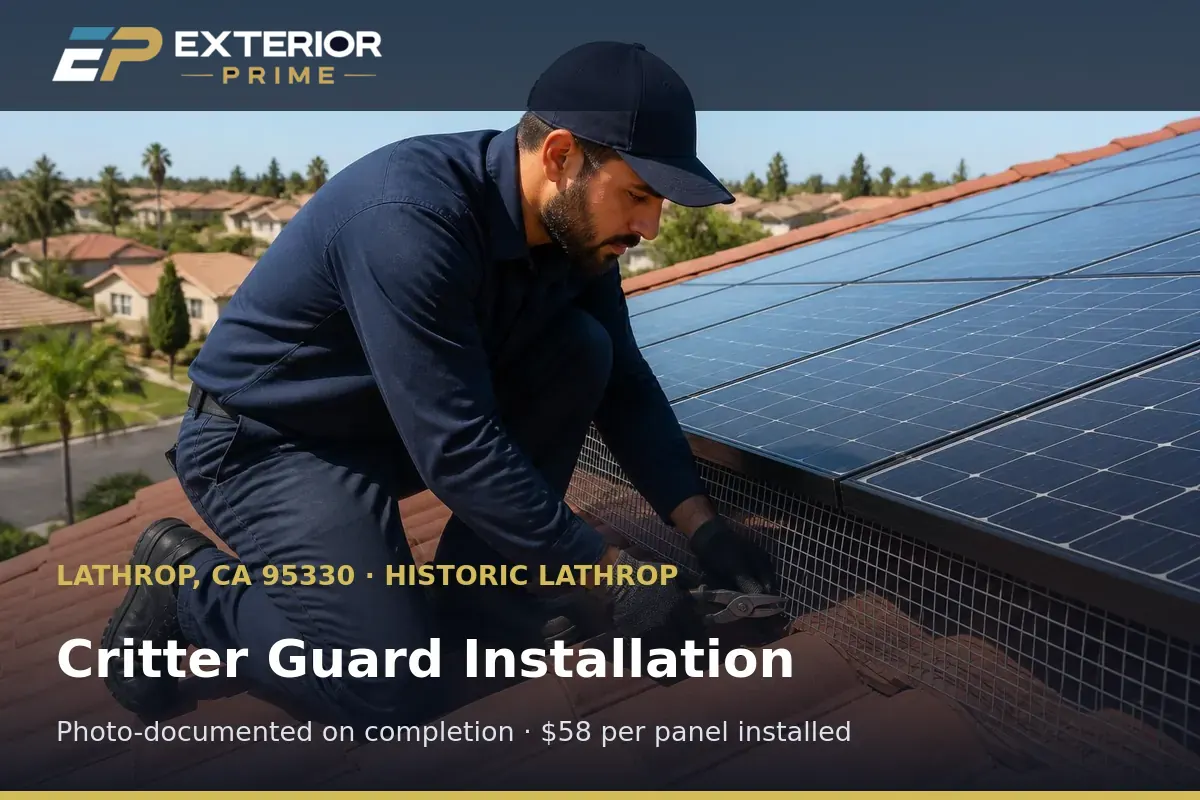
What's different about Lathrop critter guard installation versus bird mesh installation?
The mesh and clips are identical, but critter guard installs include a property-wide access check for tree limbs, fences, and utility lines that squirrels and rats use to reach the roof.
A bird-only installation typically focuses on the array itself, since pigeons and sparrows arrive by flying directly onto the roof. Squirrels and roof rats, by contrast, climb — meaning professionals need to look beyond the panels themselves at what's giving them a path up in the first place, which adds roughly 15 minutes to a standard mesh visit.
During a critter guard visit in Lathrop, we walk the perimeter of the house checking for overhanging branches near almond or oak trees common across the Central Valley, fence lines that touch the roofline, and utility or cable runs a rat could use as a highway onto the eave.
We don't trim tree limbs or move fences ourselves, but we'll flag anything within about 3 feet of the eave so a homeowner in River Islands or Woodfield can decide whether to address access points separately, since galvanized mesh alone stops nesting under the panels but doesn't stop a squirrel from being on the roof generally.
This extra walk-around typically adds 15 to 20 minutes to the overall visit but can meaningfully improve how long the exclusion holds up, especially on properties bordering open ag land.
How does Exterior Prime confirm no critters are trapped after installation?
A final camera check under the array before the last mesh section is clipped shut confirms the space is empty of birds, squirrels, or rats before full closure.
Sealing a live animal under solar panels creates a worse problem than the original nesting issue, so our process always includes a check before the final 2 or 3 stainless clips go on. Professionals run a small camera along the underside of the array and inverter conduit during the last stage of installation.
If activity is detected at this late stage, which happens occasionally on Lathrop properties with heavy squirrel traffic near mature trees, we pause, allow safe exit routes, and recheck before sealing the final section.
This step matters more for critter guard jobs than pure bird mesh, since squirrels can sometimes dart under an array mid-installation, adding 10 to 15 minutes to the job, if disturbed elsewhere on the property, something pigeons rarely do once cleanup has already displaced them.
Once confirmed clear, the final clips go in and we do one more pass with the camera to document the sealed, empty space as part of the job photos we send you.
Do I need to trim trees before critter guard installation?
Not necessarily, but trimming branches that touch the roofline reduces future squirrel access and helps the mesh installation hold up longer.
Galvanized mesh stops squirrels from nesting under the panels regardless of whether a tree branch still touches the roof, but a branch resting within 1 foot of the eave gives squirrels a comfortable staging area right next to the array, which means more persistent testing of every clip and seam.
We've installed critter guard on more than 8 Historic Lathrop properties with large old oaks overhanging the roof and had the mesh hold up fine, but we generally recommend at least 3 to 4 feet of clearance if trimming is feasible, simply to reduce daily traffic near the array.
If tree trimming isn't something you want to tackle before the install, that's fine — we'll still complete the job as scheduled and just note the tree proximity in our documentation in case a follow-up visit is ever needed.
For newer River Islands properties with younger, smaller landscaping under 10 feet tall, this usually isn't a factor at all, since trees haven't yet grown close enough to the roofline to matter.
How soon after a rodent problem should critter guard go in?
As soon as cleanup is finished — installing mesh the same day cleanup wraps up prevents the same rats or squirrels from simply moving back in overnight.
Once a nest is cleared and the area sanitized in a Lathrop 95330 home, an open array is an invitation for the same animals, or new ones, to move back in within days if mesh isn't installed promptly, so Exterior Prime schedules the follow-up fast. We schedule cleanup and critter guard installation as a single visit whenever possible for exactly this reason.
On larger Lathrop jobs where cleanup runs long, sometimes because of extensive nest material found under a 24-panel Stonebridge array, we occasionally split cleanup and mesh installation across two consecutive days rather than rush the sanitizing step.
In either case, we don't leave an array open and untreated longer than necessary. Most standard cleanup-to-mesh turnarounds happen within 24 hours, either the same day or the next morning at the latest, and every completed job carries the same 5-year workmanship warranty.
If a Lathrop homeowner needs to wait longer than about 3 days for scheduling reasons, Exterior Prime recommends at minimum covering any obvious access gaps near the gutter or eave temporarily, though a proper mesh install remains the only long-term fix.
Timing matters seasonally too: squirrel and roof rat activity peaks in Lathrop from late winter through the spring nesting months of February to May, and again in the cooler weeks of November when animals look for sheltered space under a warm array, so booking installation ahead of those windows keeps the array closed before traffic climbs.