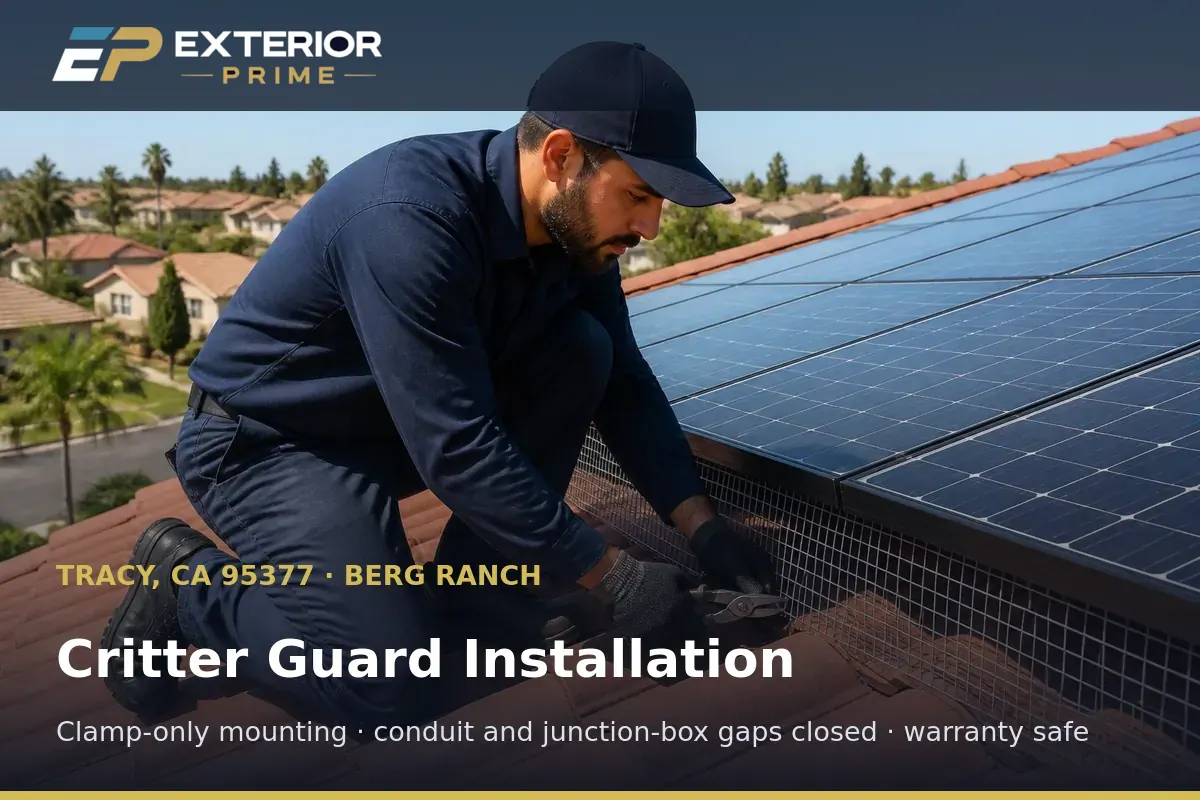
Why Clamp-Only Mounting Protects Your Tracy Warranty
Drilling into a roof deck to mount critter guard can void both roofing and solar equipment warranties, which is why Exterior Prime uses clamp-only attachment exclusively.
Most solar equipment warranties in Tracy specify that any unauthorized penetration of the roof deck or panel frame after original installation can void coverage. Homeowners in newer Tracy Hills developments especially need to protect this, since their systems are often still well within warranty terms.
Clamp-only mounting attaches guard material directly to the aluminum panel frame using stainless steel fasteners that grip mechanically rather than piercing anything. This approach has been standard practice in the solar industry for exactly this warranty-preservation reason, and it's the only method Exterior Prime uses across Tracy.
We've inspected properties in Edgewood and Plaza Park where a previous installer had screwed guard material directly into roof tiles or shingles, creating small penetrations that later became leak points during the December-January tule fog and rain season, a problem entirely avoidable with proper clamp technique.
Beyond warranty protection, clamp-only mounting is also easier to service later. If a section of guard ever needs adjustment or replacement, our professionals can unclip and refit it without any patching or resealing work that a drilled installation would require.
Sealing Conduit Runs Without Compromising Wiring
Conduit runs beneath a Tracy solar array require guard material trimmed precisely around the tubing rather than a straight cut that leaves a gap on either side.
Conduit carrying DC wiring from panel to inverter typically runs along the underside of the array, and a straight mesh or guard cut simply can't seal cleanly around a cylindrical pipe. Our professionals custom-trim guard material to wrap around conduit runs, closing the gap on both sides with small supplemental clips.
This precision matters because conduit gaps are consistently where we find the most severe rodent damage during inspections in Southside and Downtown Tracy homes, since a rodent naturally follows the conduit line as a physical guide toward the wiring itself.
We're also careful never to clamp guard material tightly enough against the conduit itself to create abrasion over time, since vibration from wind or thermal expansion could otherwise wear through the conduit's protective jacket at a pinch point we created.
This level of care takes longer than a generic straight-line install, but it's the difference between a guard that actually stops rodent access at the conduit and one that simply redirects the problem to the one gap left unsealed.
Junction Box Gaps and Why They're Often Overlooked
Junction boxes create an irregular shape that standard guard cuts frequently miss, leaving a gap that's both a rodent entry point and a bird nesting spot in Tracy installations.
Junction boxes sit at odd angles relative to the panel frame and often protrude slightly below the array's lowest plane, which means a guard section cut for a flat panel edge won't naturally follow the box's shape. This creates a small but persistent gap unless specifically addressed.
During our post-installation quality check on Tracy jobs, junction box perimeters are one of the three specific areas we verify by hand, alongside corner overlaps and roofline edges, precisely because they're the area most commonly missed by less thorough installation approaches.
We use small custom-cut guard patches around each junction box, secured with additional stainless clips, rather than attempting to force a single large sheet of guard material to conform to an irregular shape it wasn't cut for.
This attention to junction box detail is a small part of the overall job in terms of time, typically adding only 15 to 20 minutes per box, but it closes exactly the kind of gap that undermines an otherwise well-executed critter guard installation across your Tracy array.
What Proper Installation Standards Cost in Tracy
Exterior Prime's warranty-safe, gap-sealed critter guard installation runs $58 per panel across Tracy, the same rate whether your array has simple or complex conduit routing.
We don't upcharge for the additional time spent on conduit trimming or junction box sealing, since we consider that level of detail a baseline requirement rather than a premium service. A 22-panel array in Tracy, a common size for households with pool equipment or EV charging, comes to $1,276 under this standard rate.
If prior installation work by another provider needs to be corrected, for example replacing screwed-in mounts with proper clamps, we quote that remediation work separately from a straightforward new install, since removing improperly mounted material and repairing any resulting roof damage takes additional time.
As with all Exterior Prime standalone visits in Tracy, the $297 minimum applies, though critter guard jobs sized for a typical residential array clear that minimum through panel count on their own.
We provide photo documentation of the completed conduit and junction box sealing specifically, since this is the detail most homeowners want confirmed given how easily it's overlooked by less careful installation methods.
How far past the modules does solar panel critter guard installation reach?
A 95304 solar panel critter guard installation visit measures 49 feet of stucco, soffit and screen edge around the array, then logs every siding opening our professionals seal.
solar panel critter guard installation on a 11-panel Downtown Tracy roof takes about 27 minutes to map: 49 feet of stucco edge, 17 photographs, a 55 psi soft wash rinse across the concrete and algae below, and almond-orchard dust noted in the 95304 file.
Tracy Hills and Redbridge arrays fail the same way — Delta breeze pushes grit under the screen, Central Valley heat bakes mildew onto the eave and siding, so Exterior Prime folds that rinse into one solar panel critter guard installation appointment rather than a $297 second trip.
Exterior Prime records the 5-year workmanship history for 95304 and 95377 addresses, naming each soffit gap, eave screen and mildew deposit; a 11-panel job at $58 per panel is $638, with cleanup from $200.