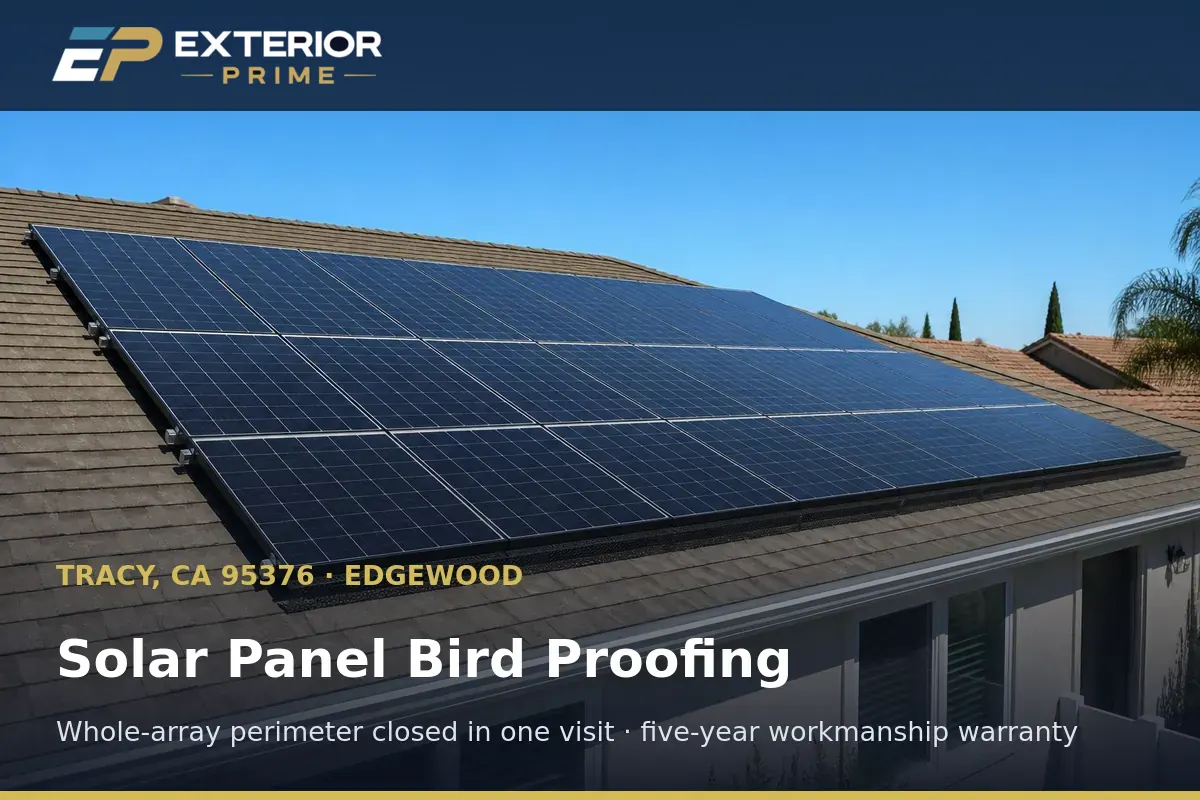
Why one-sided patches keep failing across Tracy
Blocking only the street-facing edge of a Tracy array leaves three other sides open, and pigeons find them within days.
We routinely inspect Tracy roofs where a previous handyman closed the front edge facing the street and called it finished. From the curb it looks tidy, but the rear slope facing the backyard, or the side facing a neighbor's fence line, stays completely open. Pigeons don't care which side looks nicer — they care which side still has a gap, and they'll relocate there within a week or two of the first patch going up.
Older tract homes near Southside and Downtown Tracy often carry composition shingle roofs with racking mounted low and tight, which can hide small gaps along the rail ends. A 2 or 3-inch opening that an installer skipped is more than enough clearance for a breeding pair to squeeze through and start nesting behind the array where nobody can see it from the ground.
Newer construction in Tracy Hills tends to use taller standoff racking, which actually creates a wider shaded cavity underneath. That extra clearance is attractive during 100°F+ July afternoons because it stays cool and out of direct sun. A partial seal on that kind of roof still leaves a generous, shaded corridor running the length of the array, so the birds simply enter from whichever side was left open.
Exterior Prime walks the entire roofline before quoting anything, checking every plane even when it isn't visible from the driveway. That full-perimeter assessment is the difference between a job that lasts and a job that gets a callback three months later once the birds find the one seam nobody closed.
How Exterior Prime seals a Tracy array for good
Our professionals custom-form galvanized mesh to the exact panel height on every side of your array before securing it without drilling into the roof deck.
Each visit starts with a full rooftop survey, not just a glance at the visible edge. We check junction boxes, conduit runs, and the corners where two roof planes meet, since those transition points are where installers most often leave a sliver of open space on Tracy homes.
We form heavy-gauge galvanized steel mesh on-site to match your specific rack height, whether that's the low-profile setup common on older Edgewood homes or the high-standoff racking increasingly common in Tracy Hills. The mesh is tensioned and clipped rather than glued, so it holds its shape through wind gusts off the Altamont Pass without sagging or pulling loose.
Nothing gets drilled into your racking or your roof deck. Clips attach directly to the panel frame, which keeps your solar equipment's manufacturer warranty fully intact — something we confirm in writing before we ever climb a ladder.
Once every side is closed, we do a second walk of the full perimeter to verify there isn't a single loose corner. Customers receive photos showing the finished mesh line on every edge, so you can see for yourself that this wasn't a one-side job.
How long a full-perimeter seal lasts on a Tracy roof
A properly closed Tracy array typically stays bird-free for 5 to 10 years with nothing more than an occasional visual check.
Material choice drives most of that lifespan. We use PVC-coated galvanized wire and stainless clips, which resist the corrosion that bare steel develops after just 2 or 3 winters of dense December-January tule fog settling on Tracy rooftops overnight.
Clip spacing matters almost as much as the material itself. We set fasteners every 6 to 8 inches so the mesh can't bow outward under wind load, which is the most common failure we find on cut-rate installs near Corral Hollow Road.
Temperature swings are the real stress test in the Central Valley. Tracy roofs go from cold, damp tule fog mornings to surface temperatures well over 140 degrees during a July afternoon, and mismatched materials expand and contract at different rates until fasteners work loose within a year or two.
Our workmanship guarantee runs 5 years across the 95376, 95377, 95304, and 95378 ZIPs, and arrays we closed several seasons ago near the West Valley Mall corridor remain sealed today with zero follow-up calls.
Weather in Tracy that low-grade screening can't handle
Tracy's Delta breeze, triple-digit summers, and winter tule fog all shorten the working life of thin plastic netting or unsealed wire.
The Delta breeze that funnels through the I-205/I-580 interchange keeps loose netting flapping and eventually tearing at the fastener points. Tensioned galvanized mesh handles that same wind load without shifting because it's clipped rather than merely draped over the array.
Summer in Tracy regularly pushes past 100 degrees for weeks at a stretch, and inexpensive plastic bird netting becomes brittle and starts cracking after roughly two summers under that kind of UV exposure. Galvanized steel doesn't suffer the same breakdown.
Dense tule fog rolling in most December and January mornings keeps rooftops damp for hours, and uncoated wire will show surface rust within a single wet season if it isn't properly coated.
Surrounding row-crop and almond acreage also means seasonal dust settles across rooftops after harvest. Tight-weave mesh sheds that grit with the next rain instead of trapping it into a damp mat against the roof deck the way loose netting does.
Where do Tracy homes stay open after solar panel bird proofing?
A 95376 solar panel bird proofing visit measures 63 feet of fascia, gutter and stucco edge around the array, then logs every soffit opening our professionals seal.
solar panel bird proofing on a 15-panel Redbridge roof takes about 30 minutes to map: 63 feet of fascia edge, 16 photographs, a 87 psi soft wash rinse across the algae and paver below, and Delta breeze noted in the 95376 file.
Downtown Tracy and Tracy Hills arrays fail the same way — San Joaquin County hardpan pushes grit under the stucco, Altamont Pass wind bakes screen onto the downspout and soffit, so Exterior Prime folds that rinse into one solar panel bird proofing appointment rather than a $297 second trip.
Exterior Prime records the 3-year workmanship history for 95376 and 95304 addresses, naming each gutter gap, downspout screen and screen deposit; a 15-panel job at $58 per panel is $870, with cleanup from $200.