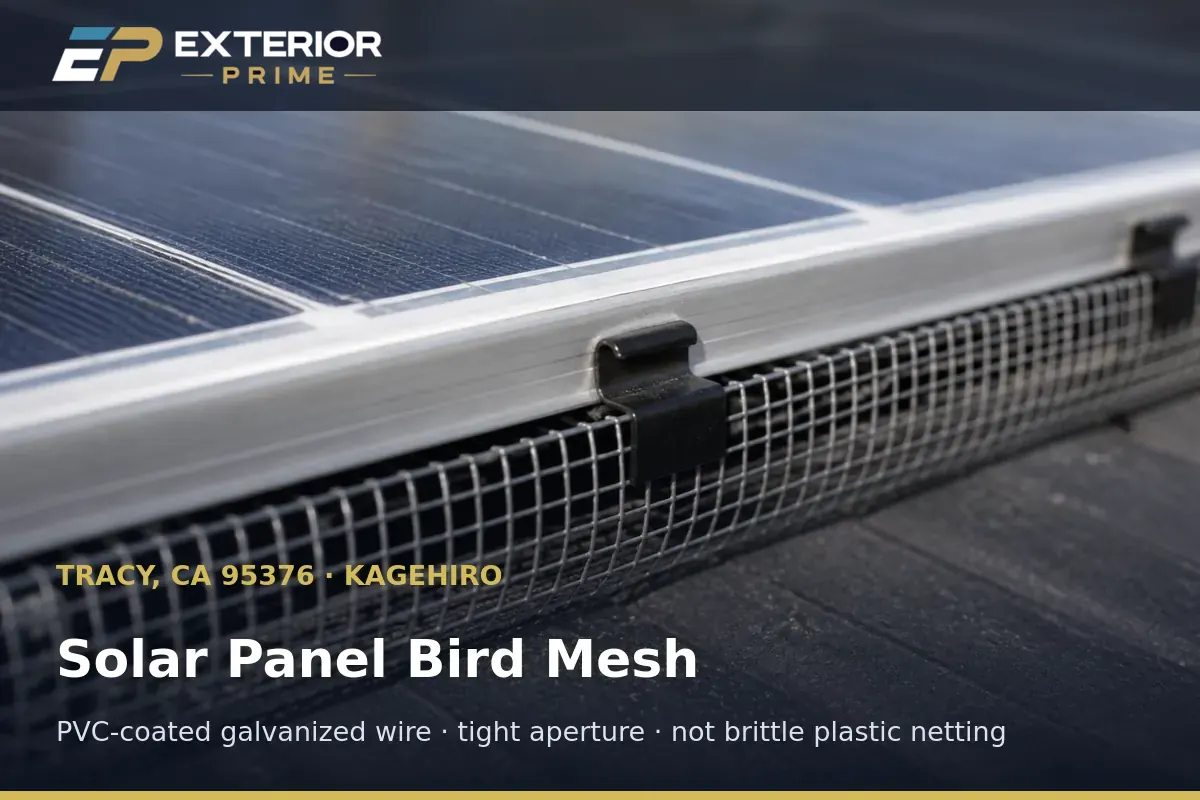
What Gauge and Coating Actually Matter in Tracy 95376?
Exterior Prime uses 19-gauge PVC-coated galvanized wire because thinner gauges deform under the Altamont Pass wind corridor's gusting conditions.
Wire gauge determines how much a mesh panel can flex before it permanently bows outward, and that matters enormously in Tracy because the Altamont Pass wind corridor pushes sustained gusts across rooftops in Tracy Hills and along Corral Hollow Road far more aggressively than in sheltered valley towns. A lighter 23-gauge wire, which many discount suppliers push, will visibly bow within its first windy winter, creating gaps large enough for a determined pigeon to squeeze through at the corners.
The PVC coating over the galvanized core is not cosmetic. It's a barrier against the salt-adjacent humidity that rolls in with the Delta breeze most afternoons, which otherwise accelerates rust at the cut edges of raw galvanized wire within three or four years. Homes near Naglee Road and the logistics corridor see enough particulate dust in the air that any exposed metal edge becomes a corrosion starting point almost immediately.
Aperture size is the third variable, and we hold to a half-inch opening for standard bird exclusion. Anything larger lets sparrows and starlings squeeze through near roofline edges; anything smaller traps dust and organic debris from the almond acreage surrounding Tracy, which can mat the mesh and block airflow beneath panels during peak summer heat.
We reject the woven polyethylene netting sold at big-box stores because UV exposure at Tracy's latitude, roughly 3,000-plus sun hours a year, turns that plastic brittle within 18 to 24 months. Once it cracks, it drops fragments into gutters and leaves the underside of the array wide open again, undoing the entire investment.
How Tracy's Climate Shortens the Life of Cheap Netting
Plastic bird netting in Tracy typically fails within two summers because UV radiation and thermal cycling make the polymer brittle and prone to splitting.
A roof surface in Tracy can swing from the 30s during a January tule fog morning to well above 130°F on a shaded shingle by a July afternoon. That thermal cycling is punishing on any plastic-based product, since the material expands and contracts thousands of times over a season and eventually loses its elasticity entirely.
Once brittle, plastic netting doesn't fail gracefully. It shatters into small shards near clip points, which then blow into neighboring yards or clog roof valleys, and it leaves a jagged opening that birds exploit within days. We've replaced failed plastic installs on Berg Ranch and Southside properties where the homeowner had only owned the netting for a single winter.
Our galvanized wire mesh, by contrast, is engineered for exactly this thermal swing. The metal core doesn't lose tensile strength from heat cycling the way polymer does, and the PVC coating flexes without cracking down to well below freezing, which matters during the coldest tule fog mornings of a Tracy winter.
This durability difference is why Exterior Prime backs every mesh install with a five-year workmanship guarantee. We aren't gambling that the material holds up; we've already selected wire mesh precisely because it outlasts the panels' own warranty period in most Tracy installations.
Fitting Mesh to Tracy's Housing Stock
Tracy's mix of 1970s-90s tract roofs and newer Tracy Hills high-standoff racking each demand a different mesh cutting and clipping approach.
Older composition-shingle homes throughout Plaza Park and Downtown Tracy tend to have lower-profile racking, meaning the mesh only needs a shallow drop to seal the perimeter, while concrete tile roofs common in Redbridge require extra care so the mesh doesn't rub against brittle tile edges during installation.
Newer construction in Tracy Hills frequently uses high-standoff racking systems, which raise the panel further off the roof deck and create a taller gap that pigeons find especially attractive for nesting. That taller gap requires wider mesh sections and additional clip points along the vertical run to keep the barrier from billowing in wind.
We hand-measure every array rather than relying on pre-cut rolls, because Tracy rooflines vary from single-plane ranch layouts near Kagehiro to multi-hip roofs with several distinct planes in Sunrise Park. A generic roll of mesh nearly always leaves a gap at a hip or valley junction that a bird will find within a week.
Regardless of racking style, our clips attach directly to the panel frame rather than the roof itself, which means the mesh installation never voids a manufacturer's roofing or solar warranty, something Tracy homeowners with newer systems specifically ask about before approving the work.
Pricing and What's Included for Tracy Installations
Exterior Prime charges $58 per panel for mesh installation across Tracy 95376, 95377, 95304 and 95378, with existing nest cleanup quoted separately starting at $200.
A typical 18-panel array in Tracy runs $1,044 for the mesh alone, and most single-story homes complete in a single visit. Larger arrays common in newer Tracy Hills construction, sometimes 24 to 30 panels to cover higher household energy use, scale proportionally at the same $58-per-panel rate.
If birds have already established a nest, we quote sanitation and debris removal starting at $200 as a separate line item, since that work involves protective gear and disposal that a clean install doesn't require. We always inspect before quoting so there are no surprise charges once our professionals are on your roof.
As with every standalone Exterior Prime visit in Tracy, there's a $297 minimum that covers mobilization, insurance, and photo-documented results, though most mesh jobs of any real size clear that minimum on panel count alone.
We provide a written quote after a roof survey, typically scheduled within the same week, so Tracy homeowners know the exact total before any clips go on the panels.
Where do Tracy homes stay open after solar panel bird mesh?
A 95304 solar panel bird mesh visit measures 105 feet of screen, siding and mildew edge around the array, then logs every oxidation opening our professionals seal.
solar panel bird mesh on a 21-panel Redbridge roof takes about 48 minutes to map: 105 feet of screen edge, 13 photographs, a 79 psi soft wash rinse across the gutter and concrete below, and San Joaquin County hardpan noted in the 95304 file.
Downtown Tracy and Tracy Hills arrays fail the same way — Tule fog pushes grit under the mildew, valley fog bakes roof onto the fascia and oxidation, so Exterior Prime folds that rinse into one solar panel bird mesh appointment rather than a $297 second trip.
Exterior Prime records the 5-year workmanship history for 95304 and 95376 addresses, naming each siding gap, fascia screen and roof deposit; a 21-panel job at $58 per panel is $1218, with cleanup from $200.