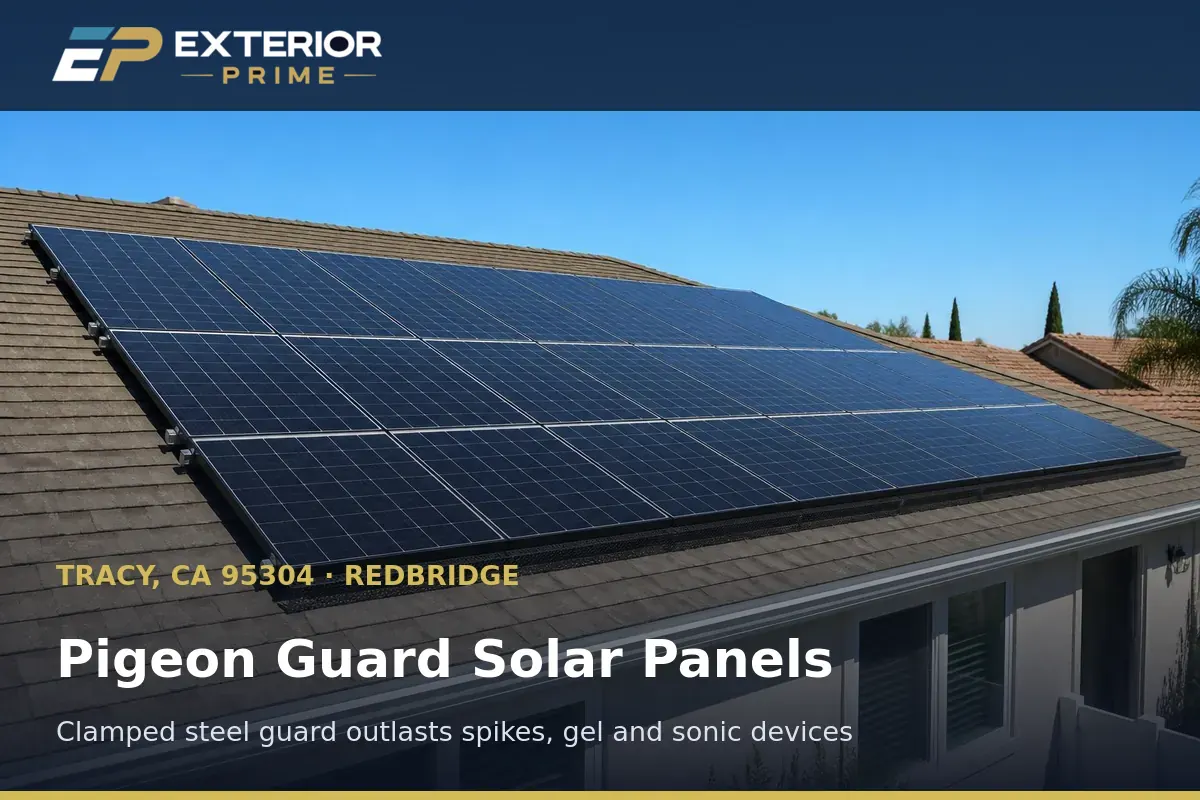
Why Spikes Fail on Tracy Solar Arrays Specifically
Pigeon spikes work reasonably well on flat ledges but leave the open underside of a solar panel completely unprotected, which is exactly where pigeons in Tracy actually nest.
Spikes are designed to prevent birds from landing and perching on a surface, which makes sense for a chimney cap or a ledge. But the pigeon problem on a Tracy solar array isn't about landing on top of the panels, it's about crawling into the gap underneath where the racking creates a sheltered nesting cavity.
We've seen homeowners in Berg Ranch install spike strips along the top edge of their array, only to find pigeons simply walking underneath from the lower edge where no spikes were placed, since the birds never needed to land on the panel surface in the first place.
Spikes also require mounting to the panel frame or roof edge with adhesive or small fasteners, and in Tracy's summer heat, adhesive-mounted spike strips have a tendency to loosen and detach entirely after a season or two of expansion and contraction on a hot roof surface.
For a Tracy solar array, spikes address the wrong access point entirely, which is why we don't offer them as a standalone pigeon solution and instead focus on sealing the underside gap directly with mesh.
Gel Repellent and Sonic Devices: Why They Underperform in Tracy's Climate
Gel repellents lose effectiveness under Tracy's intense summer sun within weeks, while sonic devices rarely penetrate the dense space beneath a solar array where pigeons actually nest.
Anti-perching gel works by creating an uncomfortable, sticky sensation that discourages birds from landing on a treated surface. In Tracy's 100°F-plus July conditions, that gel tends to soften, dry out, or attract dust and debris from the surrounding almond and row-crop acreage, reducing its stickiness and effectiveness far faster than in milder climates.
Even when fresh, gel is applied to exposed surfaces like panel edges, but again does nothing to block the actual gap beneath the panel where nesting occurs. It's a deterrent for surface landing, not an exclusion method for cavity nesting, so it misses the core problem on a Tracy roof.
Sonic and ultrasonic devices claim to disturb pigeons with sound frequencies, but the enclosed, insulated space beneath a solar array significantly muffles that sound, and pigeons in areas with sustained warehouse and traffic noise near the logistics corridor are often already habituated to ambient sound anyway.
We've removed several sonic devices from Tracy Hills properties where homeowners reported no change in pigeon activity after months of use, generally because the birds simply nested slightly further from the speaker rather than leaving the array entirely.
Why Clamped Steel Mesh Is the Only Durable Answer in Tracy
Clamped steel mesh physically seals the entire gap beneath a Tracy solar array, which is the only approach that addresses where pigeons actually gain access rather than just discouraging surface landing.
Unlike spikes, gel, or sonic devices, mesh doesn't rely on discouraging pigeon behavior at all, it simply removes the physical opportunity to enter. This distinction matters enormously in Tracy, where the resident pigeon population near the logistics corridor is persistent enough that behavioral deterrents alone rarely hold up long-term.
Steel mesh also survives Tracy's climate extremes without performance loss. It doesn't soften in July heat like gel, doesn't lose adhesion like tape-mounted spikes, and doesn't muffle or degrade like a sonic device's electronics exposed to winter tule fog moisture.
Because mesh clamps directly to the panel frame, it requires no batteries, no reapplication, and no maintenance schedule the way sonic devices and gel treatments do. Once properly installed and tensioned, it continues working without any ongoing homeowner involvement for years.
This is why, after installing and later removing most of the alternative products on the market from Tracy properties, Exterior Prime settled on clamped galvanized steel mesh as the only pigeon guard method we recommend for genuine long-term results.
What Comprehensive Mesh Guard Costs Across Tracy
Exterior Prime installs clamped steel mesh pigeon guard for $58 per panel throughout Tracy, a single upfront cost compared to the recurring reapplication expenses of gel or battery-based alternatives.
A 19-panel array in Tracy, roughly typical for a mid-size single-story home, totals $1,102 for complete mesh guard coverage. Unlike gel treatments that need reapplication every few months during peak pigeon season, or sonic devices that need battery replacement and periodic testing, this is generally a one-time cost.
Homeowners who've already spent money on spikes, gel, or sonic devices that didn't solve their Tracy pigeon problem sometimes worry about paying twice, but we factor in the removal of old ineffective products as part of our initial site assessment at no separate charge.
If pigeons have already nested and left droppings before you switch to mesh, cleanup is quoted separately starting at $200, consistent with our standard sanitation pricing across all Tracy bird and pigeon services.
The standard $297 minimum applies to standalone visits, though a full-array mesh guard installation in Tracy typically exceeds that minimum through panel count regardless of home size.
What does a Plaza Park pigeon guard solar panels report document?
A 95378 pigeon guard solar panels visit measures 56 feet of paver, stucco and algae edge around the array, then logs every screen opening our professionals seal.
pigeon guard solar panels on a 12-panel Plaza Park roof takes about 30 minutes to map: 56 feet of paver edge, 18 photographs, a 63 psi soft wash rinse across the eave and downspout below, and agricultural dust noted in the 95378 file.
Berg Ranch and Edgewood arrays fail the same way — Central Valley heat pushes grit under the algae, almond-orchard dust bakes concrete onto the siding and screen, so Exterior Prime folds that rinse into one pigeon guard solar panels appointment rather than a $297 second trip.
Exterior Prime records the 6-year workmanship history for 95378 and 95376 addresses, naming each stucco gap, siding screen and concrete deposit; a 12-panel job at $58 per panel is $696, with cleanup from $200.