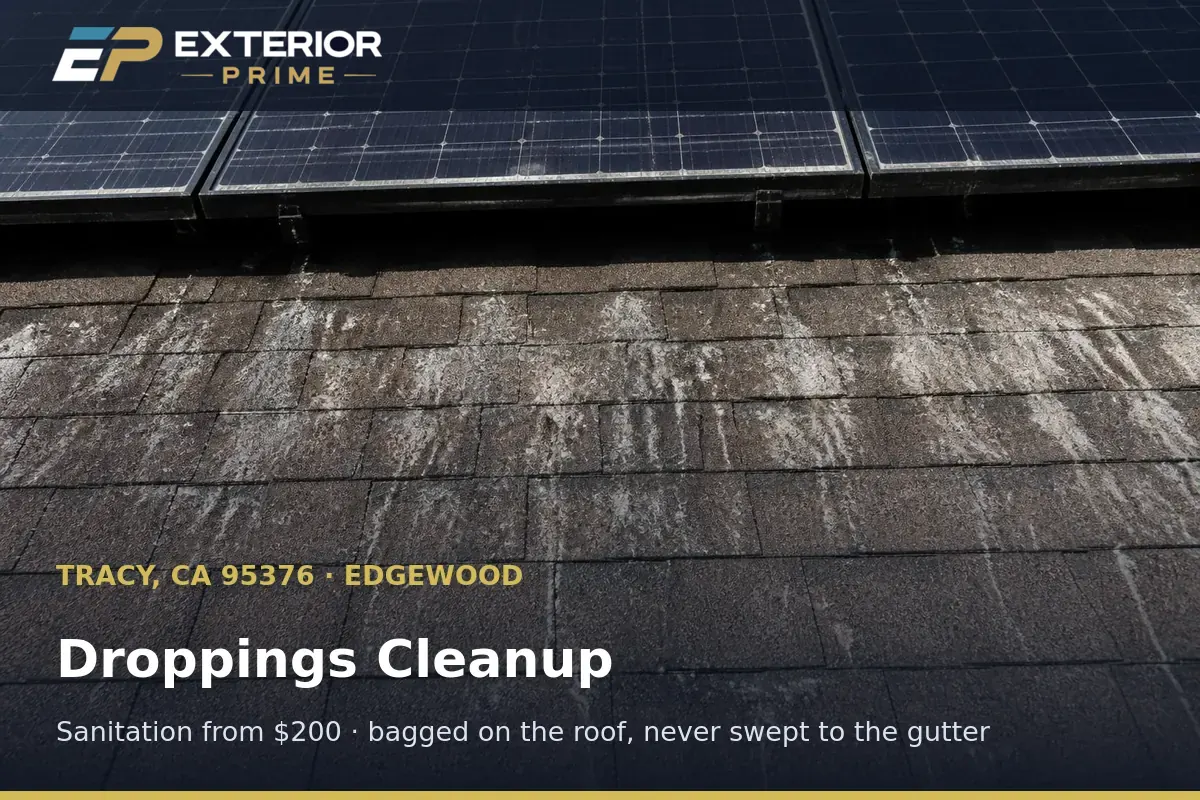
Why dried droppings threaten a Tracy roof more than they look like they should
Dried pigeon waste carries concentrated uric acid that slowly eats into composition shingles and cracks aging flashing seals.
In older sections of Tracy near Downtown and along Naglee Road, composition shingle roofs from the 1970s and 1980s were never built to withstand sustained chemical contact. Once uric acid soaks into the granule layer, the mat underneath loses its UV protection and starts curling within a couple of seasons.
Flashing around vent pipes and chimney stacks takes a similar beating. The metal edges corrode faster when guano sits wet against them during Tracy's dense December and January tule fog, and a pinhole leak there can silently soak attic insulation for months before anyone notices a stain indoors.
Concrete tile roofs common in Tracy Hills fare a little better structurally, but the porous grout lines still absorb the acid and discolor permanently. Once that staining sets in, no amount of soft washing removes it completely, which is why early extraction matters more than a cosmetic rinse later on.
There's also a health dimension homeowners in Tracy often underestimate: dried droppings can aerosolize spores linked to histoplasmosis whenever wind off the Altamont Pass corridor kicks up dust near the eaves, so leaving the mess in place isn't a passive choice.
How Exterior Prime handles extraction on a Tracy rooftop
Every cleanup crewmember bags waste at the source instead of sweeping or blowing it toward gutters and landscaping below.
We treat guano removal on a Tracy home the same way a hazardous-material technician would, sealing waste in contractor-grade bags at the roofline rather than letting it drift into a Berg Ranch backyard or a Southside driveway.
After extraction, we apply a sanitizing treatment across the exposed decking. This step matters in Tracy specifically because the region's 100°F+ July afternoons can bake residual bacteria into the tile surface if it isn't neutralized quickly after the waste comes off.
Our professionals wear protective gear throughout the process, and we keep the work area contained so nothing lands on patio furniture or landscaping beds near the home. Photo documentation before and after gives Tracy homeowners a clear record for their own files.
We finish most visits with a glass rinse across the array itself, since dried film from droppings often blocks more light than homeowners expect, and clearing it produces a visible difference the same afternoon.
What a Tracy cleanup appointment actually looks like
A typical visit runs two to four hours depending on how many seasons of buildup have accumulated under the array.
We start with a photo survey underneath the panels so the homeowner can see the extent of the nesting material before any work begins. That survey also lets us price the job accurately rather than guessing from ground level.
Properties near Grant Line Road and the logistics corridor sometimes carry heavier debris loads simply because larger commercial-style roofs attract bigger colonies, so timing can stretch toward the higher end of that window.
Once waste is cleared and the deck is sanitized, we walk the roof edge to check flashing and vent boots for any acid-related pitting that should be flagged for a roofer's attention.
We close every appointment with a second photo set showing the cleared deck, giving Tracy homeowners something concrete to keep alongside their solar warranty paperwork.
Tracy homeowners who skip cleanup risk more than a bad smell
Untreated waste under an array continues shading and heating modules, which quietly drags down production month after month.
Nesting material and dried droppings create shaded patches that force an entire string of panels to underperform, not just the cell directly beneath the mess. Homeowners in Plaza Park have told us they didn't notice the drop until comparing utility bills from one July to the next.
Heat is the other factor. Blocked airflow under the array traps warmth against the roof deck, and in a Tracy summer that already reaches triple digits, that extra thermal load shortens the working life of inverters and wiring insulation.
There's also a compounding cost: waste left through a rainy winter mixes with tule fog moisture into a paste that's far harder to remove come spring, pushing a $200 job toward the higher end of the range simply because it sat untouched.
Pairing cleanup with $58-per-panel mesh installation stops the cycle from repeating, since a sanitized roof with no access points gives returning birds nothing to rebuild on.
Where do Tracy homes stay open after pigeon droppings cleanup solar panels?
A 95304 pigeon droppings cleanup solar panels visit measures 105 feet of eave, concrete and fascia edge around the array, then logs every gutter opening our professionals seal.
pigeon droppings cleanup solar panels on a 19-panel Redbridge roof takes about 18 minutes to map: 105 feet of eave edge, 16 photographs, a 63 psi soft wash rinse across the paver and oxidation below, and almond-orchard dust noted in the 95304 file.
Downtown Tracy and Tracy Hills arrays fail the same way — Delta breeze pushes grit under the fascia, Central Valley heat bakes stucco onto the roof and gutter, so Exterior Prime folds that rinse into one pigeon droppings cleanup solar panels appointment rather than a $297 second trip.
Exterior Prime records the 5-year workmanship history for 95304 and 95376 addresses, naming each concrete gap, roof screen and stucco deposit; a 19-panel job at $58 per panel is $1102, with cleanup from $200.