01
Why do pigeon droppings damage more than they look?
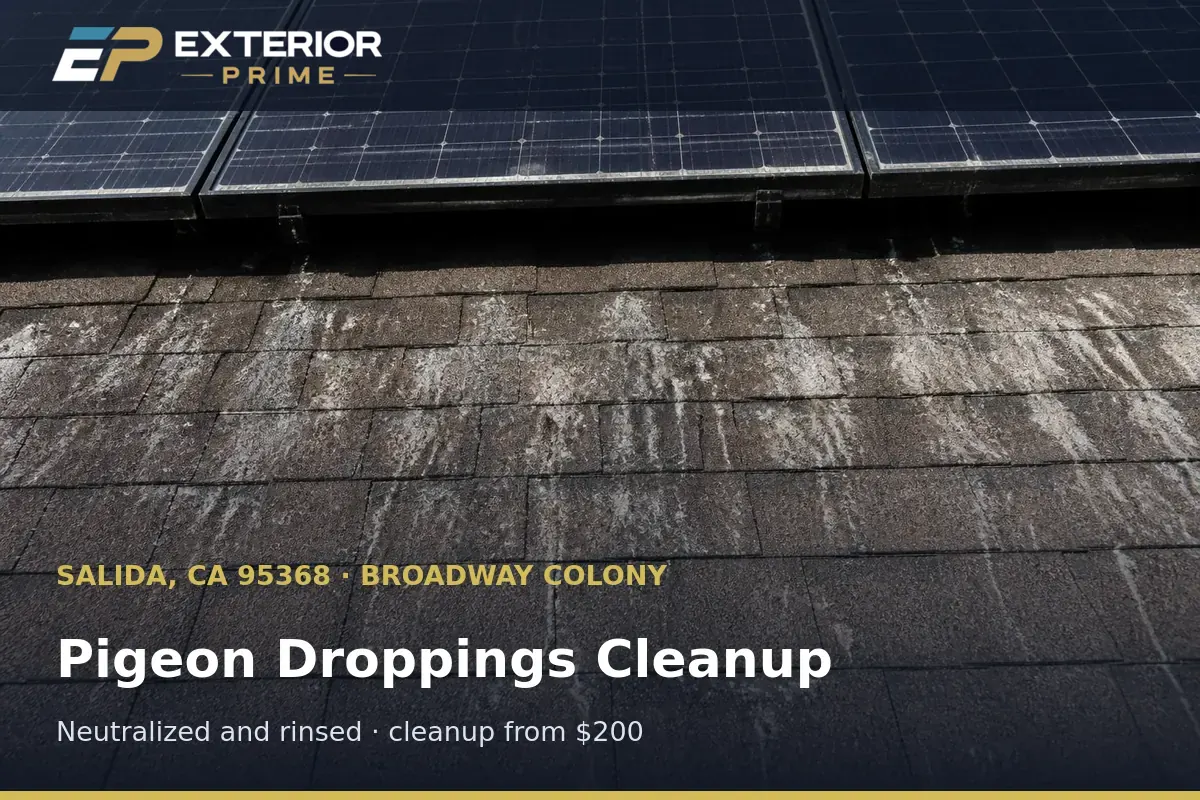
Fresh droppings are mostly uric acid, and uric acid etches composition shingle granules and pits stucco surfaces given enough time and Salida heat.
During July and August, when Salida afternoons regularly push past 100°F under a dry Central Valley sun, droppings on a sun-facing roof plane dry and bake within 1 to 2 hours, which locks the acidic residue against the surface instead of letting rain wash it away the way a milder climate would. Exterior Prime professionals see this across ZIP 95368 every summer.
On stucco walls below eave overhangs, especially on older single-storey homes in Prescott and Broadway Colony, repeated dripping and splatter over 1 or 2 seasons leaves visible staining that is difficult to pressure-wash out once it has set into the textured surface.
Roofing granule loss from acidic buildup can shave 3 to 5 years off the effective life of a composition shingle roof section faster than plain weathering would, which is a real cost most homeowners do not connect back to a pigeon problem until a roofer points it out.
02
What causes the glass crust problem unique to Salida arrays?
Droppings combined with almond hulling dust from August through October create a bonded crust on panel glass that plain water will not lift.
Salida sits close enough to the Hammett Road almond blocks that an 8-week hulling season dust settles on rooftops right alongside pigeon activity, and when droppings splash onto panel glass during that same window, the dust binds into the drying residue within about 48 hours and forms a crust that is noticeably harder than dried droppings alone.
This crust can reduce light transmission on the affected cells by a small but measurable percentage of soiling loss, and Exterior Prime professionals hear from homeowners who notice a kWh production dip on the specific string of panels sitting under an active roost, even before the array looks obviously dirty from the ground.
Removing it safely means soft-wash methods rather than scraping, since scraping risks scratching the anti-reflective glass coating that most of the roughly 2,000 Salida solar installs since the mid-2010s have used. Exterior Prime professionals rely on this method even after a Delta breeze pushes extra dust onto the array.
03
What does a Salida droppings cleanup actually involve?
A proper cleanup treats the roof deck, panel frames and glass surface as three separate zones with different handling.
Exterior Prime professionals manually scrape the roof deck underneath where droppings have hardened against tile or shingle, a step that adds roughly 15 to 30 minutes, followed by a wipe-down to lift remaining residue before it can re-bond in the next heat wave.
Panel frames are cleaned with non-abrasive methods to avoid scratching the aluminum or disturbing factory seals, since frame damage can void a panel manufacturer's warranty on Salida installs still within a 10 or 25-year coverage window. The same visit is a good time to check that stainless clips and standoff hardware on any galvanized exclusion mesh, critter guard, or perimeter racking are still seated against the module frame.
Glass surfaces get the soft-wash treatment mentioned above, which is also the point where any hulling-dust crust gets addressed, restoring light transmission across the cleaned cells.
04
What drives Salida droppings cleanup pricing up or down?
Cleanup pricing in Salida starts from $200 and increases mainly based on how long droppings have been baking and how many panels are affected.
A fresh, light dropping accumulation on a handful of panels sits near the $200 floor, while 1 or more full seasons of buildup across a larger Sisk Ranch or Pirrone Estates array of 20-plus modules, especially with hulling-dust crust involved, moves toward the $450 end of the range. Exterior Prime professionals quote it plainly before starting, whether the address sits along Highway 99 or deeper inside ZIP 95368.
Bundling the droppings cleanup with an exclusion mesh install at $58 per panel is the most common path Salida homeowners take, since it addresses both the mess already there and the reason it keeps happening.
Homeowners who wait until fall, after a full hulling season and a hot summer, typically see higher cleanup quotes than those who book in spring right as breeding activity picks up and buildup is still light.