01
Everything a Salida proofing visit covers
Roof survey with photographs, waste clearance, deck rinse, module soft wash, then mesh clamped around each reachable array edge.
The survey establishes the real perimeter. Salida homes range from compact 1970s single-storey roofs off Broadway Avenue to larger Pirrone Estates and Sisk Ranch layouts where an installer split the system across two faces, and the mesh footage differs enormously between them.
Clearance comes second. Compacted material and dropping crust are lifted into sealed bags and taken away, with the eave and gutter line kept deliberately clear so nothing ends up washing into the downspouts during the first winter storm.
The rinse and wash stage matters more in Salida than most places, because hulling dust drifting off the Hammett Road almond blocks between August and October binds to dried droppings and forms a crust that rain alone never lifts off the glass.
Mesh is then fitted tight to the module outline and the finished edge is inspected alongside the homeowner. Before leaving a Salida address, every clip line and corner is photographed and the set is sent over for your records.
02
What draws birds onto Salida solar arrays
Commercial food waste, orchard feed and sheltered warm module cavities keep the Salida flock permanently interested in local rooftops.
The retail pads along Kiernan Avenue and the truck traffic on Highway 99 sustain a steady pigeon population that never really disperses, and residential streets a few hundred metres away are inside easy commuting distance for those birds.
A module sits several inches clear of the roof surface, shaded from the summer sun that pushes past 100°F here yet dry through the winter Tule fog. Nothing else on a Salida property offers that combination.
Nesting behaviour is site-loyal, so a roof that raised one brood raises the next. Over three or four cycles the deck accumulates layers of material, the gutters begin catching straw, and the stucco below the array carries visible chalky runs.
There is a structural cost as well: the acid content in accumulated waste attacks roofing granules and metal flashing, so proofing an array is roof protection as much as bird control.
03
How the barrier fastens on a Salida roof
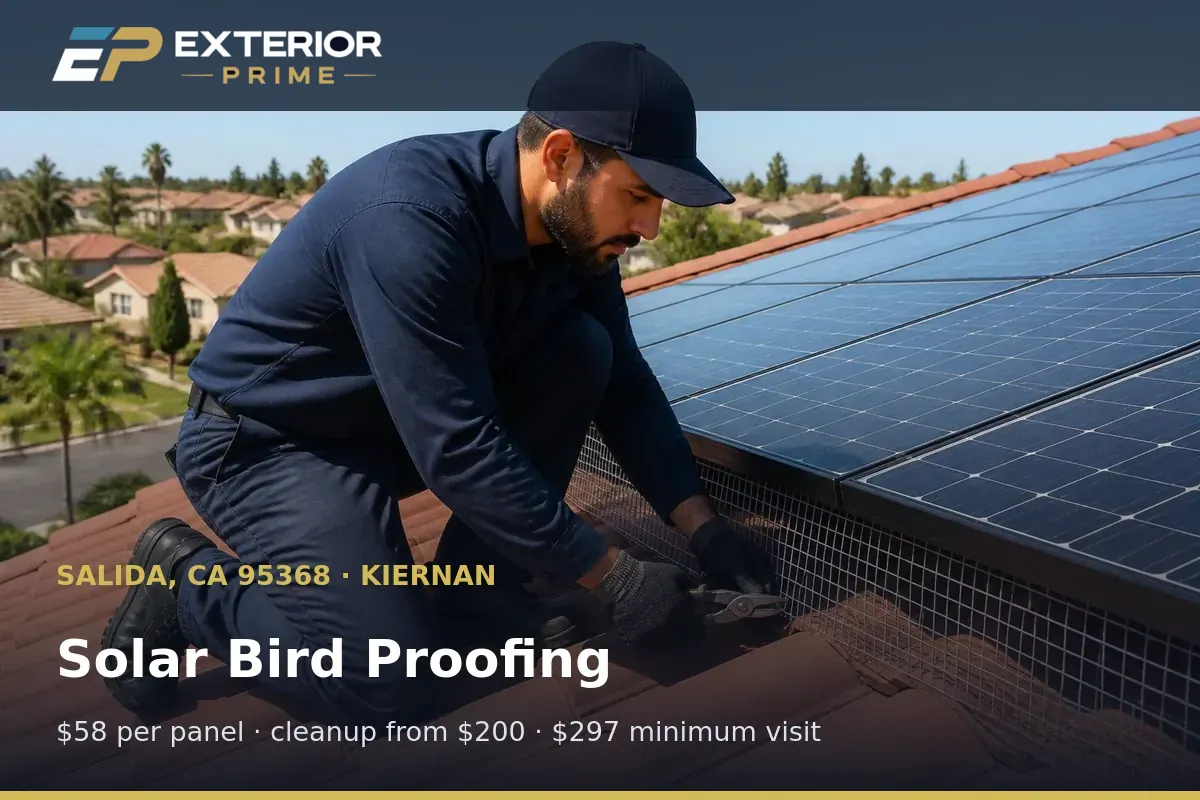
The mesh is carried entirely by stainless clamps that grip the module frame lip, leaving roof and glass free of any penetration.
Fixing a barrier with screws through a panel edge or into the roof plane is what voids module coverage and invites a leak, and it is not how any Exterior Prime installation is built.
Clamping puts the load on the frame instead. The mesh itself is galvanized steel selected to resist corrosion through Salida's damp foggy months, and stainless spikes are available for ridge or parapet runs where perching continues beyond the array edge.
Before the final seam is closed, the enclosed space is checked so nothing living is shut in. Five years of workmanship warranty then applies to the treated exclusion area, covering any clip line that lifts or seam that opens.
04
Scheduling bird proofing in Salida
Salida bookings made between December and March seal arrays ahead of the breeding season and hold cleanup labour to a minimum.
An array closed before spring never hosts a brood that year, which usually saves a few hundred dollars in clearance work compared with the same roof addressed in midsummer.
An active nest does not delay the job. Occupied pockets are worked around, reachable material is cleared once the young have gone, and the enclosure is finished in the same appointment wherever the roof allows.
Autumn is the other busy stretch, since hulling dust and a fouled array tend to be noticed together. Combining the proofing with a module wash on one trip is the efficient option, because a standalone Salida visit already carries its own minimum charge.