01
Building the system one roof plane at a time
Each roof plane on a Salida home gets its own measured mesh run because pitch, panel spacing and rail height rarely match from one plane to the next.
A single-storey stucco tract home built in the 1980s often has one simple south-facing plane, which keeps the system to a single continuous mesh run with a handful of corner returns. A two-storey Sisk Ranch or Pirrone Estates build usually has a front plane and a rear plane at different pitches, so Exterior Prime professionals treat each as its own section with its own measurements.
Panel spacing matters as much as plane count. Some Salida, Stanislaus County retrofits installed since the mid-2010s use tighter rail spacing than newer systems built after Delta breeze patterns and Tule fog exposure were better understood locally, and a tighter gap sometimes needs a finer mesh aperture to keep smaller juvenile pigeons from squeezing through later in the season.
Building plane by plane also means a partial system failure years later, if a panel is ever replaced under warranty, only requires reworking that one section instead of the whole roof.
02
What the finished mesh boundary looks like
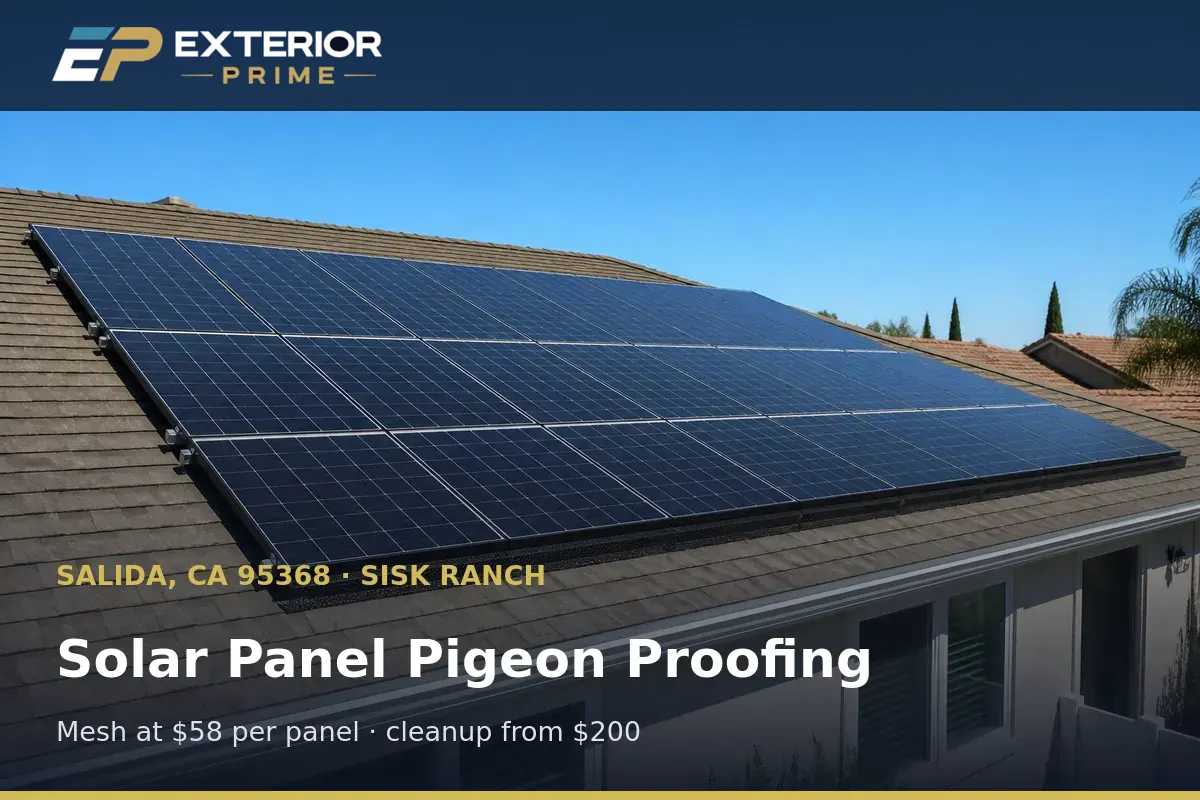
The finished boundary sits flush against the panel frame with folded returns at every rail end and no gap larger than a pigeon's head.
Exterior Prime professionals clamp mesh directly to the aluminum panel frame using the existing mounting hardware wherever possible, so the roofing material underneath, whether concrete tile or composition shingle, is never drilled or glued. That matters on Salida's older tile roofs, where extra penetrations can shorten the life of the tile itself.
Every corner gets a folded return instead of a flat cut, because a flat cut edge flexes slightly in wind and eventually opens a gap wide enough for a bird to test. Rail ends receive the same treatment, closing off the tube-shaped opening that pigeons often use as an entry point on rail-mounted arrays.
From ground level the finished mesh reads as a slightly darker line under the panel edge, similar in tone to the shadow the array already casts, which keeps the system unobtrusive on Kiernan Avenue and Broadway Colony streetscapes.
03
Post-install monitoring for Salida roofs
Exterior Prime recommends a seasonal look at the mesh boundary each spring before the March pigeon breeding window starts.
Even a well-fitted system benefits from a quick visual check once a year, since heavy Tule fog and winter storm winds between December and February can occasionally shift a clamp or loosen a corner return over several seasons. A five-minute look from the ground with binoculars usually confirms whether the boundary line is still tight.
If a homeowner ever has panel service work done, such as a module swap after storm damage, the mesh in that section should be checked afterward because service technicians sometimes need to unclamp a portion to reach the mounting hardware. Exterior Prime professionals can re-seat that section on a short follow-up visit.
Because the system is mechanical rather than chemical, there is nothing to reapply or refresh between checks, unlike gel or spray treatments that degrade under Salida's summer sun.
04
Does the mesh perimeter protect more than just the pigeons' entry point?
Yes, a properly clamped mesh perimeter in ZIP 95368 also keeps droppings and nesting debris off the racking, junction boxes and microinverters mounted under the array.
Uric acid from accumulated droppings can pit stainless steel clips and standoff hardware over several seasons, so Exterior Prime professionals route the mesh perimeter around junction boxes and bypass diode housings rather than stopping at the outer panel frame alone.
A nest pressed against a wiring run can trap heat and contribute to a hot spot on that string, and soiling loss from scattered feathers or droppings film across even 4 or 5 modules can quietly cost a household several kWh a month before it shows up on a bill.
Because every clip is fastened to existing mounting points, no roof penetration is added, and the same closed perimeter that blocks an adult pigeon also prevents a squab from ever hatching inside, removing the ectoparasites that typically arrive with an active nest.
05
Pricing the full system for a Salida home
System pricing is calculated per panel across all planes, so an 18-panel home comes to $1,044 at the standard $58 per panel rate.
A home with two roof planes and 26 total panels typically runs higher than a single-plane home with the same panel count because of the extra corner returns where the two planes meet, though the per-panel rate stays the same. Cleanup for any existing nesting material is priced separately, starting at $200.
Most systems on a single plane are completed in one visit, while split-plane systems on larger Pirrone Estates homes sometimes take a partial second morning, particularly if fog delays an early start.
Every finished system includes a walk-around confirmation and photo documentation, so homeowners have a record of exactly which sections were sealed and when.
For a typical Salida array, that means 18 modules at $58 each, roughly 140 linear feet of galvanized mesh, 2 to 4 hours on the roof, a $200 minimum if cleanup is needed, and a 5-year workmanship warranty on the stainless clips holding the barrier to the frames.