01
Why do Salida attics and roof decks attract more than birds?
Salida properties near Hammett Road almond blocks in ZIP 95368 see far more rodent pressure under solar arrays than typical suburban tracts.
The almond hulling operations that run from August through October push rodents off the orchard floor and toward the nearest cover, and a raised solar array on a Kiernan-area rooftop reads as ideal shelter. Roof rats climb stucco walls and rain gutters with ease, then squeeze through the two to four inch gap most racking systems leave along the roofline.
Ground squirrels are a different problem but end up in the same place. They travel along fence lines from vacant parcels near Sisk Road and Pirrone Road, find a low panel edge, and dig a shallow burrow beneath it. Once one animal establishes a den, droppings and scent trails invite more, and by winter a homeowner may have a small colony living under the array.
None of this is exclusive to older homes. Newer two-storey builds in Pirrone Estates and Sisk Ranch have the same open gap by design, because racking is engineered for airflow and thermal performance, not exclusion. A critter guard is the retrofit that closes that gap without touching the panels or the mounting hardware.
02
What separates a critter guard from bird netting
Bird netting stops pigeons but leaves gaps wide enough for squirrels and roof rats to push through.
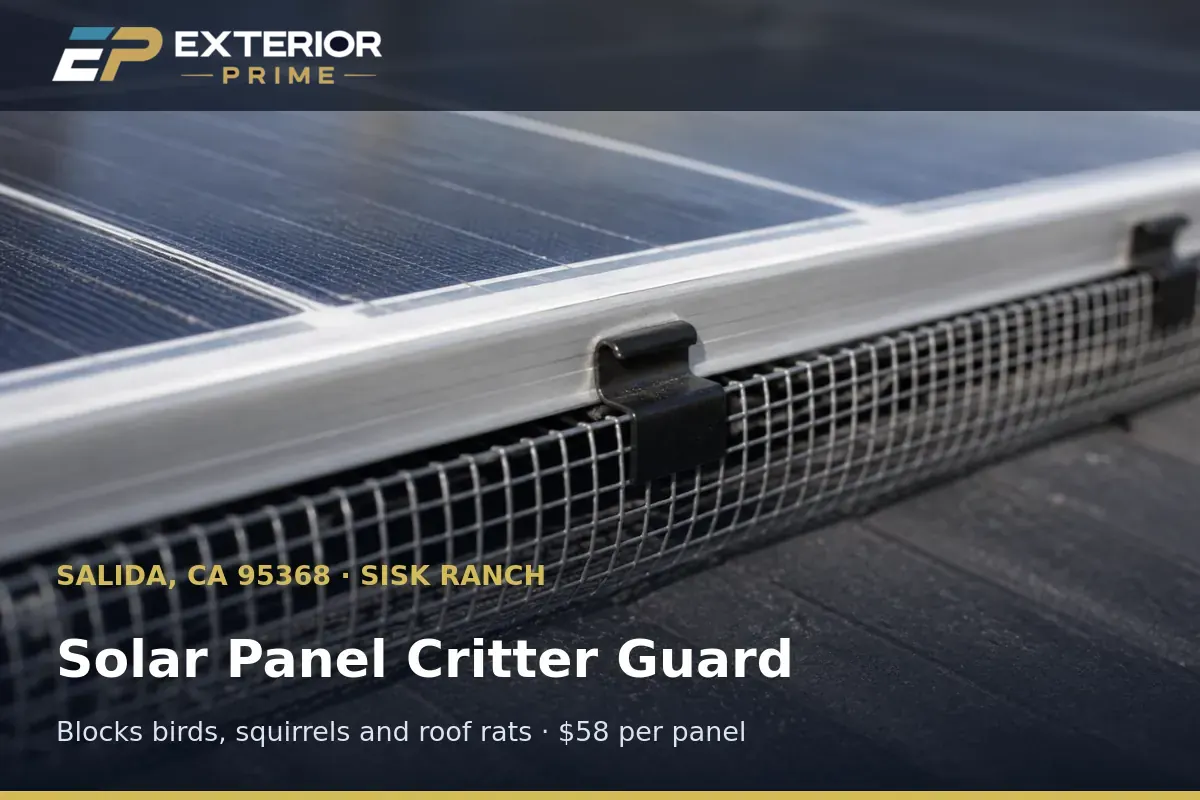
Standard bird mesh uses a wider weave, often an inch or more, because pigeons only need to be kept from landing and roosting. Rodents chew and squeeze, so a critter guard uses a tighter, heavier-gauge galvanized mesh, usually a half inch or smaller, clamped to the panel frame rather than glued or stapled.
The clamping detail matters in Salida because of the wind that funnels along the Highway 99 frontage on hot July and August afternoons, when panel temperatures alone can climb well past 100 degrees and expand any adhesive-mounted trim. Frame clips flex with that heat instead of popping loose, which keeps the guard tight through a full Central Valley summer.
Corner returns are the other detail worth checking. A critter guard that stops flat at the panel edge leaves a gap at the corner where the racking rail meets the roof deck, and that corner is exactly where a roof rat finds its way in first. Salida installs should wrap and fasten every corner return, not just the straight runs.
03
Signs a Salida homeowner already has an active problem
Chewed wire insulation, scratching sounds at dusk, and a sudden production drop are the three clearest warning signs.
Roof rats are most active at dusk and again before dawn, so scratching or thumping heard through a bedroom ceiling in the evening is a strong early indicator. Homeowners in the Broadway Colony area have reported this pattern most often in late fall, right after the almond hulling dust settles and orchard cover thins out.
A second sign shows up on the monitoring app most inverters report to: a gradual production dip on one string of panels, unrelated to weather, usually means an animal has built material against the backsheet or chewed through a connector. Chewed wiring is a fire risk as well as a production loss, so this sign should never wait for a scheduled maintenance visit.
Finally, droppings and shredded insulation visible at the panel edge with a flashlight confirm an active nest rather than a passing visitor. At that point cleanup pricing from $200 applies in addition to the guard install, because Exterior Prime professionals remove the material and sanitize the area before closing the gap.
04
How Salida's climate shapes the install timeline
December through February fog delays roof work in Salida because damp tile and shingle surfaces need to dry before mesh adhesion or fasteners set properly.
Dense Tule fog sits over the valley floor most winter mornings, and a wet composition shingle roof is not safe for a technician to walk on the same way a dry roof is. Exterior Prime professionals schedule around the fog burn-off, usually starting work by mid-morning once visibility and roof traction improve.
Spring is the busiest season for a different reason: pigeon breeding season starts in March, and rodent activity from the prior fall often overlaps with new nesting attempts. Homeowners who book a critter guard install in late winter usually beat both problems before they compound.
Summer installs are fast but require early starts, since composition shingle surfaces in Salida can exceed safe working temperature by early afternoon in July and August. A typical critter guard job on an 18 to 24 panel array still finishes in a single morning visit even with those seasonal adjustments.