01
Aperture Size That Actually Stops Pigeons
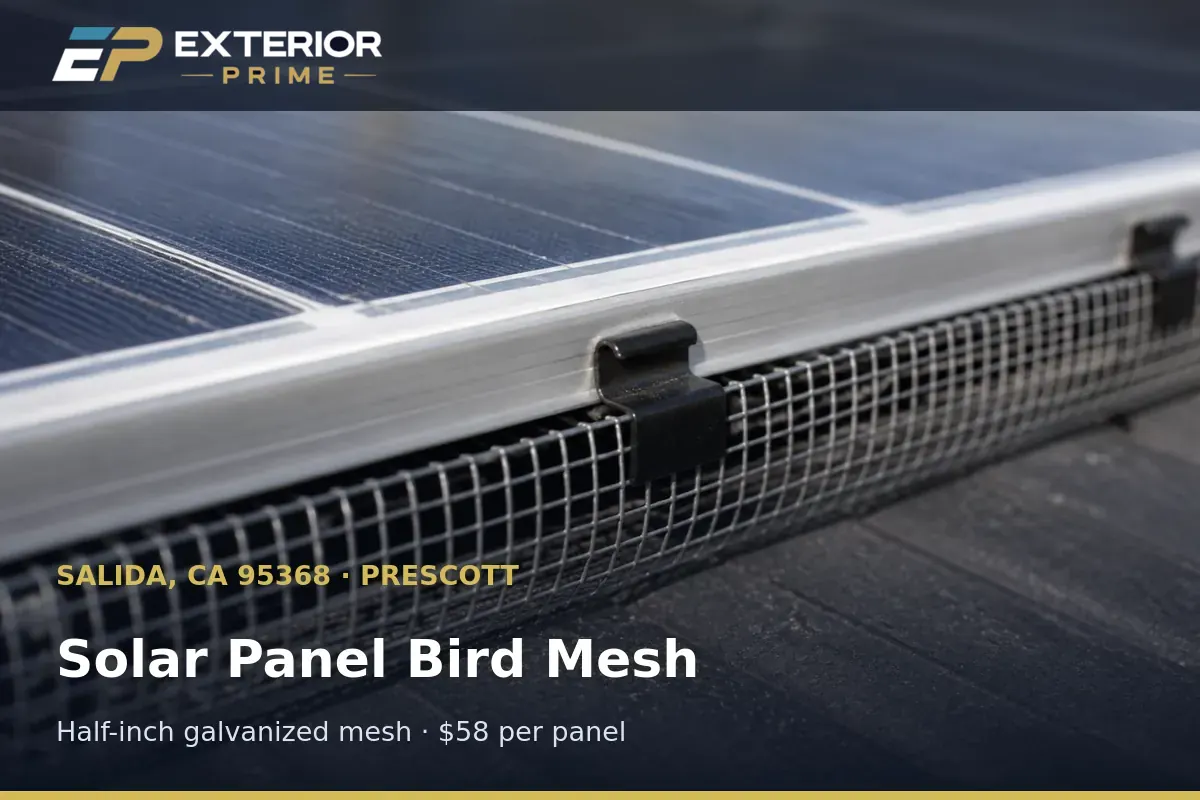
Mesh openings need to sit near one inch square to block adult pigeons without choking airflow under the array.
Aperture is the single most argued-over spec in bird mesh, and it matters more than most homeowners assume. Openings cut too wide, closer to 2 inches, let a determined pigeon squeeze a wing through and work its way in, which we still see on older DIY jobs around Broadway Colony in Salida 95368.
Openings cut too tight trap dust and reduce airflow underneath the modules, which can nudge panel temperatures up during a 100°F July afternoon in Salida and shave a sliver off system output. A roughly one-inch aperture balances both concerns for the pigeon and sparrow pressure typical of this part of Stanislaus County.
We size aperture based on what's actually roosting nearby, since a property backing onto the almond blocks off Hammett Road sees different bird pressure than a home tucked into a Prescott cul-de-sac. Exterior Prime professionals adjust mesh spacing accordingly rather than installing one fixed spec everywhere.
02
Galvanizing And Corrosion Through Salida's Foggy Winters
Hot-dip galvanized coating survives repeated damp fog cycles far better than the electro-galvanized wire sold in retail kits.
Salida's winters aren't cold in the way a mountain town's are, but they are wet in a specific, corrosive way. Dense Tule fog rolls in most December and January mornings and sits on rooftops for hours, and that daily condensation cycle is harder on bare or lightly coated metal than a single hard freeze would be.
Hot-dip galvanizing bonds a thick zinc layer to the wire that sacrifices itself slowly to protect the steel underneath, which is why it survives that repeated wet-dry cycling for years. The thin electro-galvanized coating on most retail mesh rolls wears through within a season or two of that same exposure and starts rusting from the inside of the weave outward.
We've pulled failed retail mesh off Sisk Ranch roofs where the rust had already stained the roof tile beneath it, which turns a bird problem into a cosmetic one. Hot-dip mesh doesn't leave that residue because the coating holds long after the mesh has done its job for several seasons.
03
Fitting Mesh Around Conduit And Rails
Mesh has to be cut and tucked around every conduit run and rail bracket or the whole barrier is only as good as its weakest gap.
A roll of mesh stretched flat across a rack looks finished from the ground, but pigeons don't test installs from the ground. They probe every seam, and the seams that fail fastest are the ones where mesh was cut short to avoid a conduit clip instead of notched around it.
On the newer two-storey builds in Pirrone Estates, microinverters sit low and close to the rail, which leaves little slack for sloppy cutting. We template each panel row before cutting mesh so the fit tucks fully around every fitting rather than stopping an inch short and calling it close enough.
Rail end caps and grounding lugs get the same treatment. Any hardware point that punches through the mesh plane without a tight wrap becomes the exact spot a pigeon will land and push against first, so we close those gaps by hand rather than trimming a straight edge and moving on.
04
What Mesh Weight Should Your Salida Array Use?
Panel count, roof pitch and wind exposure on your specific Salida block should decide the mesh gauge you install.
Not every roof needs the heaviest gauge available. A single-storey stucco home tucked behind other houses near Kiernan Avenue sees far less wind load than an exposed two-storey roofline in Sisk Ranch, and matching gauge to exposure keeps cost reasonable without under-building the barrier.
Split-plane arrays, common on the larger newer builds, sometimes mix gauges intentionally, using a slightly heavier mesh on the exposed south-facing plane and a lighter, easier-to-route mesh on a sheltered north-facing section. That approach still starts at the same $58 per panel because labor, not raw wire weight, drives most of the cost.
We also factor in whether the roof carries composition shingle or concrete tile, since tile edges can abrade a mesh edge over time if it isn't tucked and clamped cleanly at the perimeter. Exterior Prime professionals check that detail on every Salida site visit before quoting the job.