01
What sounds signal pigeons under the array?
Cooing, wing-flapping and light scratching before sunrise are the clearest ground-level signs of a roost.
Pigeons are most active in the early morning, so a Salida homeowner standing in the driveway around sunrise is often the first to notice a low cooing sound coming from the roofline. It tends to be quietest and most audible during the still Tule fog mornings common from December through February near Stanislaus County.
Wing-flapping sounds when a pigeon lands or leaves the array are usually followed by a brief scratching noise as the bird settles against the underside of a panel. If that pattern repeats at roughly the same time each morning, it usually means an established roost rather than a bird just passing through.
Scratching heard specifically after dark, rather than at dawn, more often points to rodents or roof rats than pigeons, so timing the sound over 2 or 3 mornings helps narrow down what is actually up there before anyone climbs a ladder.
02
What to look for on Salida ground and walls
White or gray streaking on stucco below the array edge is the most reliable visual clue from ground level.
Droppings from an active roost tend to accumulate directly below the lowest point of the array, streaking down exterior stucco or collecting on a patio surface underneath. In older Broadway Colony tracts near Kiernan Avenue, this streaking is often mistaken for well water mineral spotting from sprinklers, so it helps to check whether the marks are concentrated under the panels specifically.
Feathers caught in gutters, on window screens, or scattered across a driveway below the roofline are another sign worth checking after any windy day. A few stray feathers might mean a bird passed through, but a consistent scatter over 2 to 3 weeks usually points to nesting activity.
A musty, ammonia-like smell near a vent or eave close to the array, especially noticeable on warm afternoons once temperatures climb into the 90s and 100s in July and August, often means droppings have been accumulating out of sight for a while.
03
What a photo inspection actually confirms
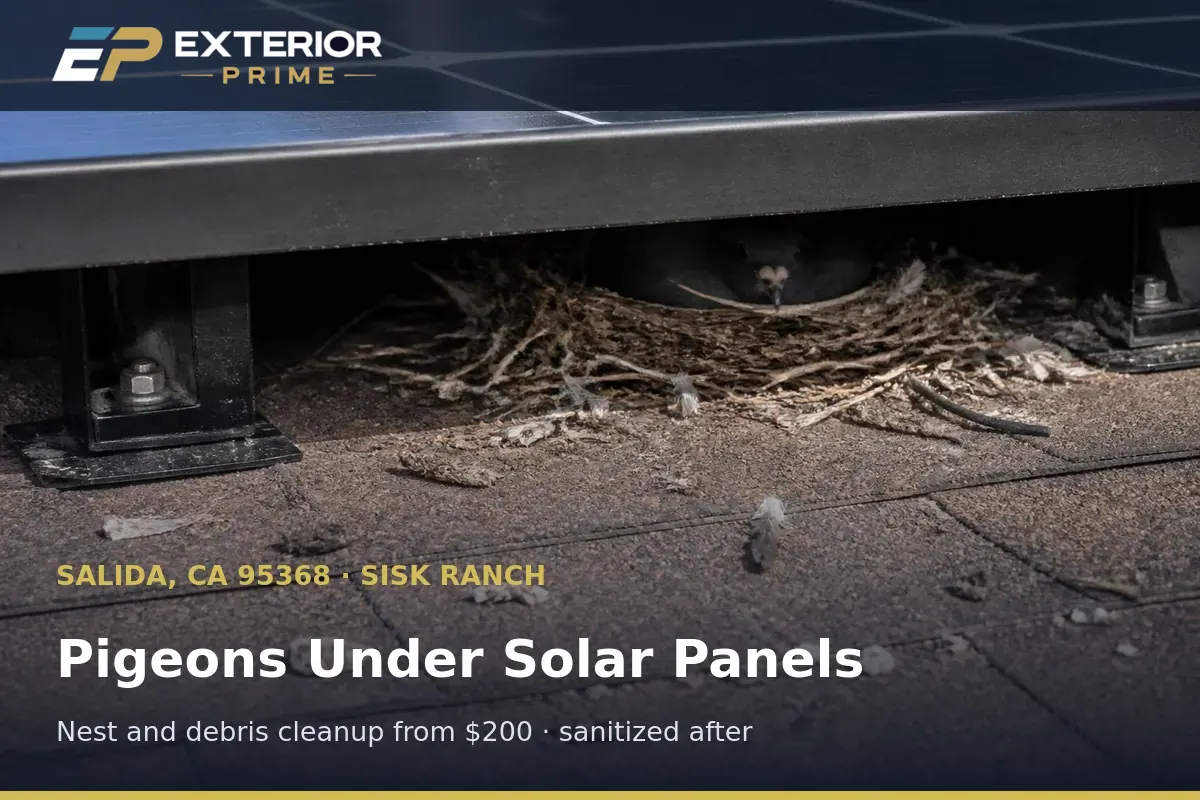
Photos taken from a ladder or drone at the array edge confirm nesting material, egg presence and entry gaps.
Exterior Prime professionals do not guess based on sounds and stains alone. A photo inspection at the panel edge shows whether there is loose nesting material, guano, mite activity, active eggs or chicks, and exactly where the gap between the racking, conduit and roof surface is wide enough for a bird to pass through.
This step matters for timing. If chicks are present, work often needs to be scheduled around fledging so nestlings are not stranded once an exit is sealed, which typically adds a short delay of 1 to 2 weeks depending on the stage of the brood.
The inspection also rules out other causes. Sometimes what sounds like pigeons is actually a squirrel or a loose piece of flashing vibrating in the wind, and a quick look under the array settles the question before any work is quoted.
04
Why the problem tends to get worse if it's ignored
A single unsealed gap under an array can host multiple pigeon generations across just one Salida breeding season.
Pigeons breed several times a year once conditions are right, and Salida's mild spring starting in March gives them an early window near Pirrone Estates. A pair that nests successfully under a panel in March or April can produce a second brood within 6 to 8 weeks in the same spot, since nothing about the location has changed.
Accumulated droppings also create their own problems over time, including corrosive buildup on panel mounting hardware and, in some cases, staining that is difficult to remove from roof tile. What starts as a noise complaint in spring can become a cleanup and hardware inspection issue by fall.
Because the underside of an array is largely invisible from the ground, it is easy for a Salida homeowner to underestimate how much material has built up until a professional actually gets eyes on it during an inspection.