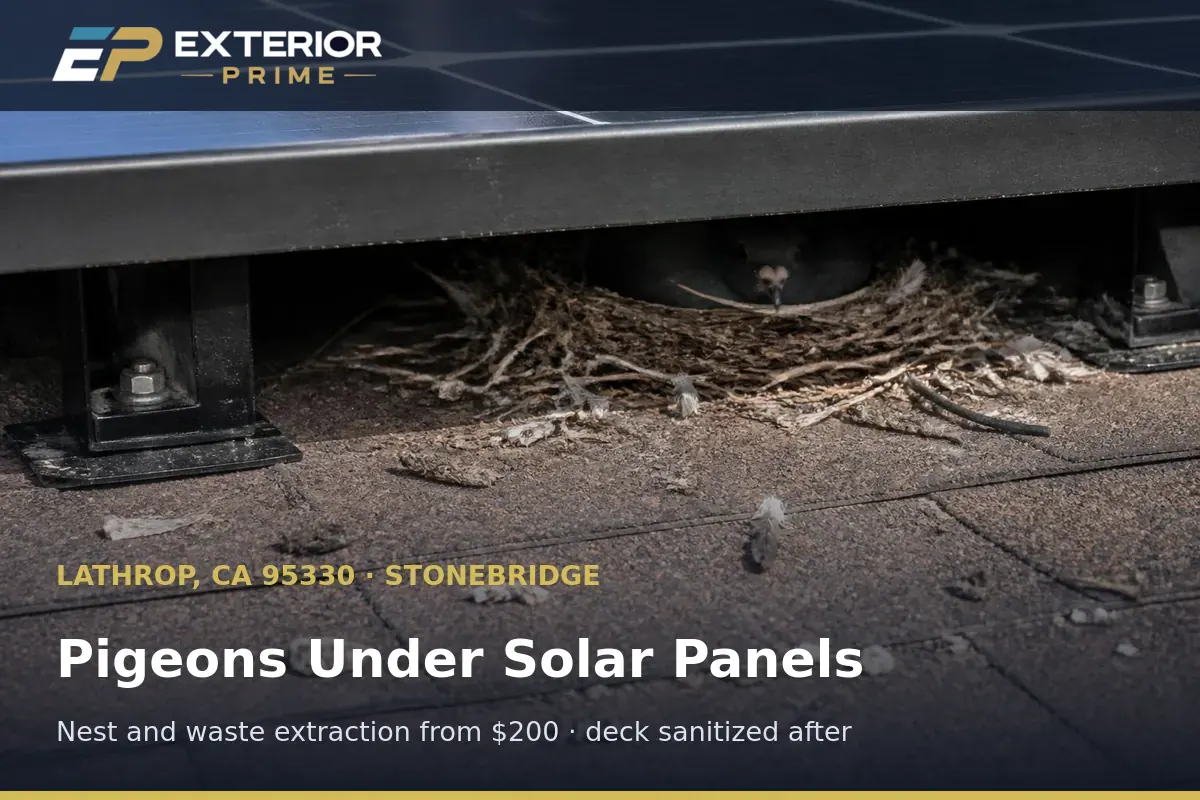
What's actually accumulating under a Lathrop solar array?
A single active nest cavity can hold 15-25 pounds of sticks, feathers, and droppings by the end of one breeding season, plus whatever a returning pair adds the next year.
The four-inch gap under a typical Central Valley racking system is warm, shaded, and out of reach for most predators, which makes it close to ideal from a pigeon's perspective. On a 20-panel Stonebridge roof, our professionals have pulled out nest piles weighing well over 20 pounds once packed feathers and dried guano are factored in.
That weight sits directly against the racking rails and, on older installs, against roof flashing too. Combined with the moisture tule fog leaves behind most winter mornings, it creates a corrosion risk for galvanized hardware that was never designed to sit under a wet mat of organic debris for months at a time.
Multiply that by years. A Historic Lathrop home where the same gap has hosted nesting pairs since the panels went in eight years ago can have layered debris from multiple broods compacted together, which takes considerably longer to extract safely than a first-season nest.
Do mites and ectoparasites really spread from a nest under the panels?
Yes, bird mites and other ectoparasites breed directly in the nest material and actively search for a new host once the birds fledge or abandon the site.
Bird mites don't stay put once their host leaves. When a brood fledges from under a River Islands array, or when a nest is abandoned mid-season, the mite population living in that debris starts looking for warm-blooded hosts nearby, and an attic vent a few feet away is an easy target.
Pest-control reports across San Joaquin County confirm sudden indoor mite complaints often trace back to a bird nest that recently emptied out on the roof or under an eave. Homeowners describe itchy, pinprick bites appearing over a few days with no obvious cause, until someone checks the solar array.
This is exactly why Exterior Prime treats sanitizing as a required step, not an optional add-on. Removing the nest without addressing the mites living in the surrounding rail and insulation just delays the indoor complaint by a week or two instead of preventing it.
How does nesting debris damage the electrical components?
Pigeons chew and rub against exposed conduit and microinverter leads while building and maintaining a nest, which can fray insulation and create a fire or performance risk.
Solar racking runs conduit and microinverter wiring along the same rails pigeons use as nest scaffolding. Beaks and claws working against zip-tied cable for months at a time wear through jacketing faster than most homeowners expect, and Exterior Prime has found bare copper exposed on more than one Golden Valley Parkway install where a nest sat undisturbed for two full seasons.
Chewed conduit isn't just a fire risk, it's also a performance issue. A compromised microinverter connection can drop a whole string's output, and on a 24-panel Woodfield system that can mean a noticeable dip in monthly production that homeowners sometimes chase for weeks before finding the actual cause under the panels.
Clearing debris without inspecting the wiring underneath misses half the problem. Our professionals check exposed conduit runs and inverter leads during every cleanup and flag anything that needs an electrician's attention before mesh goes back on.
What does clearing and sealing the gap cost?
Debris removal starts from $200 based on volume, and permanent mesh exclusion runs $58 per panel, putting most Lathrop homes in the $700-$1,400 total range.
A first-season nest with light debris on a Mossdale Landing home costs less to clear than a multi-year colony on an older roof, since extraction time scales directly with how much material and how many hardened debris layers our professionals need to remove.
Mesh pricing stays flat at $58 per panel regardless of debris history, and the $297 standalone minimum only applies if you're booking cleanup or mesh as the sole service on the visit.