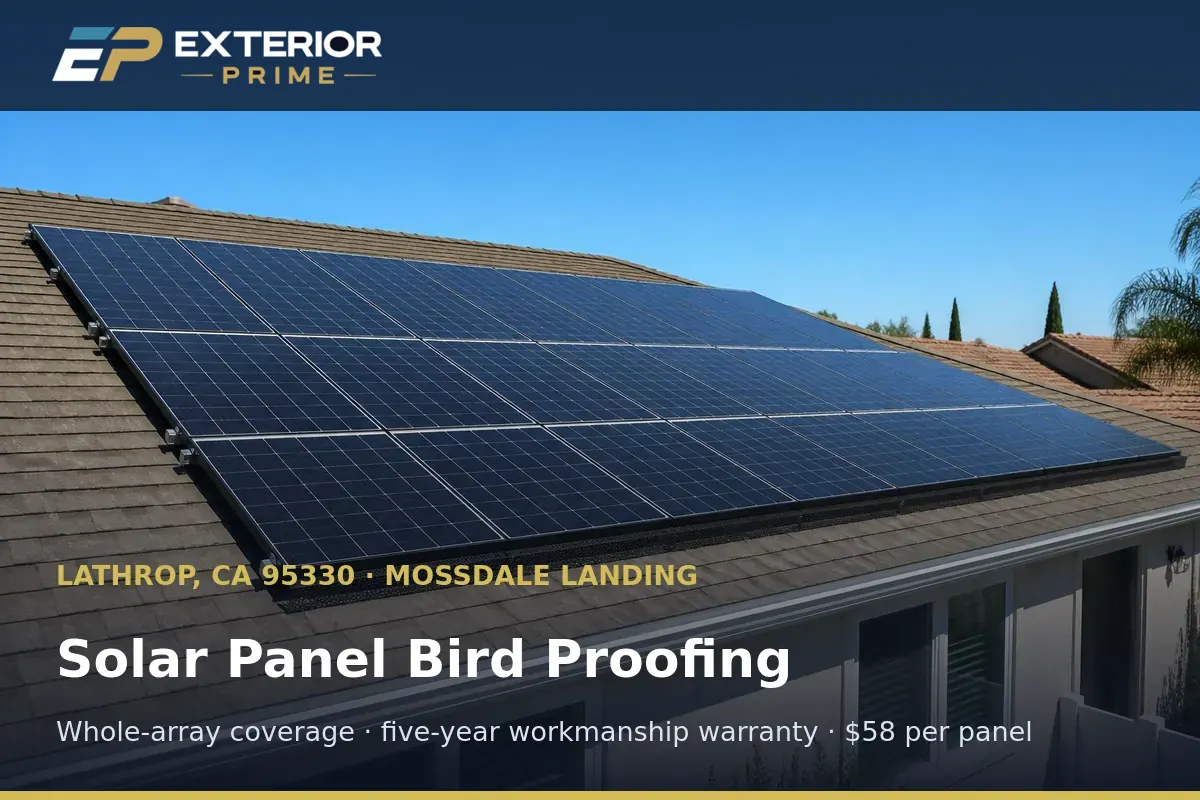
Why partial coverage fails on Lathrop roofs
A single open gap under a solar array is enough for pigeons to rebuild a colony within weeks, even after other edges are sealed.
We get calls from homeowners near Louise Avenue who paid someone to close off the street-facing edge of their array and figured that was the job done. Six weeks later, droppings show up on the driveway again because the pigeons simply moved to the back edge, over the yard, where nobody was looking. Partial mesh jobs don't reduce the pigeon population under a roof — they just relocate it to whichever seam is still open.
Lathrop's older Historic Lathrop homes near Lathrop Road often have low-pitch composition shingle roofs with racking mounted close to the deck, which creates a shaded, wind-sheltered gap on all four sides of the array. Sealing three sides and leaving the fourth open is functionally the same as sealing none — the birds use whichever route stays available, and they find it fast.
Newer River Islands builds tend to have steeper trusses and taller standoff racking, so the gap runs a consistent 4 to 6 inches around the whole perimeter. That consistency is actually good news: it means one continuous mesh run, done once, closes the entire structure instead of requiring five separate follow-up trips.
This is why Exterior Prime professionals measure the full perimeter before quoting, not just the side the homeowner mentions on the phone. A 22-panel array in Stonebridge might need 60 linear feet of mesh; skipping 10 of those feet to save money almost always means a second service call within a year.
What full-array coverage actually includes?
Full coverage means galvanized mesh clipped to the module frame around every open edge of the array, plus any adjoining eave or gutter line birds could use as a launch point.
Exterior Prime professionals walk the entire roof plane before cutting a single piece of mesh. That includes the obvious front-facing edge, the rear edge over the backyard, both side returns, and any gap where the array steps down over a lower roof section — common on the split-level floor plans built around Golden Valley Parkway.
The mesh itself is galvanized steel, cut and formed to the panel height, then clipped directly to the module frame with stainless clips. There are no roof penetrations anywhere in the install, which keeps both the roof warranty and the panel manufacturer's warranty fully intact — something we confirm in writing before our professionals leave the driveway.
For arrays with microinverters or optimizers mounted under the panels, our professionals route mesh around the conduit and junction boxes rather than through them, so nothing interferes with airflow or future service access. This matters most on 95330 rooftops installed in the last three or four years, where equipment density under the array is higher than older installs.
Once the perimeter is closed, we do a final walk-around from ground level with binoculars, checking for any daylight gap that would tell a pigeon there's still a way in. That last check is the difference between a job that holds for five years and one that gets reopened by October.
Signs your Lathrop array only has partial protection
Fresh droppings concentrated on one side of the roof, cooing sounds at dawn, and mesh that stops short of a corner are the clearest signs of a partial job.
If droppings are appearing on just one side of the house — say the side facing Dos Reis Road rather than the street — that's usually a sign a previous installer sealed the more visible edge and left the back open. Pigeons are efficient; they'll use whatever access remains and ignore the sealed sides entirely.
Another giveaway is mesh that visibly ends at a support post or vent pipe instead of wrapping around it. Roof penetrations for plumbing vents and attic fans are common gaps that get missed on a rushed bid, and they're exactly the kind of narrow opening a pigeon can squeeze through even when the rest of the array looks buttoned up.
Homeowners in Woodfield have told us they heard cooing under the panels for months but assumed it was coming from a neighbor's roof, because the mesh they could see from the ground looked complete. It wasn't until we got on the roof with a ladder that the open rear seam became obvious — about 8 feet of gap running behind the array, invisible from the street.
The tule fog season from December through February is a good time to check, since damp mornings make fresh droppings and feather debris much easier to spot against the panels before ag dust from the surrounding fields dries everything to a dusty gray by summer.
Pricing for whole-array bird proofing
Whole-array bird proofing runs $58 per panel installed, so a typical Lathrop home comes in between $1,050 and $1,400 depending on panel count and roof complexity.
The per-panel rate covers material, labor, and the clip hardware needed to secure mesh around the full perimeter — not just the front row. A 14-panel Historic Lathrop home might total around $810, while a 26-panel River Islands system with a two-story roof plane can run closer to $1,500 once the extra linear footage and ladder work are factored in.
If there's already an active nest or a heavy buildup of droppings when we arrive, cleanup is quoted separately starting from $200, priced after our professionals get eyes on the roof rather than guessed over the phone. We won't install mesh over an active nest without clearing it first — sealing pigeons inside the array creates a bigger problem than the one you started with.
Every whole-array job includes a five-year workmanship warranty on the treated exclusion zone, covering clip failure or mesh separation at no charge. That warranty only applies to the areas we actually cover, which is another reason we push for full-perimeter jobs instead of the cheaper partial quotes some homeowners get first.