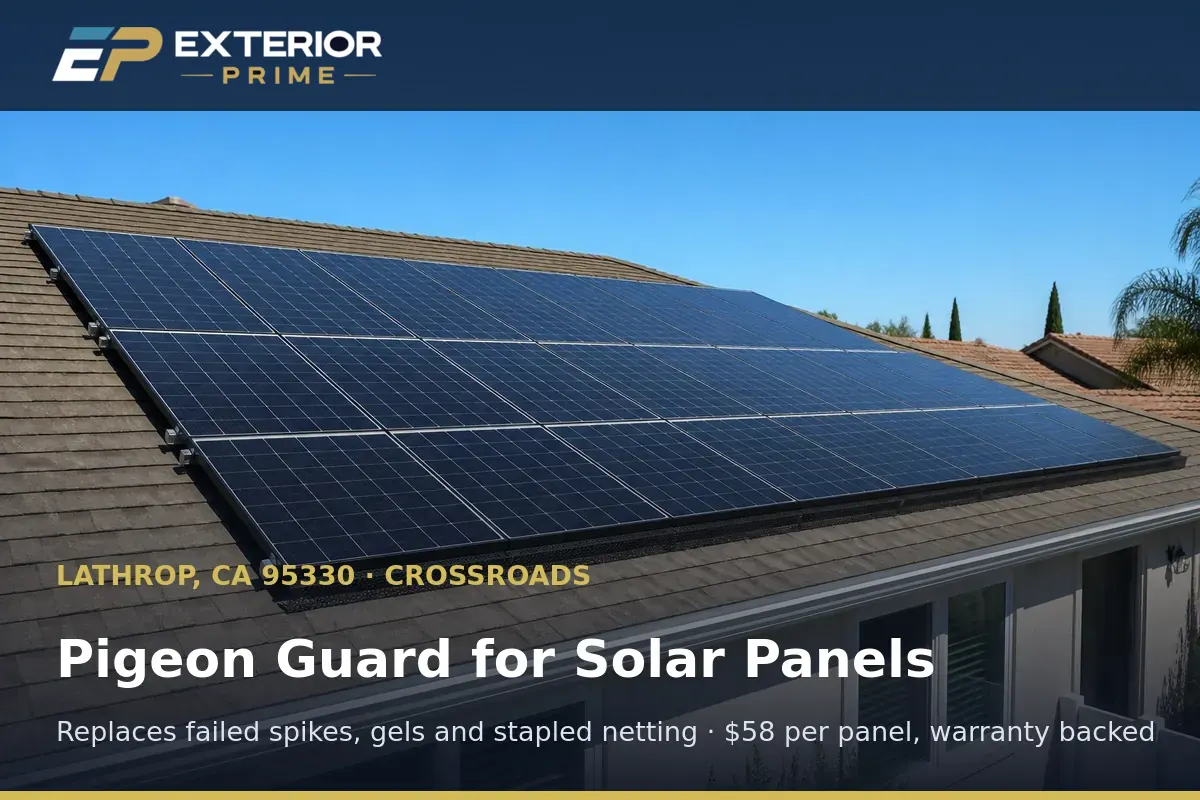
Why do spikes and gel usually fail on solar arrays?
Spikes and gel only protect the edge where they're applied, leaving the open space underneath the panels completely accessible to a determined pigeon.
Spike strips work reasonably well on a flat ledge or sign, where a bird needs to land directly on the treated surface. A solar panel array is different — pigeons can approach from underneath at an angle, bypassing spikes mounted along the top edge entirely. We've pulled spike strips off Lathrop roofs that were technically intact but doing nothing, because birds simply flew in from the side.
Sticky gel deters birds from landing on a treated surface for a while, but it degrades in Central Valley heat, picking up dust from nearby ag fields and almond orchards until it's no longer tacky. By the time a Lathrop homeowner notices pigeons are back, the gel has often been ineffective for months already.
Stapled netting is probably the most common failed DIY attempt we see. Staples pull out of aluminum panel frames under wind load, especially during the gustier delta-wind days common in spring, and once one section sags, pigeons find the gap and the whole net becomes useless.
None of these methods actually close the gap between the panel and the roof — they just try to make the edge unattractive to land on. Real pigeon guard means sealing that gap entirely with a mesh barrier that's mechanically fastened, not stapled or glued.
How does Exterior Prime remove old failed pigeon deterrents?
We remove old spikes, gel residue, and stapled netting completely before installing new mesh, so the new install isn't compromised by leftover materials.
Old stapled netting often leaves behind rusted staples embedded in the panel frame, which we remove carefully to avoid scratching the aluminum or damaging the module's protective coating. Leaving old staples in place can create small points where new mesh clips don't seat properly.
Gel residue gets scraped and cleaned before mesh installation, since a sticky surface can actually trap dust and debris that shortens the life of new stainless clips if they're mounted too close to leftover gel.
Spike strips are simply unscrewed or unclipped and hauled away — we don't leave failed deterrent hardware behind for a homeowner to deal with later. Removal is included in the mesh installation cost rather than billed as a separate line item in most cases.
Once everything old is cleared, we treat the job like a fresh install: measuring the array perimeter, checking for existing nest activity, and cleaning any droppings before the new galvanized mesh goes on.
What makes clipped mesh a permanent pigeon guard solution for Lathrop roofs?
Clipped mesh mechanically encloses the entire gap under the array using stainless fasteners on the module frame, rather than relying on a deterrent surface pigeons can eventually bypass.
Because the mesh physically blocks the opening rather than just discouraging landing, there's no learning curve for the pigeons to work around. A bird can't peck, squeeze, or fly its way past a properly clipped half-inch aperture the way it can eventually ignore spikes or dried-out gel.
Stainless clips spaced every 12 to 18 inches hold the mesh taut against the panel frame, which matters during the gustier days along River Islands Parkway and other open stretches of Lathrop where wind load is higher than in more sheltered older neighborhoods.
We've replaced failed pigeon guard setups on homes that had tried two or three different DIY methods over several years before calling us. In every case, once the mesh was properly clipped, the pigeon activity stopped within days rather than requiring ongoing maintenance or reapplication.
Unlike gel that needs reapplying every year or two, or netting that needs re-stapling after every windstorm, clipped galvanized mesh is backed by a five-year workmanship warranty and doesn't require seasonal upkeep from the homeowner.
Is replacing failed pigeon guard more expensive than a first-time install?
Only slightly, since removal of old materials is typically included in the standard $58-per-panel rate unless the old install caused unusual damage.
In most Lathrop cases, pulling off old spikes or netting adds maybe 30 to 45 minutes to the job, which we absorb into the standard installation time rather than charging a separate removal fee. A typical 18-panel replacement job still lands close to $1,050, in line with the usual $750 to $1,400 range for a first-time install of similar size.
The exception is when old netting has trapped droppings and nest debris behind it for an extended period, sometimes years, which requires the same from-$200 cleanup fee any first-time job with an active nest would need.
We've seen a few Historic Lathrop homes where old staples had actually punctured the panel's edge sealant slightly, which isn't something we can fix ourselves but is worth flagging to a solar installer if it comes up during our inspection.
Overall, most homeowners find that replacing a failed DIY or budget install costs roughly the same as doing it right the first time would have, just delayed by whatever time the failed method was in place.