Why roof penetrations are the biggest warranty risk for Lathrop solar owners
Any screw or adhesive method that touches the roof deck or racking can void manufacturer coverage, which is why penetration-free clip mounting matters more than the mesh material itself.
Solar and roofing manufacturers write their warranties around a specific, unmodified installation. The moment an aftermarket company drills into racking or the roof deck to anchor bird mesh, that warranty language typically no longer applies to the affected area — even if the pigeon proofing itself works perfectly. We've had Lathrop homeowners find this out the hard way when a roof leak years later got denied under warranty because of an unrelated mesh screw nearby.
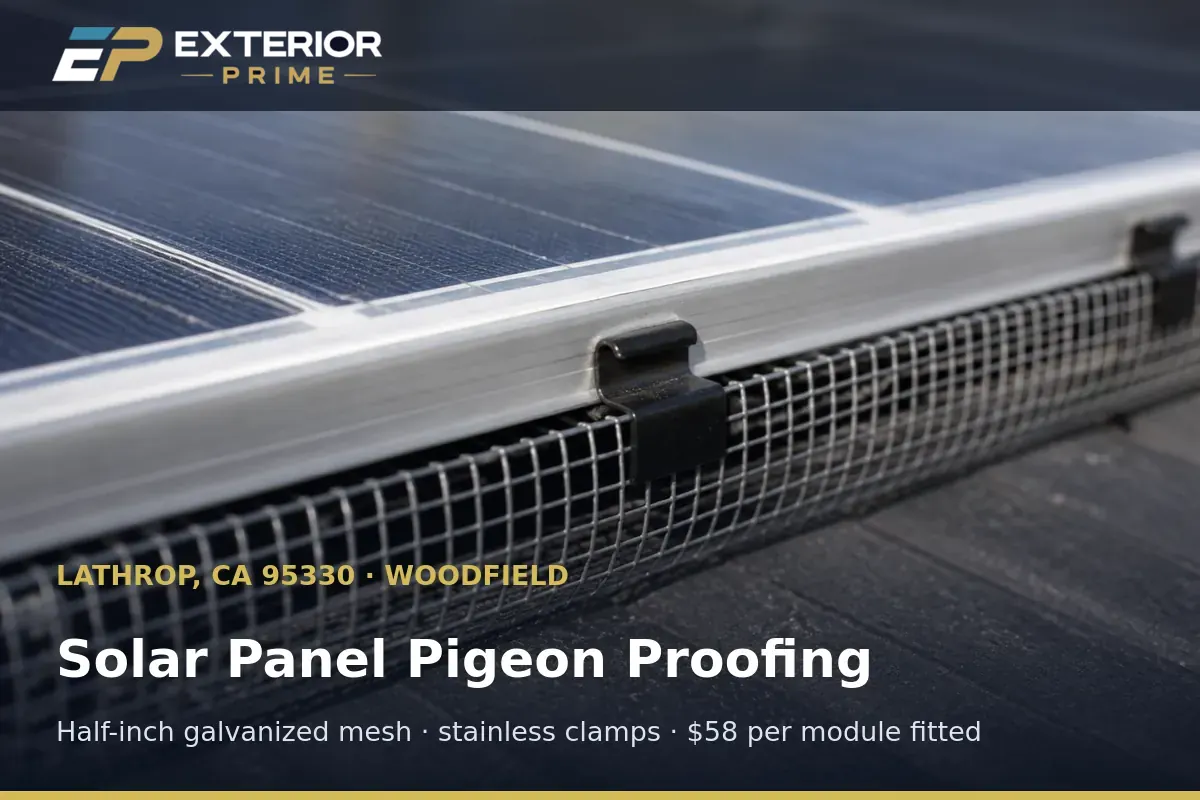
Exterior Prime professionals avoid this entirely by clipping galvanized mesh directly to the aluminum module frame with stainless steel clips. The frame is designed to be handled and doesn't carry the same warranty sensitivity as the roof deck or the racking rails underneath it.
This distinction matters especially for homes in Golden Valley Parkway's newer subdivisions, where solar systems are often financed with 20-plus year loans tied to warranty coverage. A voided warranty on a financed system isn't just an inconvenience — it can affect resale value and loan terms down the line. Homes along River Islands Parkway and Lathrop Road follow the same pattern, and 95330 lenders increasingly ask for proof that no roof penetration voided coverage before approving a refinance on panel-financed properties.
We put this in writing on every invoice: no roof penetrations, no racking penetrations, mesh attached to module frame only. It's a simple sentence that protects a homeowner's coverage for decades.
How do you install mesh without drilling into the roof?
Mesh is custom-formed to the module height and secured with spring-tension stainless clips that grip the aluminum frame edge, requiring no drilling at all.
The clips our professionals use are spring-loaded and sized to the specific frame profile of the modules installed — Lathrop homes have a mix of frame depths depending on when the system went in, so we measure before cutting any mesh. Once clipped on, the mesh holds firm against wind loads typical of Central Valley summer storms without needing a single fastener into the roof.
This method also means the install is fully reversible. If a homeowner ever needs a panel replaced or serviced under warranty, our professionals — or the solar company's own technician — can unclip the mesh section, do the work, and clip it back into place without damaging anything. Our professionals also route mesh clear of any exclusion zone around roof-mounted conduit runs, since roughly 4 in 10 Lathrop installs we inspect have at least one conduit path within a few inches of the array edge.
Galvanized mesh resists corrosion through Lathrop's full range of weather, from winter tule fog sitting on the roof for days to summer heat past 100°F with ag dust blowing in from nearby almond orchards. None of that requires re-drilling or re-anchoring over the life of the install.
We've applied this same method on roofs across Woodfield and Crossroads with tile, composition shingle, and standing-seam metal, adjusting only the clip spacing — never the attachment approach.
What warranty documentation you should keep
Homeowners should keep the itemized invoice, the attachment method statement, and dated photos showing mesh clipped to the frame in case a future claim needs proof.
Exterior Prime provides an itemized invoice describing the exact clip and mesh method used, along with the module frame specification it was matched to. This documentation is worth keeping alongside your original solar installation paperwork in case a warranty question ever comes up years down the road.
We also take dated photos of the completed install from multiple angles, showing the clips attached to the frame and no visible penetrations anywhere on the roof plane. These photos have helped more than one Lathrop homeowner resolve a warranty dispute quickly instead of arguing over what was or wasn't installed.
If your solar company or manufacturer ever asks about aftermarket additions to the array, this paperwork answers the question in under a minute instead of requiring a site visit. If droppings or an old nest are found beneath a neighboring, non-mesh section of roof during the walk-through, our professionals sanitize that area before finishing the warranty documentation, typically adding 20 to 30 minutes to the visit.
Pricing for warranty-safe mesh installation
Warranty-safe mesh installation costs the same $58 per panel as any Exterior Prime pigeon proofing job, with no premium charged for the zero-penetration method.
There's no upcharge for warranty-safe installation — it's simply how Exterior Prime does every job. A typical 20-panel Lathrop array runs around $1,150, landing within the $1,050 to $1,400 range most homes fall into depending on roof complexity and panel count.
If a prior installer already used a penetrating method elsewhere on the roof, our professionals can inspect and advise on next steps, though removing old penetrations is priced separately from new mesh installation.
Every job includes the five-year workmanship warranty on the mesh itself, which is separate from — and doesn't interfere with — the manufacturer warranty on your solar equipment.