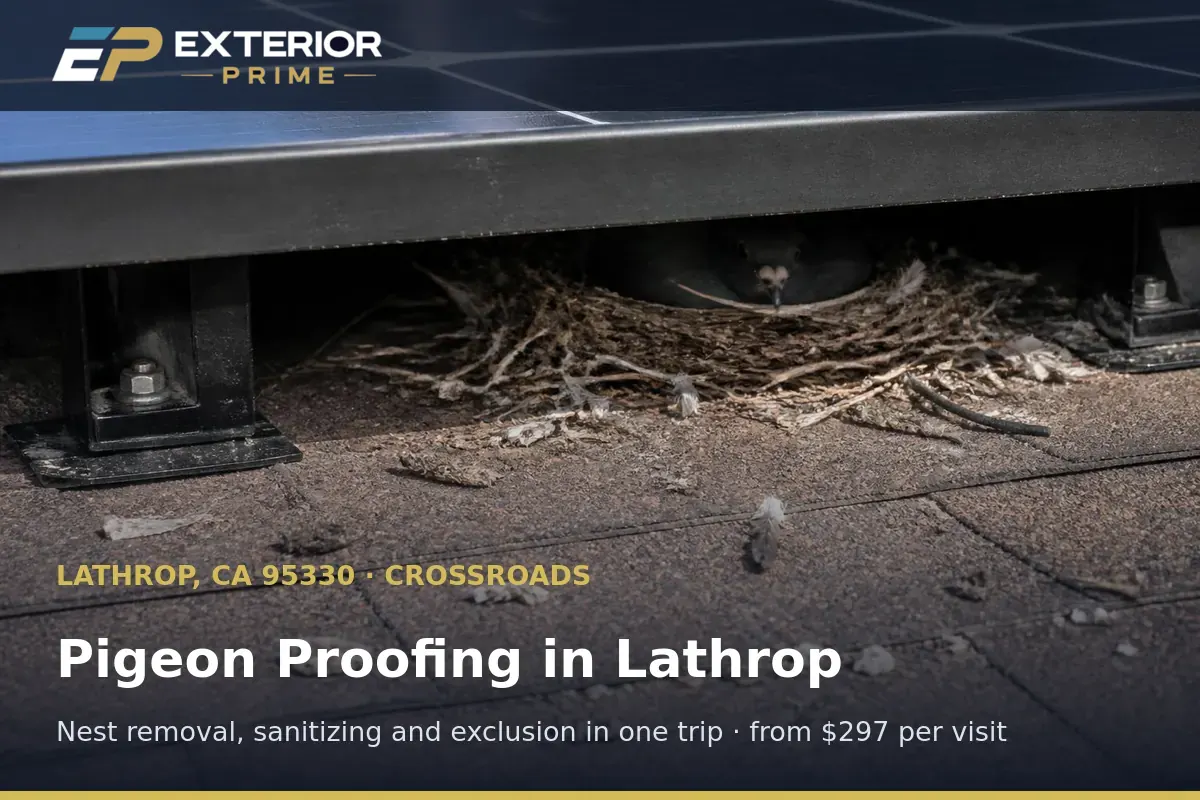
Pigeon proofing beyond the solar array
Eaves, patio cover gaps, and attic vents are just as common a nesting spot as solar racking, and all four need coverage for a property to be fully protected.
Plenty of Lathrop homes near Historic Lathrop and Lathrop Road don't have solar at all, and pigeons find plenty of other places to settle. Open eaves along the roofline offer the same shaded, wind-protected conditions as under a panel, and they're often overlooked because homeowners assume pigeon problems only happen to solar homes.
Patio covers, especially the lattice and beam style common across older Lathrop backyards, create dozens of small ledges perfect for roosting. We've cleared nests from patio cover beams that had been building up for over a year, with droppings staining the concrete below badly enough to need pressure washing afterward.
Attic vents are the entry point that worries us most, because a gap around a loose vent screen can let pigeons — or their droppings and parasites — into the attic space itself, not just the exterior of the roof. That's a bigger problem than exterior roosting and one we prioritize sealing whenever we spot it during a property walk.
Tile roofs add their own wrinkle: the gap under the curved profile of clay or concrete tile is a near-perfect nesting cavity, especially on the older tile common in parts of Woodfield, and it requires a different mesh approach than a flat composition shingle roof.
Why do pigeons target Lathrop properties specifically?
Lathrop's proximity to the San Joaquin River and delta levees near Dos Reis Road supports large resident pigeon populations that move onto nearby rooftops for shelter and nesting.
The delta environment around Lathrop, with the river, levees, and agricultural land nearby, supports pigeon and starling populations well above what you'd see in a purely urban area further from the water. These birds naturally look for elevated, sheltered structures once natural roosting spots along the river get crowded, and Lathrop's rooftops are the nearest option.
Ag dust and grain spillage from surrounding almond orchards and row crops give pigeons a steady food source close to residential areas, which keeps population pressure high year-round rather than seasonal. That means a property left unprotected doesn't just risk a one-time nesting event — it risks repeat visits every season.
Winter tule fog keeps roof surfaces damp and cool for weeks at a time, which pigeons tolerate well, while summer heat above 95°F pushes them toward the shadiest structures available — often exactly the eave, vent, or patio gap a homeowner hasn't thought to check.
Properties closer to River Islands Parkway and the river crossing near Mossdale see this pressure most intensely, simply due to proximity, but it affects the whole 95330 ZIP to varying degrees.
What each part of the property needs
Eaves need continuous mesh sealing gaps along the fascia, tile roofs need bird stops under the curved profile, patio covers need mesh or netting across beam gaps, and attic vents need fitted wire guards.
Eave sealing involves running mesh continuously along any open gap between the fascia board and the roofline, closing off the narrow horizontal opening pigeons squeeze through most easily. This is a common add-on for Historic Lathrop homes with older, slightly warped fascia boards.
Tile roofs need dedicated bird stops — small foam or mesh inserts that fill the gap under the curved edge of each row of tile without disrupting water drainage. Installing these incorrectly can actually trap water, so it's a job that benefits from experience with the specific tile profile used in Stonebridge and Woodfield developments.
Patio covers get treated with mesh or netting stretched across the beam structure, closing off roosting ledges while still allowing airflow underneath. For lattice-style covers, this sometimes means custom-cutting mesh panels to fit irregular gaps rather than one continuous run.
Attic vents are fitted with galvanized wire guards sized to the specific vent style, whether it's a gable vent, ridge vent, or soffit vent — all common across different Lathrop home ages and roof styles.
Pricing for property-wide pigeon proofing
Solar array coverage is $58 per panel, while eave, patio cover, and attic vent work is quoted per linear foot or per vent after an on-site survey, since gap sizes vary widely.
Because eaves, patio covers, and vents vary so much in size and configuration from one Lathrop property to the next, we don't quote those over the phone — our professionals measure on-site and provide a written price before any work begins. Solar array mesh stays consistent at $58 per panel regardless of what else is being addressed on the property.
Many Lathrop homeowners bundle solar mesh with eave or vent work in a single visit, since our professionals are already on the roof and can address multiple entry points without a separate trip. This often brings the combined cost in below what two separate service calls would total.
A $297 standalone minimum applies to any single-service visit, and cleanup for existing nesting anywhere on the property — solar, eaves, patio, or attic — starts from $200 depending on the extent of the buildup.