How bird droppings damage a roof over time
Concentrated droppings are acidic enough to break down shingle granules and tile sealant over months of exposure, shortening the roof's useful life under the array.
Pigeon and starling droppings are mildly acidic, and when they concentrate in one spot under a solar array for months at a time, they slowly degrade the protective granules on composition shingle roofs. This is especially common in Historic Lathrop, where many roofs are 15 to 20 years old already and don't have much wear margin left before a full replacement is due.
Tile roofs in Stonebridge and Woodfield aren't immune either. Droppings and nesting material trap moisture against the tile's underlayment, and repeated wet-dry cycles through Lathrop's tule fog winters followed by 100-degree summers accelerate cracking in the sealant lines around each tile.
There's also the matter of what's living in that nesting debris. Bird mites and other ectoparasites thrive in accumulated droppings and feather buildup, and they don't stay confined to the spot directly under the array — they migrate along the roofline into eaves and gutters, occasionally finding their way into attic vents.
A roof replacement runs into the tens of thousands of dollars, so protecting even a few extra years of shingle or tile life by keeping birds off the array is a meaningful return on a mesh install that costs a fraction of that. Central Valley summers above 95 degrees combined with ag dust from nearby almond orchards already stress composition shingle, so adding droppings acid on top shortens the roof's useful life faster than either factor alone.
Does bird proofing affect my roof warranty either way?
Properly installed bird proofing protects your roof warranty by preventing droppings damage, while penetrating attachment methods can void it — the installation method is what determines the outcome.
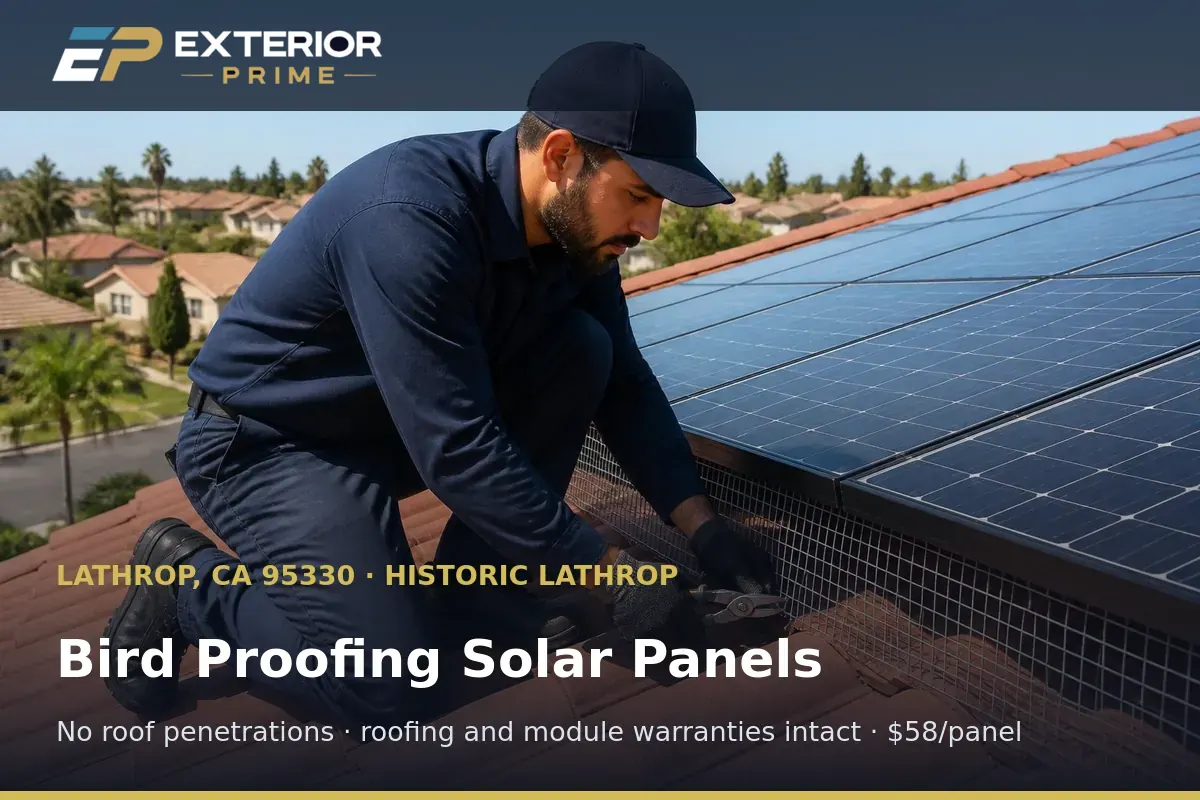
Roofing manufacturers generally don't have language against bird deterrents themselves; the risk comes from how the mesh gets attached. Exterior Prime clips galvanized mesh to the solar module frame with stainless clips, never into the roof deck or shingles, so the roof warranty stays exactly as it was before installation.
In fact, some Lathrop homeowners have used our documentation proactively — showing a roofing inspector that bird activity under the array was addressed before it caused shingle or tile damage, which can matter if a warranty claim ever needs to demonstrate reasonable maintenance.
We've seen the opposite scenario too: a homeowner near Crossroads had a prior company screw mesh brackets directly into tile to save time, cracking three tiles in the process and creating a leak that wasn't covered under the roof's original warranty because of the unauthorized modification.
The lesson is consistent across every roof type we work on in Lathrop — the mesh material matters less than how it's attached, and zero-penetration installation is the only way to guarantee the roof warranty question never comes up.
Which Lathrop roof types are most at risk?
Older composition shingle roofs in Historic Lathrop and tile roofs in Stonebridge both show measurable wear from sustained droppings exposure within two to three years of unaddressed nesting.
Composition shingle is the most visibly affected roof type, since droppings and moisture accelerate granule loss that's easy to spot as bare, discolored patches once mesh comes off during an inspection. Homes built before 2010 near Lathrop Road tend to have thinner shingle stock than newer builds, making this wear show up faster.
Tile roofs hide damage more subtly. The tile itself often survives fine, but the underlayment beneath it degrades from trapped moisture, and that's not visible until a leak actually develops — sometimes years after the bird activity started.
Metal and standing-seam roofs, less common but present on some newer Golden Valley Parkway builds, hold up best against droppings acid but still trap nesting debris that can clog drainage channels and cause water to pool in ways the roof wasn't designed for.
Pricing for roof-protecting bird proofing
Roof-focused bird proofing is priced the same $58 per panel as standard mesh installs, with cleanup for existing droppings damage assessed and quoted separately from $200.
A standard 20-panel Lathrop home runs around $1,150 for full mesh coverage, which is the same pricing structure regardless of roof material — shingle, tile, or metal all use the same per-panel rate since the mesh attaches to the module frame either way.
If droppings have already caused visible staining or granule loss, our professionals note it during the roof survey and can recommend next steps, though roof repair itself is outside our scope and would go to a roofing contractor. Our job is stopping further damage from occurring, not repairing what's already happened.
Every install includes the five-year workmanship warranty on the mesh, giving Lathrop homeowners a long runway of roof protection for a cost far below what droppings-related shingle or tile repair would eventually total.