bird proofing solar panels Tracy

    Bird Proofing Solar Panels to Protect Tracy Roof and Output

    Pigeons get most of the attention, but Tracy roofs near the surrounding row-crop and almond acreage also deal with starlings, swallows, and sparrows looking for shelter under solar arrays. Exterior Prime's mesh barrier stops all of them at once, protecting both your energy output and the roof surface underneath from years of accumulated debris.

    Serving Tracy 95376 · 95377 · 95304 · 95378 — Tracy Hills, Edgewood, Redbridge, Plaza Park, Downtown Tracy, Berg Ranch

    Quick answer

    Bird proofing solar panels in Tracy protects two things at once: energy output and the roof surface under the array, since debris from any nesting species traps heat and moisture against shingles or tile. Exterior Prime installs galvanized mesh at $58 per panel, typically $950 to $1,400 for a full Tracy home, with a $297 minimum on standalone visits.

    Tracy, CA 95376 · Pricing reviewed

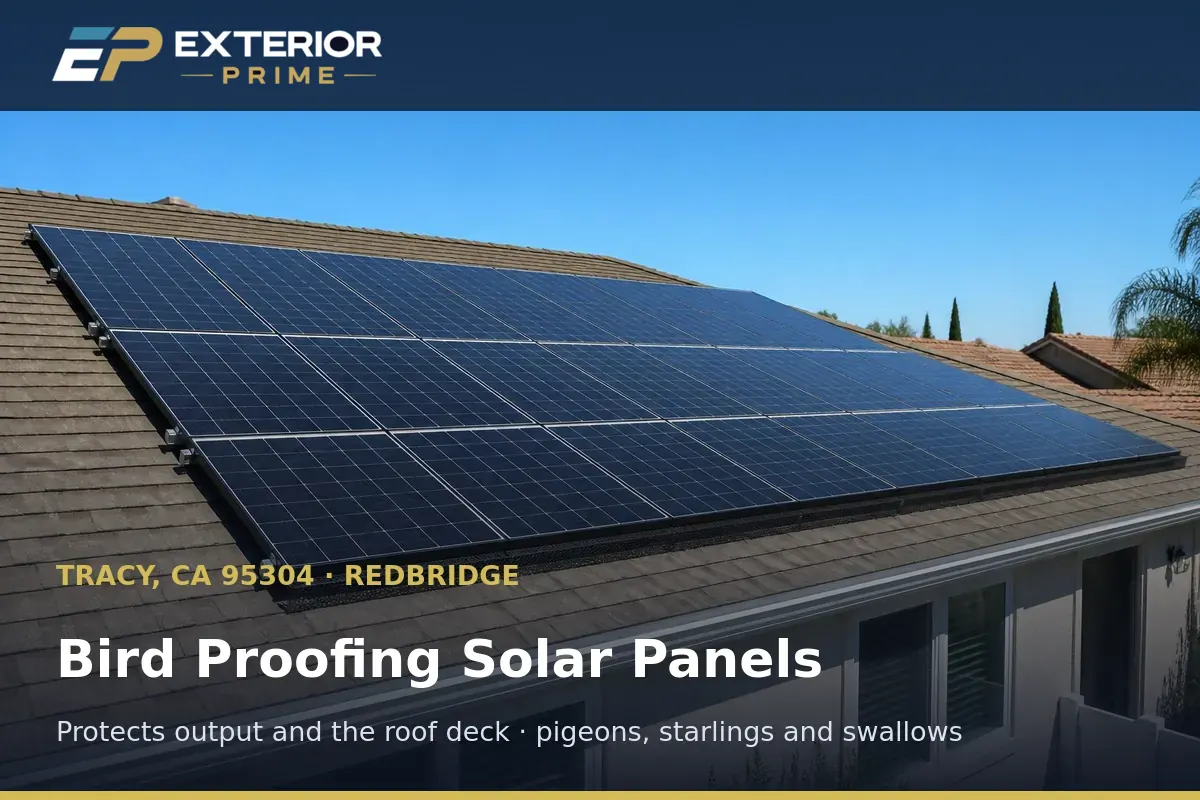
    Sealed rooftop solar array on a Redbridge home in Tracy, California with clean shingles and no bird streaking below the modules
    A Redbridge roof in Tracy 95304 two seasons after proofing — no streaking on the shingles and no debris shading the modules.

    Which birds actually target Tracy solar arrays

    Pigeons are the most common culprit in Tracy, but starlings, cliff swallows, and house sparrows also nest under panels near open farmland.

    Pigeons make up the majority of the calls we get across Tracy, largely because they're comfortable nesting close to people and thrive on the shaded, flat surfaces under standard racking. But Tracy's location surrounded by row-crop and almond acreage also brings in starlings looking for enclosed cavities and cliff swallows that build mud nests along eaves and panel edges during spring.

    House sparrows are smaller and can squeeze through a 1-inch gap that would stop a pigeon entirely, which is why mesh with the wrong gauge or an aperture over 3/4 inch sometimes stops the larger birds while sparrows keep slipping through. Our galvanized mesh spacing is chosen specifically to exclude the full range of species we see locally, not just pigeons.

    Swallows tend to show up seasonally in spring as they migrate through the Central Valley, building mud nests quickly along roof edges near Kagehiro and other neighborhoods close to open fields. Because their nests are mud-based rather than twig-based, they can actually add more weight and moisture retention against a roof surface than a typical pigeon nest of similar size.

    Regardless of species, the underlying fix is the same: physical exclusion that closes the gap entirely rather than a repellent that only discourages one type of bird temporarily. Our full-perimeter mesh approach doesn't discriminate between species — if a gap exists, it gets closed.

    How trapped debris damages your Tracy roof surface

    Nesting debris under solar panels traps heat and moisture against shingles or tile, accelerating wear well beyond what sun exposure alone would cause.

    Composition shingle roofs common throughout older Tracy neighborhoods are designed to shed heat and moisture efficiently when exposed directly to air. Once nesting material builds up underneath a panel, that airflow gets blocked, and the shingle surface underneath stays warmer and damper for longer stretches than the surrounding roof.

    Concrete tile roofs, more common in some Tracy Hills sections, are more physically durable but still suffer from trapped organic debris that holds moisture against mortar and flashing points. Over several seasons, that trapped moisture can contribute to the kind of slow degradation that's expensive to repair once it's noticed.

    Droppings themselves are acidic and can etch into shingle granules or tile coatings over time, especially when concentrated in one spot under a nest for months. This is a slower, less obvious form of roof damage compared to the visible mess on top of the panels themselves.

    Beyond the roof surface, debris buildup between panels and racking blocks airflow that panels rely on to stay at optimal operating temperature. A layer of feathers, twigs, and droppings insulates the underside of the panel, which is the opposite of what you want during a hot Tracy summer.

    How nesting debris cuts into Tracy solar output

    Panels running hotter due to trapped debris underneath produce measurably less power than a clean, properly ventilated array.

    Solar panels lose efficiency as their operating temperature rises above the optimal range, and trapped nesting material acts like insulation that keeps heat locked against the panel's underside. During peak Tracy summer conditions, when afternoons hold above 100°F for 6 to 8 hours, that effect compounds an already hot environment and pushes panels into a less efficient temperature range for most of the production day.

    Beyond the heat issue, debris can physically shade or partially block individual cells, especially along the lower edge of a panel where nesting material tends to accumulate first. Even partial shading on a single cell can disproportionately reduce output across an entire connected string, depending on your system's wiring configuration.

    Droppings that streak across the glass surface itself block direct sunlight from reaching the cells underneath, functioning similarly to dirt or dust buildup but concentrated and harder to remove with a simple rinse. Left unaddressed through a full growing season, this buildup accumulates faster than normal environmental dust.

    Keeping the space under and around your array completely sealed prevents all of these compounding issues from developing in the first place, which is the core argument for full bird proofing rather than periodic cleaning alone.

    Full-species exclusion for Tracy homes near open farmland

    Homes closer to Tracy's surrounding agricultural acreage need mesh sized to exclude smaller species like sparrows, not just larger pigeons.

    Properties on the edges of Tracy near open row-crop fields tend to see a wider variety of bird activity than homes deeper into established neighborhoods like Downtown Tracy. That broader exposure means mesh spacing needs to account for the smallest likely visitor, not just the largest.

    We size our mesh openings specifically to exclude house sparrows in addition to pigeons and swallows, which is a tighter spec than some generic bird netting sold for general use. This slightly tighter weave doesn't add meaningfully to material cost but does close the gap that lets smaller birds slip through where larger-gauge mesh would fail.

    Seasonal migration patterns also mean the species pressure on a given Tracy roof can shift through the year — more swallow activity in spring, more pigeon activity year-round, and occasional starling interest in late summer and fall. A properly closed perimeter handles all of these without needing separate treatments for each species.

    Ultimately, the same $58-per-panel mesh installation covers full-species exclusion at no extra charge, since the material and installation method don't change based on which bird happens to be interested in your particular Tracy roof.

    Which 95378 rooflines does bird proofing solar panels inspect?

    A 95378 bird proofing solar panels visit measures 84 feet of concrete, mildew and gutter edge around the array, then logs every roof opening our professionals seal.

    bird proofing solar panels on a 18-panel Berg Ranch roof takes about 39 minutes to map: 84 feet of concrete edge, 19 photographs, a 55 psi soft wash rinse across the stucco and fascia below, and agricultural dust noted in the 95378 file.

    Edgewood and Plaza Park arrays fail the same way — Central Valley heat pushes grit under the gutter, almond-orchard dust bakes soffit onto the paver and roof, so Exterior Prime folds that rinse into one bird proofing solar panels appointment rather than a $297 second trip.

    Exterior Prime records the 6-year workmanship history for 95378 and 95377 addresses, naming each mildew gap, paver screen and soffit deposit; a 18-panel job at $58 per panel is $1044, with cleanup from $200.

    Full-Species Bird Proofing Process for Tracy Solar Arrays

    1. 1

      Inspection identifying which species have shown interest in your specific array.

    2. 2

      Assessment of roof surface condition beneath any existing nesting debris.

    3. 3

      Sanitation of debris and droppings starting at $200 where needed.

    4. 4

      Custom-fit galvanized mesh sized to exclude sparrows as well as larger birds.

    5. 5

      Secure clip installation across every panel edge and roof plane transition.

    6. 6

      Final inspection confirming both the array and roof surface are fully protected.

    Bird Proofing Pricing for Tracy Homes

    Full-species exclusion uses the same $58-per-panel rate regardless of which birds have been active, with a $297 minimum for standalone Tracy visits.

    Bird Proofing Pricing for Tracy Homes
    ServicePriceNotes
    Small Array (up to 12 panels)$580-$696Common on compact Tracy lots
    Mid-Size Array (13-19 panels)$754-$1,102Typical family home in Tracy Hills
    Large Array (20-27 panels)$1,160-$1,566Bigger roofs with multiple planes
    Debris & Droppings SanitationStarting at $200Priced after on-site inspection
    Standalone Visit Minimum$297Applies to bird proofing-only bookings

    Standalone Exterior Prime visits in Tracy start at $297, which covers mobilization from Manteca, commercial-grade equipment, insurance and photo-verified documentation. Lower add-on rates apply when the work rides along with another service on the same trip.

    What Unchecked Bird Activity Does to Tracy Solar Systems

    • Reduced panel output from trapped heat and shading debris
    • Acidic droppings slowly etching shingle granules or tile coatings
    • Moisture trapped against the roof deck accelerating wear
    • Multiple species competing for the same shaded array space
    • Airflow blocked between panel and roof reducing cooling efficiency
    • Visible streaking and mess that lowers curb appeal and resale condition

    Why Tracy homeowners choose Exterior Prime

    • One mesh barrier excludes pigeons, starlings, swallows, and sparrows
    • Protects both solar output and the roof surface underneath
    • Improves panel cooling by keeping the under-array space clear
    • Prevents acidic droppings from accumulating against roofing material
    • Five-year workmanship guarantee across all Tracy neighborhoods
    • Sized mesh spacing that closes gaps smaller pigeons-only netting misses

    bird proofing for solar panels service area in Tracy, CA 95376

    Exterior Prime professionals cover every Tracy ZIP — 95376 through downtown and the Plaza Park blocks, 95377 across Tracy Hills and Edgewood, plus 95304 and 95378 out toward the Corral Hollow and Banta edges of town.

    Exterior Prime

    Manteca, CA 95336 · Serving Tracy, CA 95376 · 95377 · 95304 · 95378 in San Joaquin County, California

    (209) 821-1212

    Landmarks we route around

    • I-205 & Tracy Boulevard — Our main entry point into Tracy; most in-town stops sit within 10 minutes of it.
    • West Valley Mall — Reference point for the retail corridor where road film builds fastest on walls and walkways.
    • Downtown Tracy (11th Street) — Older wood-sided and shingled homes that need gentler soft-wash pressures.
    • Tracy Hills — Newer concrete-tile roofs and light stucco that show west-side grit within a season.
    • Grant Line Road corridor — Ag-adjacent blocks that pick up field and harvest dust each summer.
    • Corral Hollow Road & I-580 — Our southwest boundary before Livermore-side work begins.

    Directions to Tracy

    From Manteca
    Take I-205 west about 16 miles to Tracy Boulevard, then south into central Tracy — roughly 20 minutes.
    From Lathrop
    Follow I-205 west about 10 miles to Grant Line Road — about 13 minutes.
    From Mountain House
    Head east on I-205 about 6 miles to Tracy Boulevard — roughly 8 minutes.
    From Stockton
    Take I-5 south to I-205 west, about 22 miles total into Tracy — about 25 minutes.
    Open driving directions in Google Maps

    Neighborhoods inside the route

    • Tracy Hills
    • Edgewood
    • Redbridge
    • Plaza Park
    • Downtown Tracy
    • Berg Ranch

    Tracy is about 20 minutes west of our Manteca base on I-205, so Tracy visits are scheduled on the same route day as Lathrop and Mountain House work.

    Instant Quote

    Get Your Instant Quote

    Tell us a few quick details about your solar bird proofing project and get a fast, no-pressure quote from Exterior Prime — typically within one business day.

    Fast Response

    Most quotes returned within one business day.

    Photo-Verified Work

    Before/after photos on every job.

    Licensed & Insured

    Trained Exterior Prime professionals.

    No payment required to get a quote.

    How bird proofing for solar panels is priced in Tracy

    Do larger Tracy lots pay proportionally more for bird proofing for solar panels?
    Roughly, though not linearly. Doubling the surface on a Plaza Park property does not double the setup time, so the per-square-foot figure tends to improve as the job grows. Big Tracy exteriors usually come in better than owners expect per foot. Measured for bird proofing solar panels, small array (up to 12 panels) sits at $580-$696.
    Does Tracy have more than one pricing zone?
    No. Tracy spans several ZIPs including 95376, and all of them read from the same rate sheet. Wind exposure and canal-adjacent dust can lengthen a bird proofing for solar panels visit, but that shows up as scope on the quote, never as a hidden zone premium. Measured for bird proofing solar panels, small array (up to 12 panels) sits at $580-$696.
    What could push a Tracy bird proofing for solar panels quote above the estimate?
    Three things, all visible on arrival: far heavier soiling than the photos showed, surfaces needing a gentler and slower method, or access that blocks equipment. Professionals raise these before starting in Tracy and re-quote — the work does not proceed on a stale number. Measured for bird proofing solar panels, small array (up to 12 panels) sits at $580-$696.

    bird proofing for solar panels in Tracy — frequently asked questions

    No, our galvanized mesh is sized to exclude pigeons, starlings, swallows, and sparrows with a single installation. Homes near Tracy's surrounding farmland tend to see more species variety, so we size mesh openings tight enough to stop even smaller birds without needing separate treatments for each type.

    Book Tracy solar bird proofing →Compare Tracy packages & pricingSee how Tracy solar panel cleaning works

    Copy link to this answer: Do I need different proofing for pigeons versus other birds in Tracy?

    Trapped debris raises operating temperature and can shade individual cells, both of which reduce output during peak Tracy summer production hours. The exact percentage varies by how much material has accumulated, but keeping the space fully sealed from the start prevents this compounding loss entirely rather than trying to measure it after the fact.

    Book Tracy solar panel cleaning →Compare Tracy packages & pricingSee how Tracy solar panel cleaning works

    Copy link to this answer: How much solar output can debris under panels actually cost me?

    Yes. Droppings are acidic and can etch into shingle granules or tile coatings when concentrated in one spot over months. Combined with trapped moisture from nesting debris, this can contribute to roof wear beyond what normal sun and weather exposure alone would cause on a Tracy home.

    Book Tracy solar bird proofing →Compare Tracy packages & pricingSee how Tracy solar panel cleaning works

    Copy link to this answer: Can bird droppings actually damage my roof, not just my panels, and how is ladder work kept safe?

    Both. Pigeons account for most of our calls, but cliff swallows build mud nests along panel edges seasonally, particularly on homes closer to open fields near Tracy. Mud nests can actually hold more moisture against a roof than a similarly sized pigeon nest, making full exclusion valuable even on properties without a pigeon problem.

    Book Tracy solar bird proofing →Compare Tracy packages & pricingSee how Tracy solar panel cleaning works

    Copy link to this answer: Are swallows a real problem for Tracy solar arrays, or mostly pigeons?

    No, our standard mesh spacing already accounts for smaller species like sparrows at no additional charge. The $58-per-panel rate covers full-species exclusion, since the tighter weave doesn't meaningfully change material cost compared to looser mesh sold for pigeons alone.

    Book Tracy solar bird proofing →Compare Tracy packages & pricingSee how Tracy solar panel cleaning works

    Copy link to this answer: Does excluding smaller birds like sparrows cost more than pigeon-only mesh?

    Our inspection checks for discoloration, granule loss, or soft spots beneath the array where debris may have sat for a while. Homes with visible droppings on the panels themselves often have more extensive buildup underneath than what's visible from the ground, which is why we always look underneath before quoting.

    Book Tracy solar bird proofing →Compare Tracy packages & pricingSee how Tracy solar panel cleaning works

    Copy link to this answer: How do I know if my Tracy roof already has hidden bird damage, and who confirms the finished result?

    Sealing the array specifically addresses the shaded, protected space under solar panels, which is the most attractive nesting spot on most Tracy roofs. Other areas like eaves or ridgelines can still attract birds separately, and we can assess those during the same visit if you'd like broader coverage.

    Book Tracy solar bird proofing →Compare Tracy packages & pricingSee how Tracy solar panel cleaning works

    Copy link to this answer: Will sealing the array stop birds from just nesting somewhere else on my Tracy roof?

    A 18-panel Berg Ranch array is a 6-hour visit in 95378: 39 minutes mapping 84 feet of concrete and gutter edge, 19 photographs, the roof and paver checks, then the 55 psi rinse. Steep two-story Edgewood pitches add roughly 65 minutes to a bird proofing solar panels job, and Exterior Prime books that 95377 follow-up before leaving.

    Book Tracy solar bird proofing →Compare Tracy packages & pricingSee how Tracy solar panel cleaning works

    Copy link to this answer: What is the bird proofing solar panels timeline for a Berg Ranch home?

    December through February, before spring nesting and while agricultural dust holds the soffit load down in 95378 and 95377: a 18-panel bird proofing solar panels job runs $58 per panel, or $1044, with $200 cleanup and the $297 minimum on the smallest Plaza Park arrays. Exterior Prime slots bird proofing solar panels work in Berg Ranch within 2 weeks, typically 5 days after the 95378 walkthrough.

    Book Tracy solar bird proofing →Compare Tracy packages & pricingSee how Tracy solar panel cleaning works

    Copy link to this answer: When should a Edgewood homeowner book bird proofing solar panels?

    Book Now (209) 821-1212

    Still have a question about your Tracy property? Call and a trained Exterior Prime professional will walk you through it.

    Related Tracy services

    bird proofing for solar panels in cities near Tracy

    Same trained Exterior Prime professionals and the same flat-rate pricing, with local detail written for each city.

    Ready to get started?

    Book Your Premium Wash Today

    Fast scheduling. Photo-verified results. Clear pricing from the start.