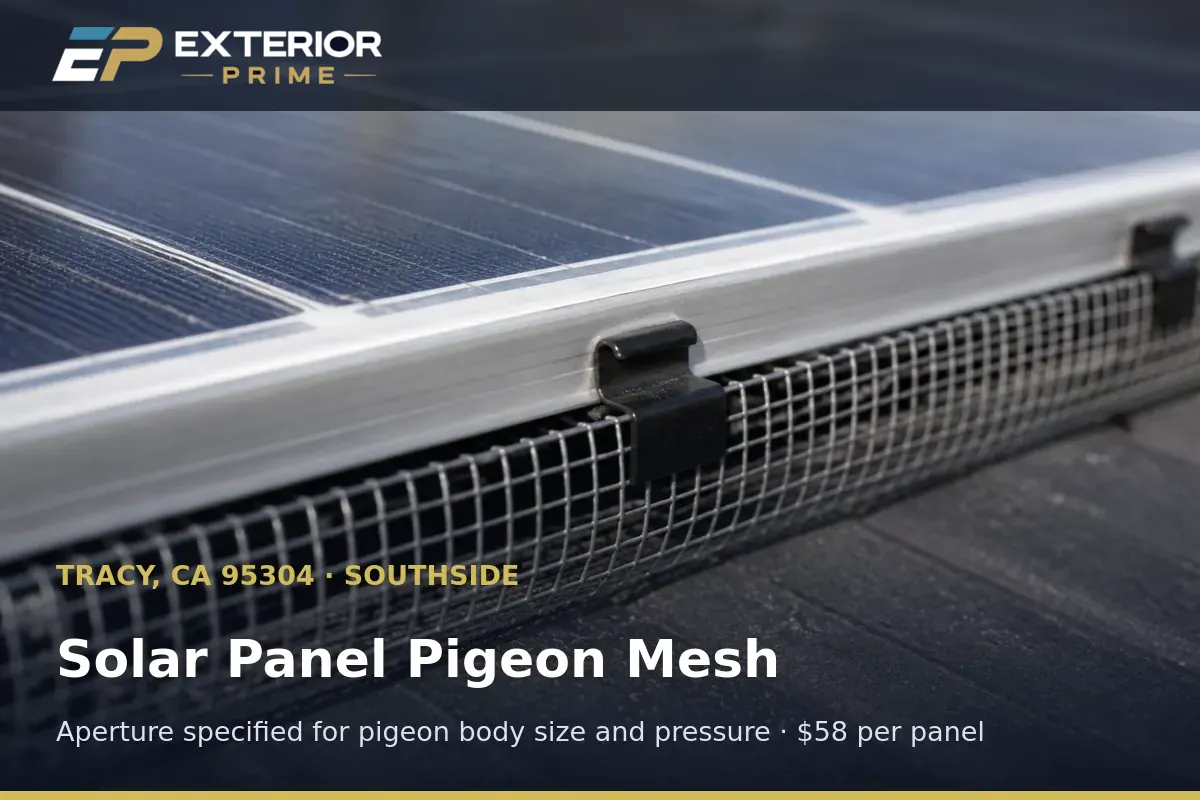
Why Pigeon Pressure Changes the Mesh Math in Tracy
A pigeon weighs roughly 300 to 500 grams and will repeatedly push against a weak point in mesh, which requires stiffer wire than lighter songbirds ever test.
Sparrows and finches, common around Tracy's row-crop-adjacent neighborhoods, mostly test mesh by trying to slip through an opening headfirst. Pigeons behave differently. They land on the mesh surface and push with their full body weight against any section that gives even slightly, probing for a weak clip or a loose overlap seam.
This means the aperture size that stops a sparrow doesn't automatically stop a pigeon from working a gap wider over time. We size pigeon-specific mesh at a tighter opening near the roofline edges, where pigeons in Tracy Hills and Plaza Park most often attempt entry, while using a slightly more open weave higher on the array where pressure testing is less common.
Wire stiffness matters just as much as aperture. A softer wire mesh, adequate for excluding smaller birds, will slowly deform under a pigeon's repeated body-weight pressure across a season, eventually creating a permanent bulge that becomes an entry point. We select a stiffer gauge specifically because Tracy has a resident pigeon population that returns to the same roofs year after year.
This is also why clamp density matters more for pigeon mesh than for general bird exclusion. We increase clip frequency at the lower edges of the array by roughly 30 percent compared to a standard install, since that's where pigeon body-weight testing concentrates.
How Tracy's Pigeon Population Differs From Other Central Valley Areas
Tracy's warehouse and logistics corridor supports an unusually persistent pigeon population that returns to the same roof structures repeatedly.
The dense logistics and distribution facilities along the I-205 and I-580 interchange provide abundant loading-dock shelter and food scrap access, which supports a larger resident pigeon population than you'd find in a purely residential Central Valley town. That population pressure spills into nearby residential streets in Southside and Downtown Tracy.
Pigeons are also strongly site-loyal birds. Once a pair successfully nests beneath a solar array, they and their offspring will often return to that exact roof for multiple breeding seasons, which is different from the more opportunistic nesting behavior of sparrows that move between yards.
This site loyalty means a partial or improperly rated mesh installation in Tracy doesn't just risk a new pigeon finding the gap, it risks the same established pair returning and specifically re-testing the barrier they remember succeeding against before.
Because of this, we treat pigeon mesh jobs in Tracy with extra scrutiny at the corner seams and roofline edges during our post-install inspection, since a returning pair is a more determined adversary than a first-time visitor.
Why Generic Bird Netting Underperforms Against Tracy Pigeons
Generic plastic bird netting, rated primarily for smaller songbirds, typically gives way to sustained pigeon body pressure within a single Tracy nesting season.
Big-box bird netting products are usually rated with sparrows and starlings in mind, since those are the most common backyard nuisance birds nationally. That rating doesn't account for a 400-gram pigeon repeatedly landing and pushing against the same three-inch section of netting day after day during spring nesting season.
We've inspected failed netting jobs in Berg Ranch and Kagehiro where the plastic mesh had a visible sagging pocket exactly where a pigeon had worked it loose over several weeks. Once that pocket forms, it grows quickly since the plastic has already lost its original tension.
Our pigeon-rated wire mesh doesn't have this failure mode because the material doesn't stretch under repeated pressure the way woven plastic does. A pigeon pushing against properly tensioned galvanized wire simply can't create the same progressive sagging pocket.
This is the core reason we price pigeon mesh the same as standard bird mesh at $58 per panel rather than treating it as a premium add-on: the material and clamp-density adjustments cost us little extra, but the difference in real-world durability against Tracy's pigeon population is significant.
Cost and Scope for Pigeon Mesh Jobs Across Tracy
Pigeon mesh installs in Tracy run the same $58 per panel as general bird mesh, with cleanup for existing pigeon droppings starting at $200 separately.
A 15-panel array, a common size on older Tracy tract homes near Downtown Tracy, comes to $870 for pigeon-rated mesh installation. Larger arrays on newer Tracy Hills homes with 24 or more panels scale up proportionally at the same per-panel rate.
Pigeon droppings carry more acidity and volume risk than smaller bird waste due to the birds' larger size and longer roosting periods, so cleanup for an established pigeon roost is quoted based on the extent of buildup, generally starting at $200 and increasing for heavier accumulation.
We always recommend pigeon-specific mesh over generic bird mesh for any Tracy property that has already experienced a pigeon problem, since the incremental cost difference is minimal but the mesh's resistance to repeat pigeon pressure is substantial.
As with all standalone visits, a $297 minimum applies, though pigeon mesh jobs of typical Tracy array size clear that threshold through panel count alone.
What else does solar panel pigeon mesh close off on a Tracy roof?
A 95376 solar panel pigeon mesh visit measures 35 feet of downspout, algae and eave edge around the array, then logs every concrete opening our professionals seal.
solar panel pigeon mesh on a 23-panel Tracy Hills roof takes about 21 minutes to map: 35 feet of downspout edge, 15 photographs, a 95 psi soft wash rinse across the oxidation and siding below, and Delta breeze noted in the 95376 file.
Redbridge and Downtown Tracy arrays fail the same way — San Joaquin County hardpan pushes grit under the eave, Altamont Pass wind bakes fascia onto the mildew and concrete, so Exterior Prime folds that rinse into one solar panel pigeon mesh appointment rather than a $297 second trip.
Exterior Prime records the 3-year workmanship history for 95376 and 95377 addresses, naming each algae gap, mildew screen and fascia deposit; a 23-panel job at $58 per panel is $1334, with cleanup from $200.