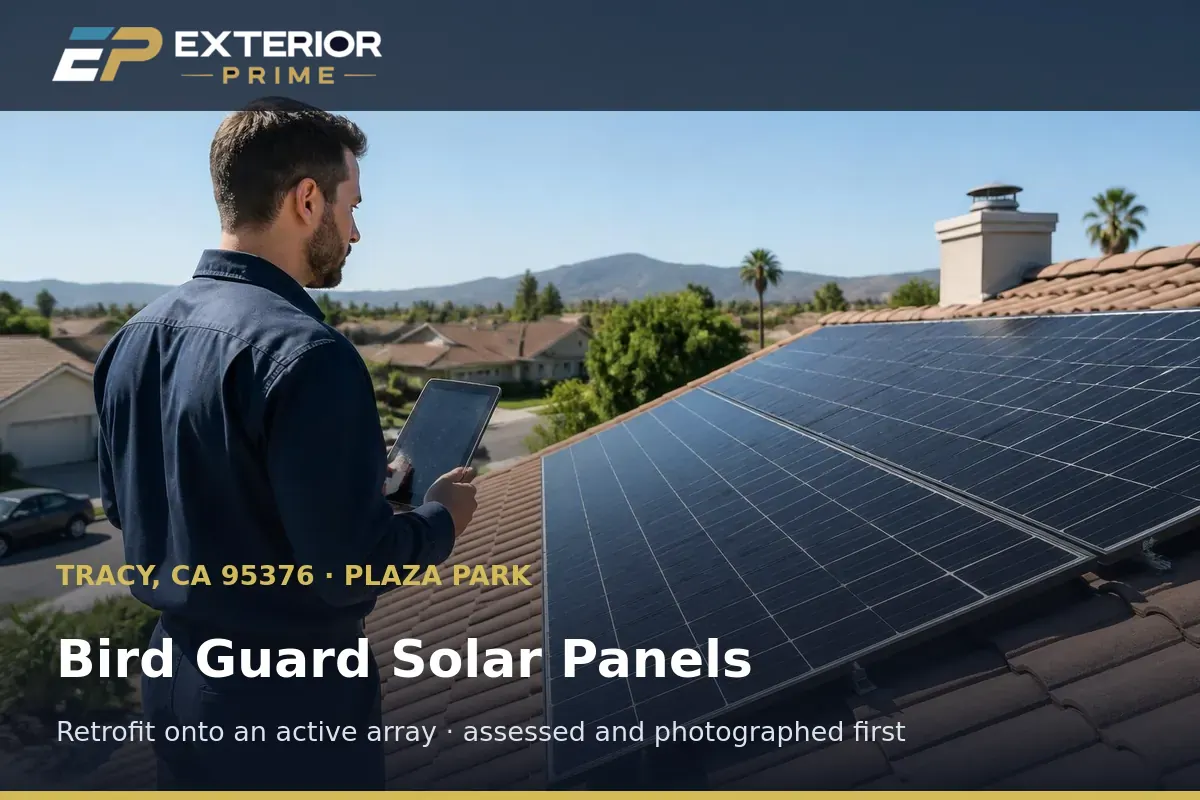
Why can't you just clip a guard onto a Tracy roof with birds already there?
Installing mesh over an occupied gap traps droppings, mites, and sometimes live chicks inside the array, turning a solvable problem into a sealed one.
Tracy homes near the I-205 and I-580 interchange sit close to a steady flow of pigeons moving between the logistics corridor's warehouse rooflines and residential streets, and a solar array with an open perimeter is an easy stopover. When a homeowner calls after noticing droppings on the driveway, there's frequently already a nest, eggs, or a half-grown brood tucked against the racking rails, and none of that goes away just because mesh gets stapled over the opening.
Our professionals walk the full perimeter of the array before touching a single clip, checking gap height at every roof plane since Tracy's mix of 1970s-90s tract homes and newer Tracy Hills builds with high-standoff racking produce very different clearances. A gap under three inches rarely hosts adult pigeons, but four to six inches, common on older Redbridge and Southside roofs, is prime real estate.
If the survey turns up active nesting, we sequence the job so extraction and sanitizing happen before the guard closes the gap for good, not after. Skipping that step doesn't just look bad later; it can trap live birds, and that's a mess nobody wants to discover mid-summer when Tracy afternoons push past 100 degrees.
Retrofitting also means working around solar hardware installed by someone else, sometimes years earlier, so our technicians photograph the racking configuration and confirm mounting type before ordering mesh, since a mismatched cut wastes a trip and delays closing the gap for another week of exposure.
What does the assessment actually check on a Tracy home?
The assessment measures perimeter length, gap height at each plane, and confirms whether any nesting material or live birds are present before we quote the guard.
A 20-30 minute walk of the roof gives our professionals the numbers needed for an accurate quote: linear footage around the array, the number of distinct roof planes, and whether a garage wing or dormer breaks the perimeter into separate sections, something we see often on Berg Ranch and Plaza Park lots with L-shaped roof layouts.
We also check for existing damage. Pigeon droppings are mildly acidic, and racking hardware left exposed for a season or two near the tule fog belt of December and January can show early corrosion that a homeowner never notices from the ground. Flagging that now saves a second call later.
Wiring gets a close look too. Nesting pigeons chew and displace zip-tied conduit runs along the rail, and a chewed jacket near a junction box is a fire risk worth catching during the same visit rather than after the guard is already clipped over it.
Every assessment ends with a written scope: gap height, perimeter footage, whether cleanup is needed first, and a firm per-panel price, so a Tracy homeowner isn't guessing between the phone call and the invoice.
How is the retrofit guard installed on an existing Tracy array?
Our professionals cut galvanized mesh to match the measured perimeter and clip it to the panel frame with stainless clips, adding no new roof penetrations anywhere on the array.
Mesh sections are cut on-site to match each roof plane exactly, since a retrofit rarely has the uniform edge lines of a brand-new install; older systems near Downtown Tracy sometimes have racking extensions or add-on panels from a later expansion that shift the perimeter shape.
Clips attach to the aluminum module frame, not the shingles or the concrete tile common on Tracy's older stock, so the roofing warranty and the solar manufacturer's warranty both stay intact through the retrofit. Nothing is drilled or adhered to the roof deck.
Corners and seams get extra attention on a retrofit because that's exactly where a determined pigeon will test for weakness first, particularly around Tracy Hills homes with steeper, higher-standoff racking that leaves a taller gap at the ridge line.
The finished install closes with photo documentation of every seam and a five-year workmanship warranty, so if Altamont Pass wind gusts work a clip loose during a spring storm, we come back and reset it at no charge.
What does a Tracy retrofit bird guard cost?
Retrofit mesh runs $58 per panel just like a new install, so a typical 20-panel Tracy roof lands between $1,160 and $1,650 once cleanup and perimeter length are added in.
If the assessment finds an occupied nest, cleanup is quoted separately starting at $200, priced by debris volume rather than a flat rate, since a fresh single-season nest near Sunrise Park costs far less to clear than a multi-year colony on an older Kagehiro-area home.
Every standalone visit is subject to Exterior Prime's $297 minimum, which covers the drive out, insurance, and equipment, though that minimum rolls into the total rather than stacking on top of the per-panel mesh cost.
Homes with multiple roof planes, like a main house plus a detached garage near Naglee Road, typically see a modest surcharge because two separate mesh runs need to be cut and seamed rather than one continuous perimeter.
Where do Tracy homes stay open after bird guard solar panels?
A 95376 bird guard solar panels visit measures 63 feet of roof, paver and downspout edge around the array, then logs every algae opening our professionals seal.
bird guard solar panels on a 13-panel Redbridge roof takes about 33 minutes to map: 63 feet of roof edge, 19 photographs, a 71 psi soft wash rinse across the siding and soffit below, and Tule fog noted in the 95376 file.
Downtown Tracy and Tracy Hills arrays fail the same way — almond-orchard dust pushes grit under the downspout, agricultural dust bakes eave onto the screen and algae, so Exterior Prime folds that rinse into one bird guard solar panels appointment rather than a $297 second trip.
Exterior Prime records the 3-year workmanship history for 95376 and 95304 addresses, naming each paver gap, screen screen and eave deposit; a 13-panel job at $58 per panel is $754, with cleanup from $200.