Why do shingle roofs need a gentler cleaning approach in Tracy?
Composition shingle relies on a thin granule coating for UV protection, and pressure washing removes that coating permanently.
Every asphalt shingle is manufactured with a layer of mineral granules pressed into an asphalt base, and those granules do the heavy lifting of blocking UV rays and shedding rain. A pressure washer at typical driveway settings will strip that coating loose within seconds of contact, and once granules wash into a gutter there is no reattaching them.
Homes near Kimball and along Corral Hollow Road, many built in the 1990s and 2000s tract boom, are now old enough that their original shingle is losing granules naturally through age, which makes protecting what remains during any cleaning even more important than it would be on a newer roof.
Soft washing avoids this entirely by using a dwelling cleaning agent that chemically breaks down algae, moss and lichen colonies over several minutes before a low-pressure rinse carries the dead growth away, never applying more force than a garden hose could produce.
What causes the dark streaking on Tracy shingle roofs?
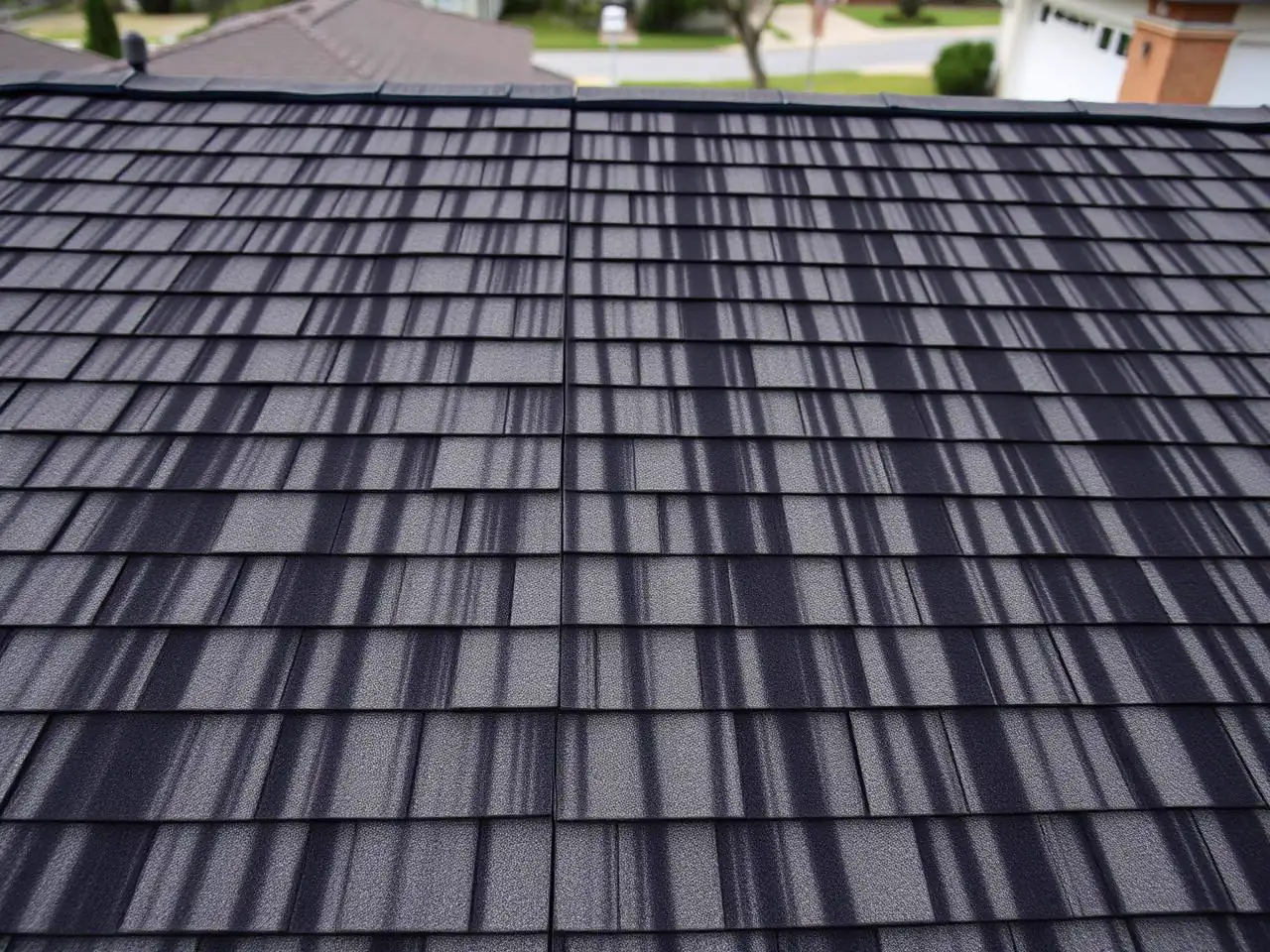
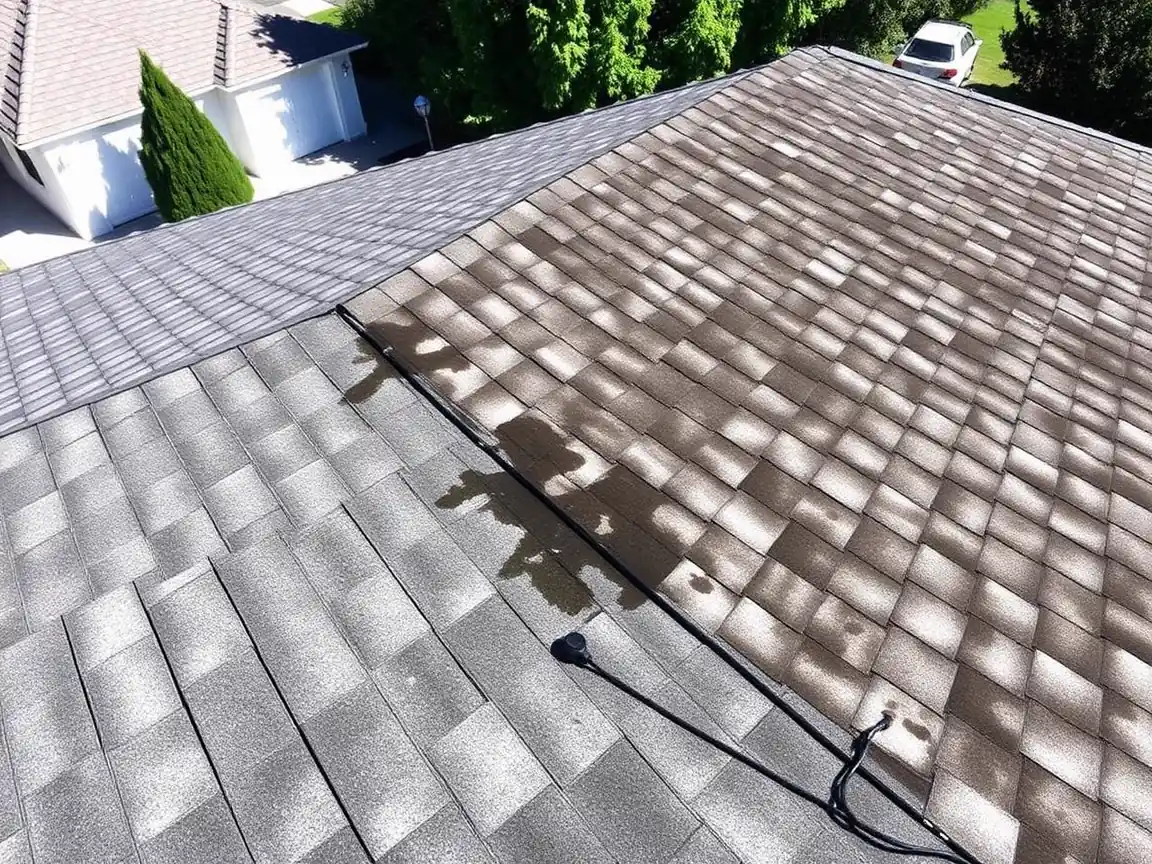
Dark streaking on shingle is almost always a colony of gloeocapsa magma algae feeding on the shingle's limestone filler.
That algae spreads by airborne spores that land more heavily on shaded, north-facing slopes, which is why homes in tree-lined stretches of Edgewood and Redbridge often show streaking on one side of the roof years before the sun-facing slope shows any change at all.
San Joaquin County's damp winter months, combined with tule fog that blankets Tracy mornings from December through February, give that algae exactly the moisture window it needs to establish and spread before summer heat arrives.
Left untreated for several years, the same algae colony can invite moss growth on top of it, and moss holds moisture directly against the shingle surface, which accelerates granule loss even faster than the algae alone would cause.
How much does shingle roof cleaning cost in Tracy?
Shingle roof cleaning in Tracy prices at $0.50 per square foot, with a $297 minimum applied to any standalone roof-only visit.
A 1,000 sq ft shingle roof runs close to $500, a 1,400 sq ft roof near $700, and a larger 2,000 sq ft roof common on two-story Berg Ranch homes runs near $1,000, all at the base rate before any surcharge applies.
An extra $0.10 per square foot applies to unusually steep pitches that require additional harness time, and an extra $0.05 per square foot applies when moss or lichen coverage is heavy enough to need a second pass along the valleys.
Most quotes for homes in the 95376 and 95378 ZIP codes come in between $500 and $900 for a standard single-story roof, with the written estimate confirming exact square footage before any date gets scheduled.
How does soft washing protect gutters and downspouts during shingle cleaning?
Runoff from a shingle roof carries loosened algae and granule debris straight toward the gutter and downspout system below.
Exterior Prime professionals flush gutters and downspouts as a standard part of every shingle cleaning visit, since dislodged algae, lichen and normal granule shedding all collect there during the rinse and can clog a downspout if left in place.
Homes near Plaza Park with older galvanized gutters sometimes show more buildup than homes with newer seamless aluminum gutters, since older sections corrode slightly and give debris more surface to catch on during the rinse.
Checking downspout flow at the end of the visit also flags any existing blockage from ag dust or leaf litter that predates the cleaning, giving a Tracy homeowner a clear picture of gutter condition rather than just a clean roof.
How does heavy truck traffic near Tracy's logistics corridor affect shingle roofs?
Road film and diesel exhaust drifting from the I-205 and I-580 logistics corridor settle onto shingle as a fine gray haze over time.
Tracy's position along major freight routes means homes closer to those corridors accumulate a layer of road film on top of normal algae and lichen growth, and that film can make a roof look dingy even on slopes with little biological growth.
Soft washing removes both the film and the organic growth in the same pass, since the cleaning solution is formulated to break down oily residue as well as algae, without needing a separate degreasing step or added pressure.
Homes tucked farther from the freight corridors, closer to Gretchen Talley area streets, tend to show cleaner shingle for longer between services, though tule fog moisture still drives algae regrowth on shaded slopes regardless of distance from traffic.