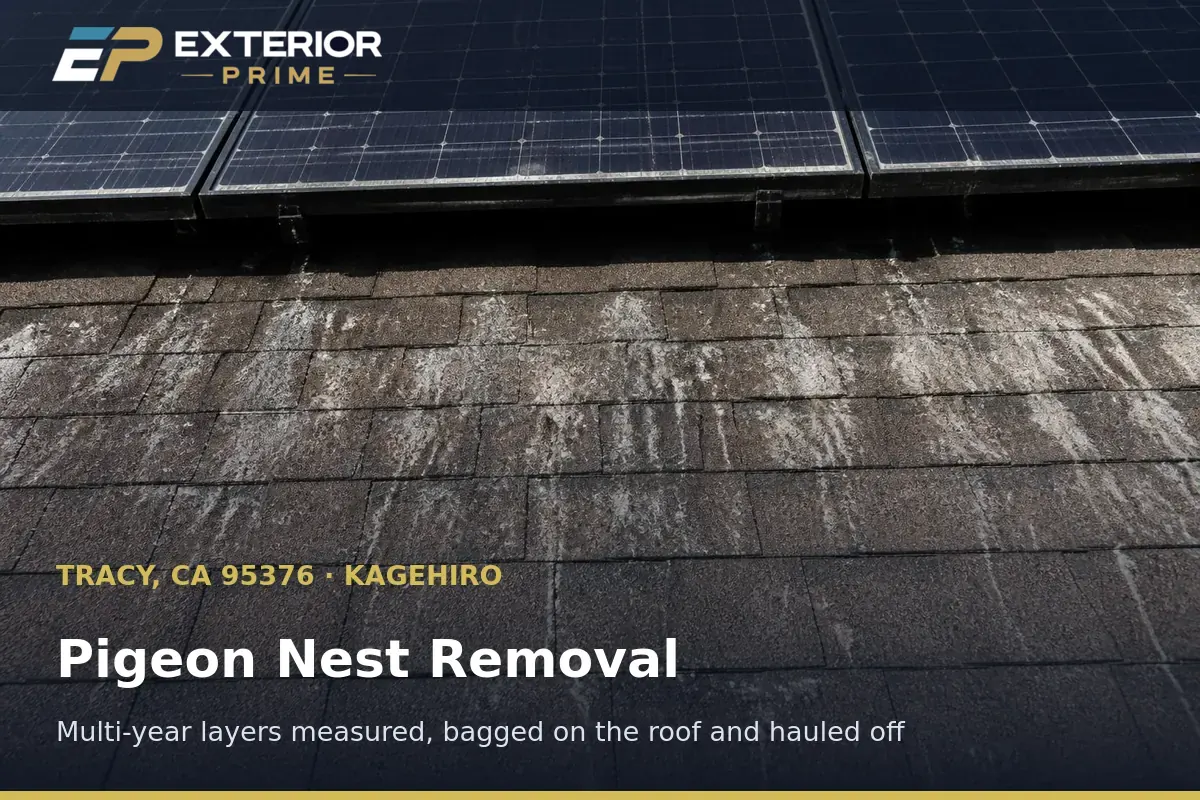
How does a multi-year pigeon nest differ from a single-season one in Tracy?
Multi-year nests compact into distinct layers as birds build on top of old material each season, sometimes reaching several inches of depth by the third or fourth year.
A first-season nest under a Tracy array is typically a loose pile of sticks and feathers an inch or two thick, easy to identify and quick to clear. A colony returning for a third or fourth consecutive year behaves very differently, adding fresh material on top of the previous season's debris rather than clearing it out first.
Our professionals commonly measure four to six inches of compacted depth on older Tracy roofs, particularly in Southside and Downtown Tracy homes where a colony has had years of uninterrupted access to the same gap. Each layer compresses under the weight of the next, forming a dense mat rather than loose debris.
That compaction changes the extraction method entirely. Loose material can be lifted out in handfuls, but a compacted multi-year mat often needs to be worked free in sections with hand tools, since pulling too aggressively can dislodge racking hardware or damage wiring buried underneath.
Depth also correlates with concentration of dried droppings, which is the main reason multi-year jobs require more time and more careful PPE than a first-season cleanup, not just more bags at the end.
How does Exterior Prime measure and scope a multi-year nest in Tracy?
Our professionals probe the debris with a measuring tool during the initial inspection to determine layer depth, which directly sets the extraction time and price.
Before quoting anything, our technicians use a probe or measuring rod to check depth at several points across the nest footprint, since debris often isn't uniform, thicker at the center where birds have nested repeatedly and thinner toward the edges.
That measurement gets recorded alongside estimated square footage of coverage, since a shallow but wide multi-year mat spread across a long Tracy Hills array takes different handling than a deep, concentrated pile in one corner of a smaller roof.
We also check how close the debris sits to wiring and the roof deck during this same inspection, since multi-year nests are far more likely to have compressed material directly against conduit or fasteners than a fresh single-season nest would.
The scoping visit ends with a specific quote tied to measured depth and coverage rather than a flat estimate, since two multi-year nests on different Tracy roofs rarely require the same amount of labor.
What sanitation and PPE does a multi-year Tracy removal require?
Concentrated, aged droppings pose a higher inhalation risk than fresh debris, so our technicians use full respiratory protection, gloves, and disposable coveralls throughout extraction.
Dried droppings from a multi-year colony are more concentrated per cubic inch than a fresh nest, and aged material breaks down into finer particles that become airborne more easily when disturbed, especially in Tracy's dry summer conditions.
Our professionals wear respirators rated for particulate exposure, along with gloves and disposable coveralls, standard precautions given the volume of material involved in a multi-year job versus a quick first-season cleanup.
Sanitizing after extraction is more involved on these jobs too, since mites and other debris-dwelling pests have had years to establish themselves rather than a single season. Our technicians treat the full cavity and surrounding racking rails rather than spot-treating just the nest footprint.
Everything extracted gets double-bagged given the volume, typically five or more contractor bags on a well-established multi-year nest, compared to two or three for a single-season cleanup, and hauled off the property the same day.
What does multi-year pigeon nest removal cost in Tracy?
Pricing starts at $200 and scales up based on measured depth and coverage, with well-established multi-year nests commonly running $500-$900 before exclusion mesh.
A shallow, first-year nest sits at the low end of the range, while a deep, multi-year mat spanning several feet of a Tracy Hills or Downtown Tracy array requires substantially more hand-extraction time and lands toward the higher end.
Exclusion mesh at $58 per panel is strongly recommended immediately after a multi-year removal, since a colony with years of investment in that exact gap is more likely to attempt returning than one that only nested once.
The $297 standalone minimum applies only when removal is scheduled without exclusion mesh; most homeowners facing a multi-year problem choose to add mesh the same day, since leaving the freshly cleared gap open again invites a repeat within the same breeding season.
What does a Plaza Park pigeon nest removal under solar panels report document?
A 95377 pigeon nest removal under solar panels visit measures 98 feet of concrete, mildew and gutter edge around the array, then logs every roof opening our professionals seal.
pigeon nest removal under solar panels on a 18-panel Plaza Park roof takes about 48 minutes to map: 98 feet of concrete edge, 15 photographs, a 55 psi soft wash rinse across the stucco and fascia below, and Central Valley heat noted in the 95377 file.
Berg Ranch and Edgewood arrays fail the same way — Altamont Pass wind pushes grit under the gutter, Delta breeze bakes soffit onto the paver and roof, so Exterior Prime folds that rinse into one pigeon nest removal under solar panels appointment rather than a $297 second trip.
Exterior Prime records the 4-year workmanship history for 95377 and 95304 addresses, naming each mildew gap, paver screen and soffit deposit; a 18-panel job at $58 per panel is $1044, with cleanup from $200.