Why pigeons, specifically, are harder to dislodge from a Manteca array
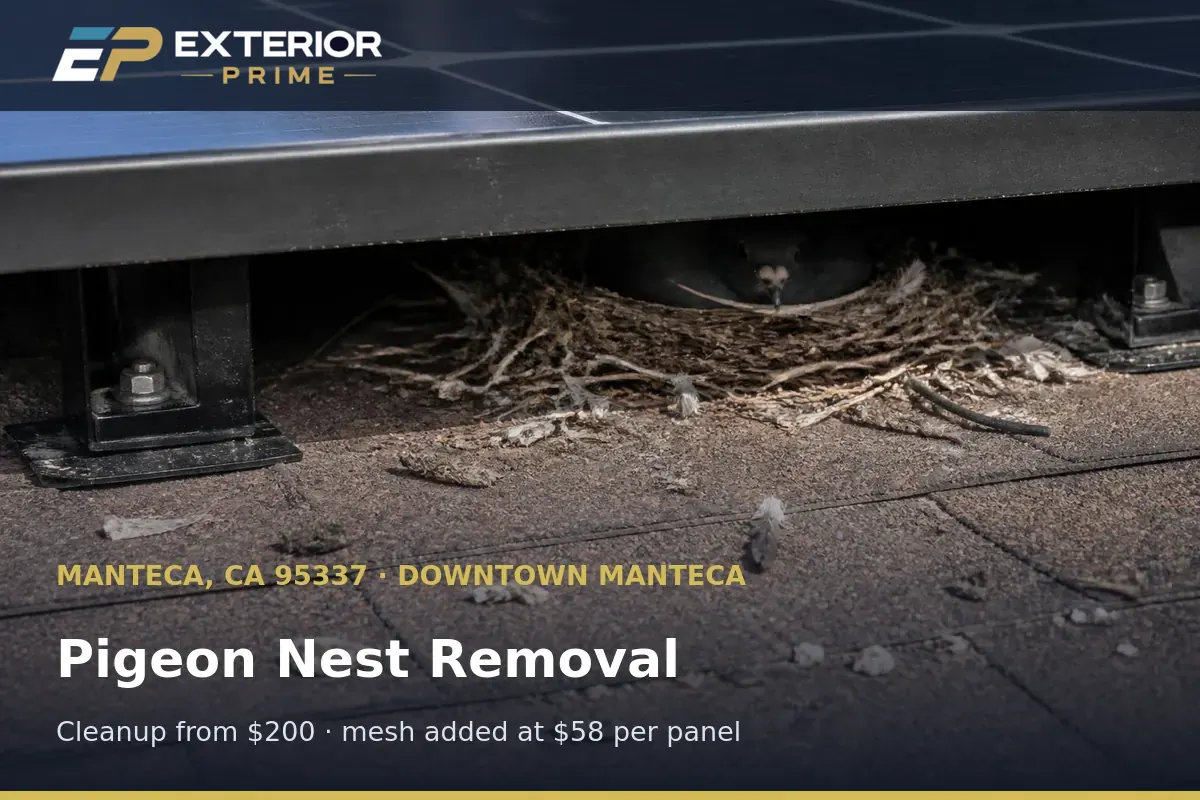
Pigeons reuse the same Manteca nest site across multiple broods per year and often for several years running, unlike smaller songbirds that build fresh each season.
A sparrow or finch on a Manteca roof usually starts over somewhere new the following spring. A pigeon pair does the opposite: once they raise a successful brood under a particular array, they come back to that exact spot within the same 12-month cycle, sometimes 2 or 3 times, sometimes adding a thin new layer over the old nest rather than building fresh.
That habit is why some Manteca homeowners describe the same corner of the roof producing droppings and noise for three or four consecutive years, even after a casual cleanup. The birds are not finding a new spot each time, they are returning to a proven one, and only physical exclusion actually breaks that pattern.
Neighborhoods with dense, similar rooflines like Union Ranch, Del Webb and the newer streets off the 120 Bypass see this most, because a flock scouting the area finds dozens of nearly identical open cavities across a single block of 15 to 20 homes and settles into a routine among them.
Timing removal around the Manteca brood cycle
Pigeons in Manteca nest most heavily from February through May, and a pair can raise more than one brood inside that stretch.
Because Central Valley winters rarely get cold enough to fully suspend breeding, and San Joaquin County's tule fog season keeps birds sheltered rather than migrating, some Manteca pairs start a first clutch as early as late January in a sheltered array. The bulk of activity, though, runs February through May, with young birds fledging roughly four to six weeks after eggs are laid.
If a nest is found with eggs or very young squabs still in it, the responsible approach is to wait for fledging rather than disturb it mid-cycle. Exterior Prime professionals will note the estimated hatch stage during the initial Manteca inspection and schedule the return visit accordingly, usually within a few weeks.
Homeowners who call in Manteca during winter, before the February push begins, get the cleanest outcome: any lingering nest from last year is removed and the array is meshed before a new clutch is ever started.
Mites, parasites and why old pigeon nests are a health issue
Pigeon nests harbor mites and other parasites that can migrate into a Manteca attic space once the birds move on or are excluded.
Bird mites do not need the host bird to survive short term. When a long-occupied nest under a Manteca array is finally removed, or when the resident pigeons are excluded and abandon the site, mites already present in the bedding will actively search for a new host, and the nearest gap into an attic or soffit is often just a few inches away.
This is one reason a professional cleanout matters more for pigeon sites than for a light songbird nest: bedding material, accumulated droppings and feather dust are handled and bagged in one motion, typically inside a 30 to 45 minute window, rather than left to dry out and drift, which limits how far any mite population can spread before the site is closed off.
Manteca homes with older soffit vents near Downtown Manteca and the Powers Tract streets, many of them built before 2005, are the ones we see this issue on most, simply because those vents give displaced mites or overflow debris a nearby path indoors, and homes in Woodward Park with similar 1990s soffit designs show the same pattern in roughly 1 out of every 4 inspections.
Does removing a pigeon nest without mesh actually solve the problem?
No, removing the nest without sealing the cavity only clears what is visible today, and the same pigeon pair almost always returns to the identical Manteca cavity within a matter of weeks.
Because pigeons are creatures of habit, a repeat site is the clearest case for pairing removal with galvanized mesh the same day. Once the old nest and bedding are cleared, cleaned residue is rinsed away, and mesh is clipped along the module frame before the ladders come down, so the birds arrive back to a closed cavity instead of the cleared platform they remember.
For Manteca customers who have dealt with the same corner of the roof for multiple seasons, this combined visit is almost always cheaper over a two or three year span, saving roughly $150 to $250 versus repeating a standalone $297 removal call every spring.