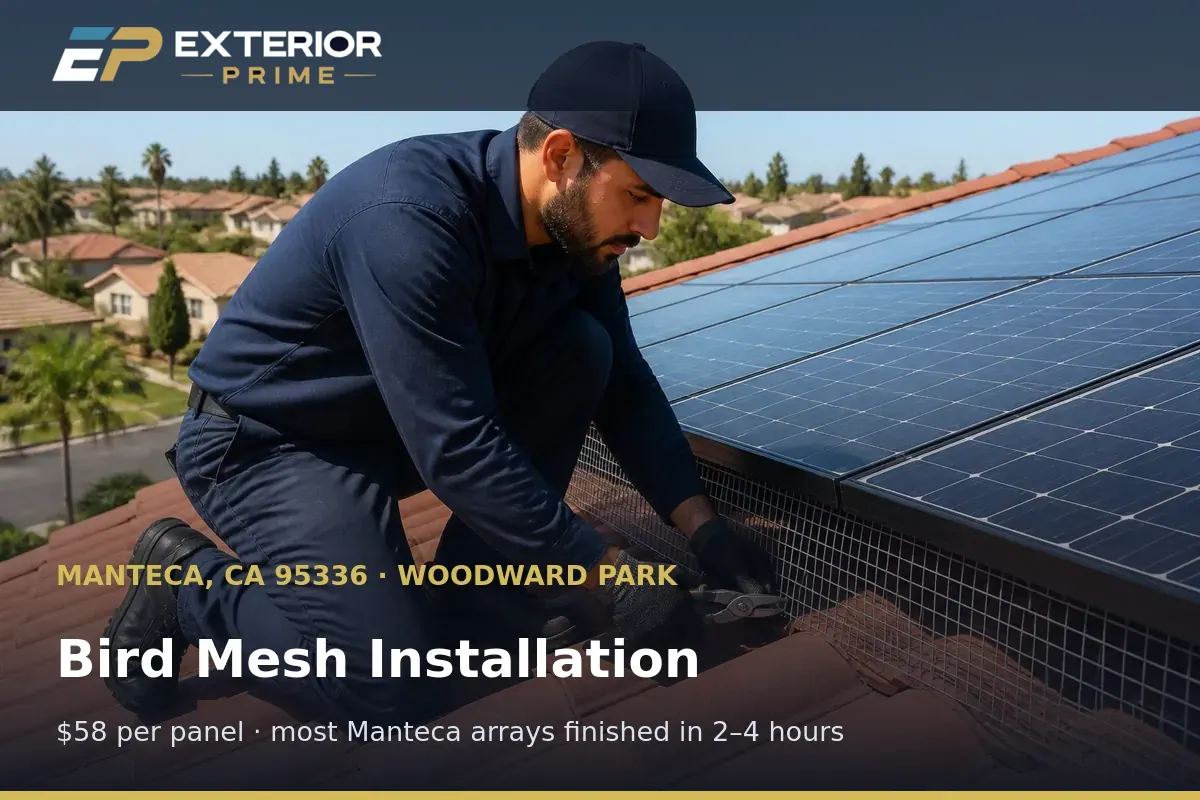
Arriving and setting up access on installation day
Every Manteca installation begins with ladder placement, a roof-safety check, and a walk of the array to confirm the plan matches the quote.
Ladders go up against a structural point of the roofline, not against gutters or fascia boards that could bend under repeated trips carrying mesh rolls and tool bags. On steeper Manteca rooflines near Mayors Park and Powers Tract, a harness anchor point is set within the first 10 minutes on site, before anyone steps onto the tile or shingle field. Central Valley wind gusts off the Delta make that anchor point non-negotiable on any two-story job.
Before cutting begins, an Exterior Prime professional walks the array from end to end confirming panel count, plane splits and any obstruction — vent stacks, chimney chases, satellite mounts — that will change how mesh sections get cut later in the day.
This confirmation step matters because a Manteca quote is built from a photo count done ahead of time, and any mismatch between the quoted panel count and the roof in front of the professional gets flagged with the homeowner before hardware goes on.
Clip hardware used on the module frame
Stainless non-penetrating clips pinch onto the aluminum module frame lip, holding mesh tension without a single drilled hole.
The clip design grips the lip that runs along every module frame's edge, the same lip the racking system itself often uses. Spacing runs every 4 to 6 inches along the mesh line so wind load on a gusty Manteca spring day is distributed across many small grip points instead of concentrated on a handful of anchors.
Because nothing punctures the frame or the roof surface, module warranties and roof warranties both stay intact — a detail Manteca homeowners frequently ask about before agreeing to any rooftop add-on.
Clips are torqued by hand to a firm but adjustable grip, since over-tightening thin aluminum framing can deform it over repeated hot-and-cold cycles through a Manteca year.
Cutting mesh along split south and west roof planes
Mesh is measured and cut plane by plane on a Manteca roof, then seamed at the ridge or valley where south and west faces meet.
Many Manteca homes, especially those built with a two-story massing near Del Webb at Woodbridge, Union Ranch or the newer Terra Ranch streets, carry a south-facing array plane and a separate west-facing plane. Each gets measured independently rather than assuming one uniform cut across both.
At the seam where the two planes meet, mesh sections are overlapped and clipped so no gap opens along the ridge line — the exact spot birds test first because it is the highest, driest ledge on the array.
Cut lines also route around vent boots and conduit runs, trimmed close enough to seal the gap without pinching mesh against a hot conduit that could wear through the wire over 3 to 5 Manteca summers.
What happens if weather or an active nest interrupts a Manteca installation?
Work pauses for wind, wet tile or active nesting activity, and safety on a Manteca roof always takes priority over finishing on the original same-day schedule.
Composition shingle common on older Manteca tract homes gets slick when damp, so a job scheduled during a San Joaquin County Tule fog morning in December or January may start later than planned to let the roof surface dry first, sometimes by an hour or two.
If an active nest with eggs or chicks is found mid-installation, that section is left open and finished once the birds have fledged, rather than sealing anything in. This is physical exclusion work, never trapping or removal by force.
On a two-story Manteca home with a steep west-facing plane, fall protection stays on for the full climb, and mesh rolls are hauled up by rope rather than carried by hand up the ladder.
Wrapping up: final check and the Manteca warranty
The installation closes with a hand tension-check of every mesh edge and a five-year workmanship warranty on the treated area.
Before the ladders come down, every clip line is pulled by hand to confirm it holds under load, and any section that gives slightly is re-clipped on the spot rather than left for a return trip.
Photos of the finished perimeter go into the homeowner's file, useful later if a Manteca solar installer or a home buyer's inspector asks whether the array cavity was properly closed.
If a clip lifts or a seam opens within five years, an Exterior Prime professional returns to correct it at no charge, covering the full length of mesh installed on that Manteca roof.