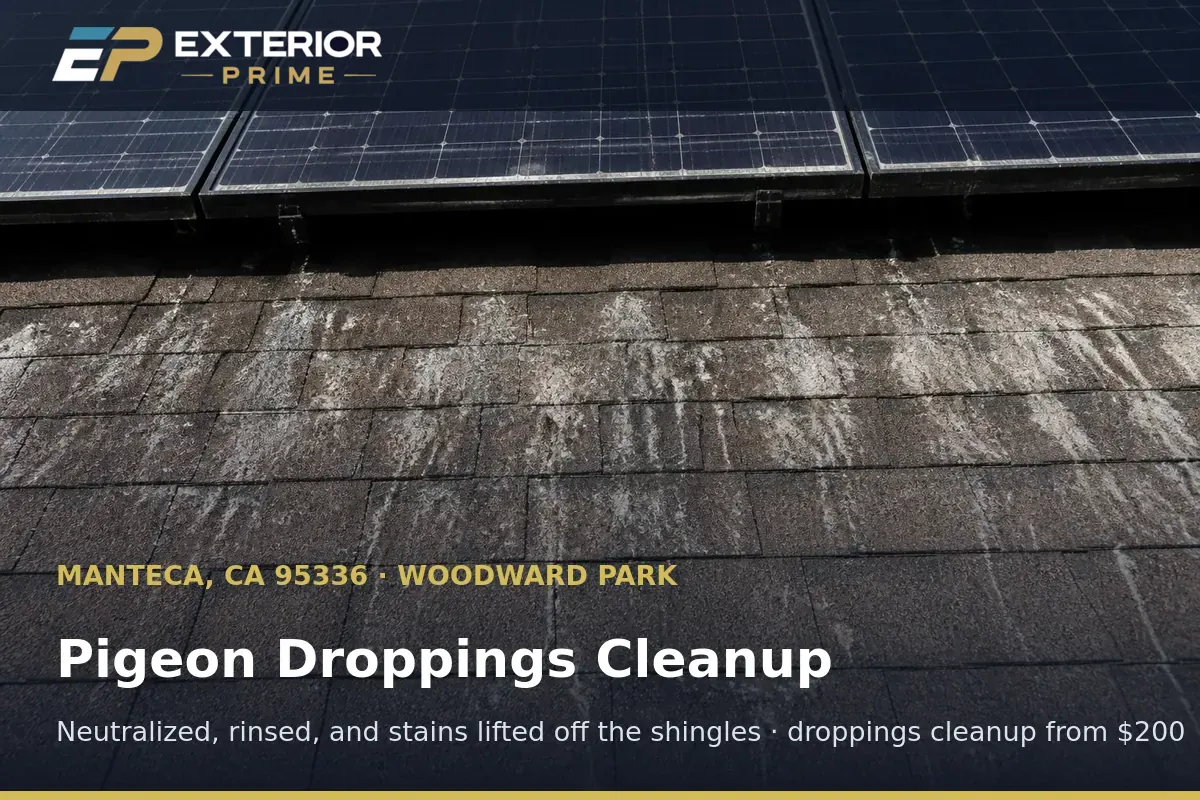
Why droppings cleanup in Manteca is a sanitation job, not a wipe-down
Accumulated pigeon droppings under a Manteca array carry pathogens and require PPE and containment, not a garden hose and a rag.
Dried droppings dust up easily once disturbed, and airborne particles from a heavily used Manteca nesting site are a real inhalation concern for anyone working directly underneath the panels without protection, especially during Central Valley ag-dust season when the air is already carrying fine particulate. Exterior Prime professionals wear gloves and respiratory protection and wet material down before disturbing it, a step that adds roughly 10 minutes to the visit but keeps dust from becoming airborne on the roof.
Manteca's July and August heat bakes fresh droppings onto glass and tile within days, turning what would be a simple rinse in cooler weather into a job that needs a dwell time and a dedicated cleaning pass to actually lift the residue rather than just smear it.
Runoff is also controlled and neutralized rather than left to drain wherever gravity takes it, since untreated droppings runoff reaching a Manteca planter bed in the 95336 or 95337 ZIP codes, or seeping toward hardpan soil common across San Joaquin County, is not something we want to leave behind after a cleanup visit.
Why is guano more corrosive than ordinary bird droppings?
Guano carries a higher uric acid concentration than most songbird droppings, and that acidity etches concrete tile, discolors stucco, and can corrode unprotected racking and conduit fittings on a Manteca array if it sits through more than one summer.
The newer concrete tile roofs common on Manteca builds near Woodward Park and Terra Ranch are porous enough that droppings sitting through a hot July and a wet December can leave a stain that a simple rinse will not lift, requiring a dedicated treatment pass with a cleaning solution formulated for mineral and organic staining. Dried guano also flakes into a fine powder that can carry mites and other ectoparasites, so the same PPE and containment used for nest removal applies here, and any galvanized racking hardware within reach gets a quick corrosion check during the pass.
Stucco walls below an array edge, especially on two-story Manteca homes where runoff tracks down past a window line, show the same problem in streak form. Left alone across a full year, that streak becomes a visible discoloration that a future exterior paint job or resale inspection will flag.
Because staining severity depends entirely on how long the droppings sat and how much direct summer heat they baked under, two Manteca homes with similar 20-panel arrays can need very different cleaning effort even though the bird activity itself was comparable, and a module warranty claim on affected panels is easier to support with dated before-and-after photos from the visit.
Flushing the gutter and downspout run below a Manteca array
Droppings and feather debris washing off a Manteca array during rain routinely clog the gutter and downspout section directly below it.
During Manteca's wetter months, roughly December through February, rain carries loosened droppings and bedding fragments straight into the gutter run beneath the array. That section clogs faster than the rest of the gutter system, and a partially blocked downspout during a heavy Tule fog season storm can send overflow down the fascia instead of away from the foundation.
Exterior Prime professionals flush the specific gutter and downspout segment tied to the array footprint as part of the same visit, rather than leaving it for a separate gutter-cleaning appointment weeks later, since droppings-clogged sections tend to smell and attract flies faster than ordinary leaf debris.
Homeowners in the flatter Mayors Park and Del Webb at Woodbridge sections of Manteca, where roof pitches drain slowly, see this gutter buildup fastest and benefit most from having it addressed on the same trip.
Restoring panel output with a same-visit wash
Caked droppings block enough sunlight that a soiled Manteca array can lose several percent of its expected output until it is washed.
Solar panels are rated assuming a clean glass surface, and a scattering of dried droppings across even a portion of the array shades individual cells enough to measurably reduce the string's output, not just the appearance of the roof. Exterior Prime professionals see Manteca customers monitoring production through an app notice the dip before they ever climb up to look, sometimes within 2 to 3 weeks of the first heavy dropping event.
The same-trip panel wash, priced from $120, uses a soft-bristle approach with deionized or filtered water so no mineral spotting is left behind once the glass dries, which matters given Manteca's hard water supply.
Bundling the wash with the droppings cleanup and the mesh exclusion in one appointment is the most efficient way to handle a Manteca array that has gone a season or more without attention, since the ladder and access setup only has to happen once.